Start, Stop, Continue: A Simple Action-Oriented Retrospective
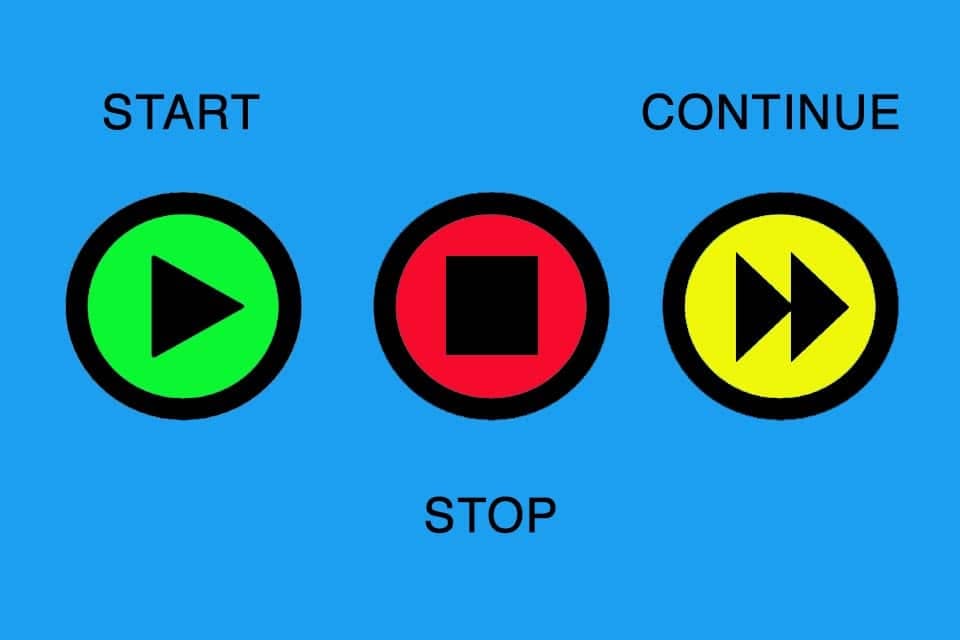
This retrospective turns feedback into action by asking what to start, stop, and continue doing. Teams use it after a sprint to improve processes and collaboration. The footgun: the 'Continue' list can become a long praise session, losing focus on improvement.
The mental model
The Start, Stop, Continue retrospective is a framework for turning a team's recent experiences into a concrete action plan. Instead of a free-form discussion, it forces decisions by sorting all feedback into three clear categories: new things to begin, ineffective things to end, and successful things to maintain.
How it works
The process is typically facilitated by a Scrum Master or project manager. First, the facilitator sets the stage, explaining the rules like the "Vegas Rule" (confidentiality) and managing the timebox. Second, the team brainstorms items for each category: Start, Stop, and Continue. This is often done silently with sticky notes. Third, the team discusses the collected items, groups similar ideas, and clarifies their meaning. Finally, the team prioritizes the proposed actions, often by voting. This ensures the team commits to a small, manageable number of improvements for the next cycle.
When to use it
This format is excellent for teams new to retrospectives due to its simplicity and intuitive structure. It's versatile enough to address both technical issues (like tools or processes) and interpersonal dynamics (like communication or collaboration). Because it directly generates action items, it's effective for teams that want to move quickly from discussion to improvement at the end of a sprint or project phase.
When not to use it
The main drawback is potential fatigue. If used repeatedly without variation, teams can find it stale. The "Continue" column can easily become a long, self-congratulatory list that doesn't provide actionable insight. The format is also more focused on refining existing practices than generating radical new ideas; other formats might be better for pure idea generation.
One canonical example
A development team finishes a sprint. In their retrospective, they generate the following key points. START: "Begin dedicating the first hour of every Friday to clearing technical debt." STOP: "Stop discussing new feature ideas during the daily stand-up meeting." CONTINUE: "Continue the practice of peer-reviewing all code before it's merged." After a dot-voting session, the team commits to implementing the "Start" and "Stop" actions in the upcoming sprint.
Interview question
Which common challenge is explicitly highlighted when using the Start, Stop, Continue retrospective?
- a.It frequently results in an overwhelming number of radical new ideas.
- b.Teams often find it too complex and difficult to facilitate effectively.
- c.It struggles to address interpersonal dynamics or communication issues within the team.
- d.The "Continue" category can become a lengthy, non-actionable praise session.Correct
Why? this is the answer
The card explicitly states that "The 'Continue' column can easily become a long, self-congratulatory list that doesn't provide actionable insight," identifying this as a main drawback. Option A is incorrect because the card mentions this format is "more focused on refining existing practices than generating radical new ideas."
Just read this? Test yourself on what you have been reading.
Read the original → t2informatik.de
You just looked this up. Could you explain it out loud?
That is the part interviews actually test. Tezvyn takes questions like this one and gives you what the interviewer is really checking, the answer that lands, and the mistake that ends the conversation, in the four minutes before your next meeting.
The iPhone app is on the way
We are building it. Until it lands, nothing here is held back from you: every interview card, your saved cards, streaks and the job board all work in Safari, plus hundreds of free practice quizzes of thirty questions each. Sign in and it all carries over to the app the day it arrives.
Want it as an icon? Tap Share at the bottom of Safari, then Add to Home Screen. It opens full screen and the cards you have read stay available offline.
We are hiring for this. Open roles that interview on agile — each one lists the topics its interview covers.
See open roles