STATIK: Designing a Kanban System from First Principles
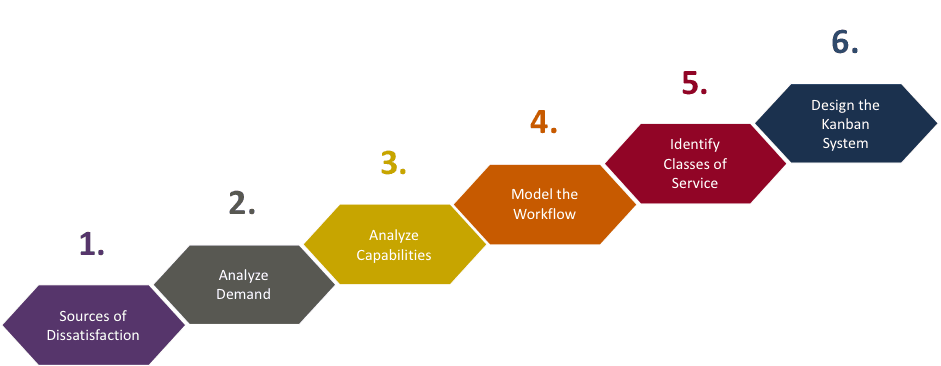
STATIK is a diagnostic recipe for designing a Kanban system tailored to your team's actual work, not just copying a template. Use it when starting a new implementation or when an existing process is stuck. The footgun is skipping the analysis.
The mental model
STATIK, the Systems Thinking Approach to Introducing Kanban, is a diagnostic toolkit, not a rigid template. It forces you to analyze your current system's problems and capabilities before designing a solution. Instead of copying a generic board, you build one from first principles based on evidence of how your team actually works, what your customers need, and where the pain points are.
How it works
STATIK is a sequence of six core activities. First, you identify sources of dissatisfaction from both customers and your team. Second, you analyze demand to understand the types and arrival rates of work. Third, you analyze your current capability to see how quickly you complete that work. Fourth, you model the actual workflow steps from start to finish. Fifth, you identify different classes of service, like 'standard' versus 'expedite'. Finally, using all this data, you design the Kanban system, including the board, explicit policies, and meeting cadences.
When to use it
Use STATIK when you are introducing Kanban for the first time to ensure the system is fit for purpose. It is also the perfect tool when an existing process feels stuck, slow, or misaligned with customer needs. If you are not sure where to start improving, STATIK provides a structured path to identify opportunities.
When not to use it
STATIK is an in-depth design approach, so it's overkill for extremely simple, stable workflows with no obvious dissatisfaction. If you're not willing to invest time in the initial analysis of demand, capability, and workflow, you won't get the benefits and a simpler approach may be better. It is not a quick fix for deep organizational dysfunction.
One canonical example
A support team feels overwhelmed. Using STATIK, they identify dissatisfaction: customers complain about slow ticket resolution. Demand analysis shows 70% of tickets are simple password resets, while 10% are complex bug investigations. Capability analysis reveals resets take 10 minutes, but bugs take 3 days and block the queue. They model their workflow, create two classes of service ('Standard Request' and 'Bug Investigation'), and design a Kanban board with a separate fast-track lane for password resets. This immediately improves flow and customer satisfaction.
Interview question
What is the core distinguishing characteristic of the STATIK approach to designing a Kanban system?
- a.It emphasizes starting with a pre-defined Kanban board template and adapting it as needed.
- b.It focuses on identifying and eliminating all sources of team and customer dissatisfaction upfront.
- c.It systematically analyzes current work, demand, and capability to build a tailored system from first principles.Correct
- d.It prioritizes rapid implementation of basic Kanban practices to achieve quick wins and build momentum.
Why? this is the answer
STATIK is explicitly described as a diagnostic recipe to design a Kanban system tailored to your team's actual work by analyzing current system's problems and capabilities and building from first principles. It is not about using templates or eliminating all dissatisfaction upfront, nor is it a rapid implementation approach.
Just read this? Test yourself on what you have been reading.
Read the original → kanban.university
You just looked this up. Could you explain it out loud?
That is the part interviews actually test. Tezvyn takes questions like this one and gives you what the interviewer is really checking, the answer that lands, and the mistake that ends the conversation, in the four minutes before your next meeting.
The iPhone app is on the way
We are building it. Until it lands, nothing here is held back from you: every interview card, your saved cards, streaks and the job board all work in Safari, plus hundreds of free practice quizzes of thirty questions each. Sign in and it all carries over to the app the day it arrives.
Want it as an icon? Tap Share at the bottom of Safari, then Add to Home Screen. It opens full screen and the cards you have read stay available offline.
We are hiring for this. Open roles that interview on kanban — each one lists the topics its interview covers.
See open roles