The Feature-Benefit-Value Ladder: Selling Outcomes, Not Specs
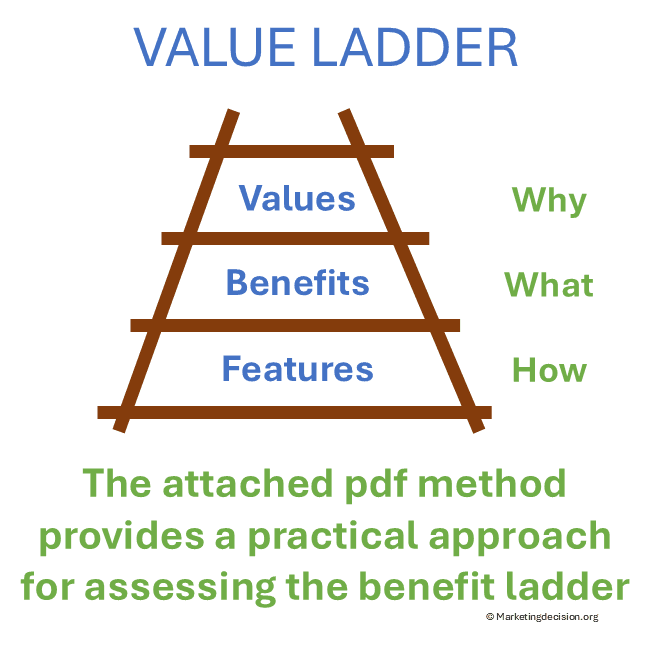
The Feature-Benefit-Value Ladder connects product specs to the outcomes customers truly want. It's used to prioritize features and craft messaging that links to core values.
Why it exists
Customers don't buy products; they buy better versions of themselves. Simply listing technical specifications fails to communicate the actual improvement a customer will experience. The Feature-Benefit-Value ladder was created to systematically bridge the gap between what a product is and what it does for the customer on a deeper, more valuable level.
The mental model
Think of it as climbing a ladder of abstraction by repeatedly asking "Why does this matter?". At the bottom rung are concrete features. In the middle are the direct benefits those features provide. At the top are the core human or business values that the benefits fulfill. You move up the ladder from "what" (the feature) to "so what?" (the benefit) to "why is that important?" (the value).
How it works
The process involves connecting three distinct levels. First, Features: these are the tangible, often technical, characteristics of your product, like "end-to-end encryption." Second, Benefits: this is what the feature does for the customer, the direct result, like "your messages cannot be read by third parties." Third, Values: this is the deeper emotional or strategic goal the benefit helps the customer achieve, like "peace of mind" or "security." You connect them by asking "why." Why is the feature important? To get the benefit. Why is that benefit important? To fulfill the value.
When to use it
Use this framework when defining a product strategy, prioritizing a feature roadmap, or crafting marketing and sales copy. It is essential for ensuring that engineering efforts are aligned with genuine customer needs. It also helps sales teams communicate the true value proposition, not just a list of specs, and allows you to compare your solution against competitors based on what truly matters to users.
When not to use it
The ladder is less critical for pure commodity products where the buying decision is almost entirely based on a single, obvious feature like price or quantity. It can also be overkill for internal technical components where the "customer" is another engineering team that is already fluent in features and their direct, functional benefits.
One canonical example
Consider an electric car. The Feature is a 400-mile battery range. The Benefit, found by asking "why does that matter?", is that you can complete long road trips without stopping to recharge frequently. The Value, found by asking "why does THAT matter?", is a feeling of freedom and spontaneity, unconstrained by the logistics of charging infrastructure. The product isn't selling a battery; it's selling freedom.
Interview question
What is the core mechanism by which the Feature-Benefit-Value Ladder connects product attributes to customer outcomes?
- a.By comparing product specifications to industry benchmarks and best practices.
- b.By analyzing competitor products to determine gaps in the market for new features.
- c.By conducting extensive customer surveys to identify their most desired product functionalities.
- d.By systematically asking "why does this matter?" to move from tangible features to direct benefits and then to deeper values.Correct
Why? this is the answer
The card explicitly states the ladder's mechanism involves "repeatedly asking 'Why does this matter?'" to ascend from features to benefits to core values. While competitor analysis (B) is a use case, it's not the fundamental process of connecting attributes to outcomes.
Just read this? Test yourself on what you have been reading.
Read the original → marketingdecision.org
- #product strategy
- #marketing
- #user psychology
- #prioritization
You just looked this up. Could you explain it out loud?
That is the part interviews actually test. Tezvyn takes questions like this one and gives you what the interviewer is really checking, the answer that lands, and the mistake that ends the conversation, in the four minutes before your next meeting.
The iPhone app is on the way
We are building it. Until it lands, nothing here is held back from you: every interview card, your saved cards, streaks and the job board all work in Safari, plus hundreds of free practice quizzes of thirty questions each. Sign in and it all carries over to the app the day it arrives.
Want it as an icon? Tap Share at the bottom of Safari, then Add to Home Screen. It opens full screen and the cards you have read stay available offline.
We are hiring for this. Open roles that interview on product strategy — each one lists the topics its interview covers.
See open roles