The Golden Circle: Leading with Why
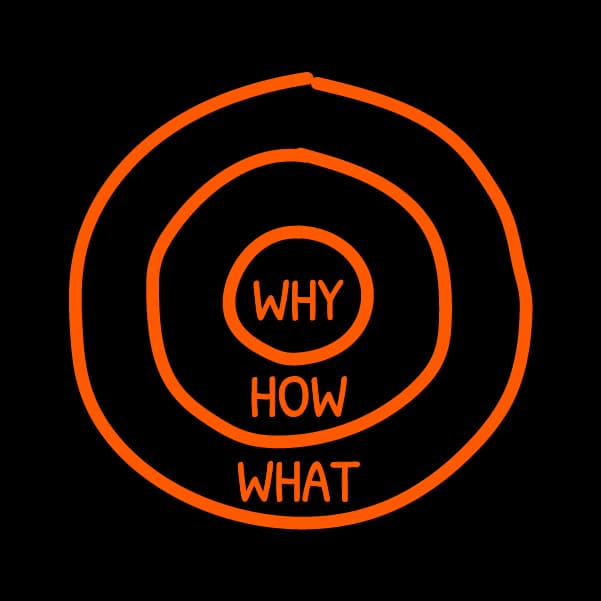
The Golden Circle is a framework for inspiring action by communicating from the inside out: starting with your purpose (Why), then your process (How), and finally your product (What). It's used to build loyalty by connecting on belief, not just features.
Why it exists
The Golden Circle was developed to explain why some leaders and organizations inspire deep loyalty and success while others don't. It finds a predictable pattern in human behavior, suggesting that inspiration is driven by purpose, not just features or services.
The mental model
Think, act, and communicate from the inside out. Instead of starting with what you do, start with why you do it. The central idea is that "people don't buy WHAT you do, they buy WHY you do it." The goal is to attract customers and employees who share your fundamental beliefs.
How it works
The model has three concentric rings. First, the WHY is the core purpose, cause, or belief that drives you. It is not about making money, which is a result. Second, the HOW describes the specific actions, values, or processes you use to bring your WHY to life. This is your unique differentiator. Third, the WHAT is the most concrete layer: the products you sell or the services you offer. Most companies communicate from the outside in (WHAT to WHY), which is less compelling.
When to use it
Use this framework to guide high-level strategy in leadership, hiring, product development, sales, and marketing. It is especially powerful for building a strong brand identity and company culture that attracts and retains both customers and talent for the long term.
When not to use it
While powerful for vision and strategy, the Golden Circle is not a substitute for tactical execution. In situations where a customer's decision is purely based on technical specifications or a tight budget, leading with an abstract "Why" may be ineffective without quickly connecting it to the concrete "What."
One canonical example
The Optimism Company, founded by Simon Sinek, defines its WHY as "to inspire people to do the things that inspire them." Its HOWs include keeping offerings simple and adopting an infinite mindset. Its WHATs are the tangible products like classes, keynotes, and podcasts that fulfill the mission.
Interview question
What is the fundamental principle behind the Golden Circle's approach to inspiring deep loyalty?
- a.Prioritizing market share growth and financial profitability.
- b.Clearly articulating the organization's purpose, cause, or belief.Correct
- c.Focusing on the unique features and benefits of products and services.
- d.Developing efficient and proprietary processes for product creation.
Why? this is the answer
The Golden Circle emphasizes that deep loyalty is inspired by communicating an organization's core purpose or belief (the 'Why') first, as people connect with this underlying motivation. Focusing on products or services (the 'What') is less compelling for building lasting loyalty.
Just read this? Test yourself on what you have been reading.
Read the original → simonsinek.com
You just looked this up. Could you explain it out loud?
That is the part interviews actually test. Tezvyn takes questions like this one and gives you what the interviewer is really checking, the answer that lands, and the mistake that ends the conversation, in the four minutes before your next meeting.
The iPhone app is on the way
We are building it. Until it lands, nothing here is held back from you: every interview card, your saved cards, streaks and the job board all work in Safari, plus hundreds of free practice quizzes of thirty questions each. Sign in and it all carries over to the app the day it arrives.
Want it as an icon? Tap Share at the bottom of Safari, then Add to Home Screen. It opens full screen and the cards you have read stay available offline.
We are hiring for this. Open roles that interview on product strategy — each one lists the topics its interview covers.
See open roles