The Opportunity Solution Tree: Connecting Outcomes to Solutions
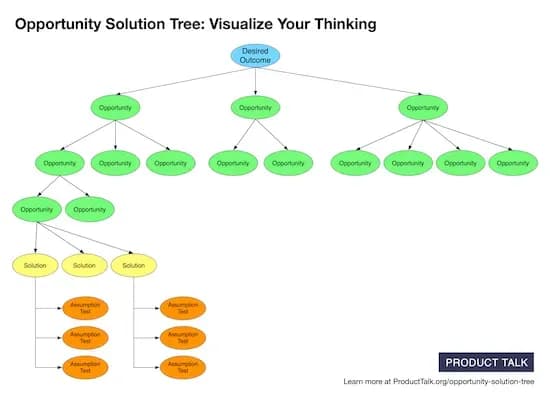
An Opportunity Solution Tree is a visual map connecting a business goal to the customer problems you could solve to achieve it. Product teams use it to explore paths to an outcome, ensuring features address real user needs.
The mental model
An Opportunity Solution Tree (OST) is a visual diagram that prevents teams from jumping straight to building features. It forces a clear line of sight from a business goal, through a customer problem, to a specific solution. It’s a tool for navigating discovery, not a static delivery plan.
How it works
The tree has four distinct layers. First, the root is the desired OUTCOME, a measurable business metric like "Increase user retention by 15%." Second, branching from the outcome are OPPORTUNITIES—these are customer needs, pain points, or desires that, if addressed, might drive the outcome. Examples include "Users struggle to find relevant content" or "New users feel overwhelmed." Third, for a chosen opportunity, you brainstorm multiple SOLUTIONS, which are specific features or initiatives. For the "overwhelmed new user" opportunity, solutions might be a guided onboarding tour or a simplified first-time user interface. Fourth, you design assumption TESTS to validate which solution best solves the opportunity and impacts the outcome.
When to use it
Use an OST during continuous discovery when you have a clear outcome but are uncertain of the best path to achieve it. It helps product trios (product, design, engineering) build a shared understanding and align stakeholders on the "why" behind the work. It excels at managing complex problem spaces with many potential paths by making the decision-making process transparent.
When not to use it
An OST is overkill when the problem and solution are already well-defined and validated, such as fixing a critical, well-understood bug. It's a tool for exploration and de-risking, not for managing the execution of a known task. Don't mistake it for a product roadmap; it's the input that helps you decide what might go on the roadmap.
One canonical example
Imagine a team wants to achieve the outcome of "Increase new user activation." They identify an opportunity: "Users don't understand the product's core value in their first session." They then generate three potential solutions to this opportunity: first, an interactive product tour; second, a series of setup-prompting emails; third, a pre-recorded demo video on the dashboard. They would then design experiments to test which of these solutions most effectively helps users grasp the core value and activate.
Interview question
What is the primary benefit of using an Opportunity Solution Tree (OST) in product discovery?
- a.It provides a detailed, static plan for feature development and release schedules.
- b.It helps product teams quickly validate technical feasibility for all potential solutions.
- c.It ensures that all developed features directly address identified customer problems and contribute to a business outcome.Correct
- d.It serves as the definitive product roadmap, outlining all future development for stakeholders.
Why? this is the answer
The OST's core purpose is to prevent teams from jumping straight to building features by forcing a clear line of sight from a business goal, through a customer problem, to a specific solution. Options A and D are incorrect because the card explicitly states the OST is not a static delivery plan or a product roadmap. Option B is a distractor as the tests are primarily for validating solution effectiveness in solving the opportunity and impacting the outcome, not solely technical feasibility.
Just read this? Test yourself on what you have been reading.
Read the original → producttalk.org
You just looked this up. Could you explain it out loud?
That is the part interviews actually test. Tezvyn takes questions like this one and gives you what the interviewer is really checking, the answer that lands, and the mistake that ends the conversation, in the four minutes before your next meeting.
The iPhone app is on the way
We are building it. Until it lands, nothing here is held back from you: every interview card, your saved cards, streaks and the job board all work in Safari, plus hundreds of free practice quizzes of thirty questions each. Sign in and it all carries over to the app the day it arrives.
Want it as an icon? Tap Share at the bottom of Safari, then Add to Home Screen. It opens full screen and the cards you have read stay available offline.
We are hiring for this. Open roles that interview on product management — each one lists the topics its interview covers.
See open roles