The Spotify Model: Scaling Agile with Autonomy
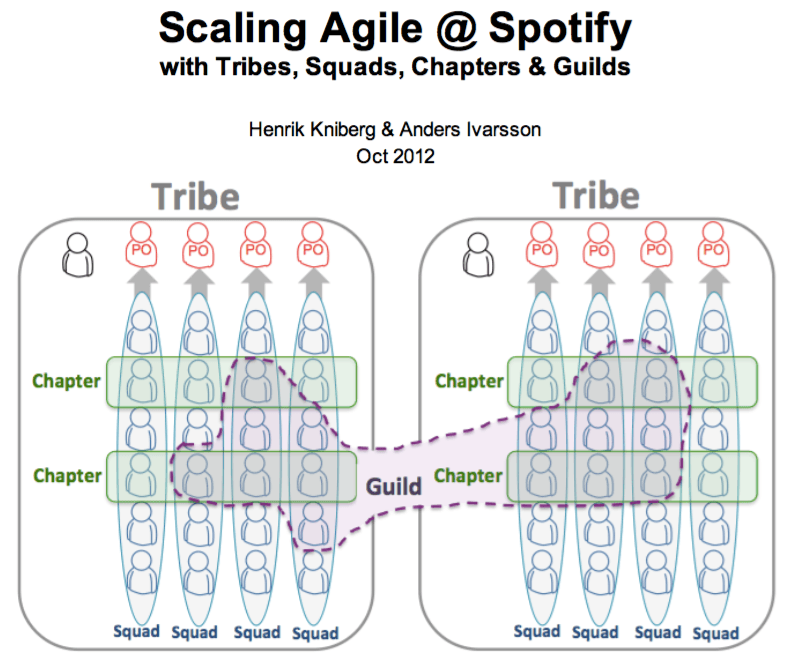
The Spotify Model organizes teams for autonomy and alignment, using mini-startups (Squads) and skill-based communities (Chapters). It helps scale agile in large orgs, but copying the structure without the culture of trust creates a rigid hierarchy in disguise.
THE MENTAL MODEL: The Spotify Model is not a rigid framework but a set of principles for organizing agile teams at scale. Think of it as a matrix organization designed for autonomy and speed. The vertical dimension is about product delivery (what you build), managed by Squads and Tribes. The horizontal dimension is about technical excellence and community (how you build), managed by Chapters and Guilds. The goal is high autonomy with loose alignment, avoiding the bottlenecks of top-down command and control.
HOW IT WORKS: The model is built on four core components. First, the Squad is the basic unit, like a small Scrum team. It's a cross-functional, self-organizing team with end-to-end responsibility for a specific feature area, from design to deployment and maintenance. Second, a Tribe is a collection of related Squads working in the same business area. Tribes provide a sense of belonging and a clear mission, typically co-located and numbering under 100 people. Third, a Chapter is a group of people with similar skills within the same Tribe, like all the backend engineers. The Chapter lead is their formal line manager, responsible for mentorship and career growth, but not day-to-day work. Fourth, a Guild is a lightweight, cross-Tribe community of interest for sharing knowledge and best practices across the organization.
WHEN TO USE IT: Use this model when your organization has grown to a size (e.g., 30+ teams, hundreds of developers) where communication and alignment become difficult, but you want to preserve the speed and ownership of a smaller company. It's for organizations that are committed to a culture of high trust, autonomy, and decentralized decision-making.
WHEN NOT TO USE IT: Avoid this model if your organization has a strong command-and-control culture. Simply renaming teams to "Squads" without giving them true autonomy and ownership will fail. It's also not a one-size-fits-all solution; Spotify itself has evolved past this specific model. Don't adopt it as a strict blueprint. A key principle is that squads are responsible for their own maintenance; if your org relies on separate maintenance teams, this model will cause friction.
ONE CANONICAL EXAMPLE: A "Player" Tribe at Spotify might be responsible for the core music playback experience. Within this Tribe, one Squad focuses on the "Now Playing" view on mobile, another on playlist management, and a third on backend streaming services. The backend engineers from all these Squads would belong to the "Backend Engineering Chapter" within the Player Tribe, meeting regularly to discuss best practices and tooling, all while their day-to-day work is directed by their Squad's mission.
Read the original → blog.crisp.se
Get five bites like this every day.
Tezvyn delivers a daily feed of 60-second tech bites with quizzes to lock in what you learn.