TorchServe: Serving PyTorch Models in Production
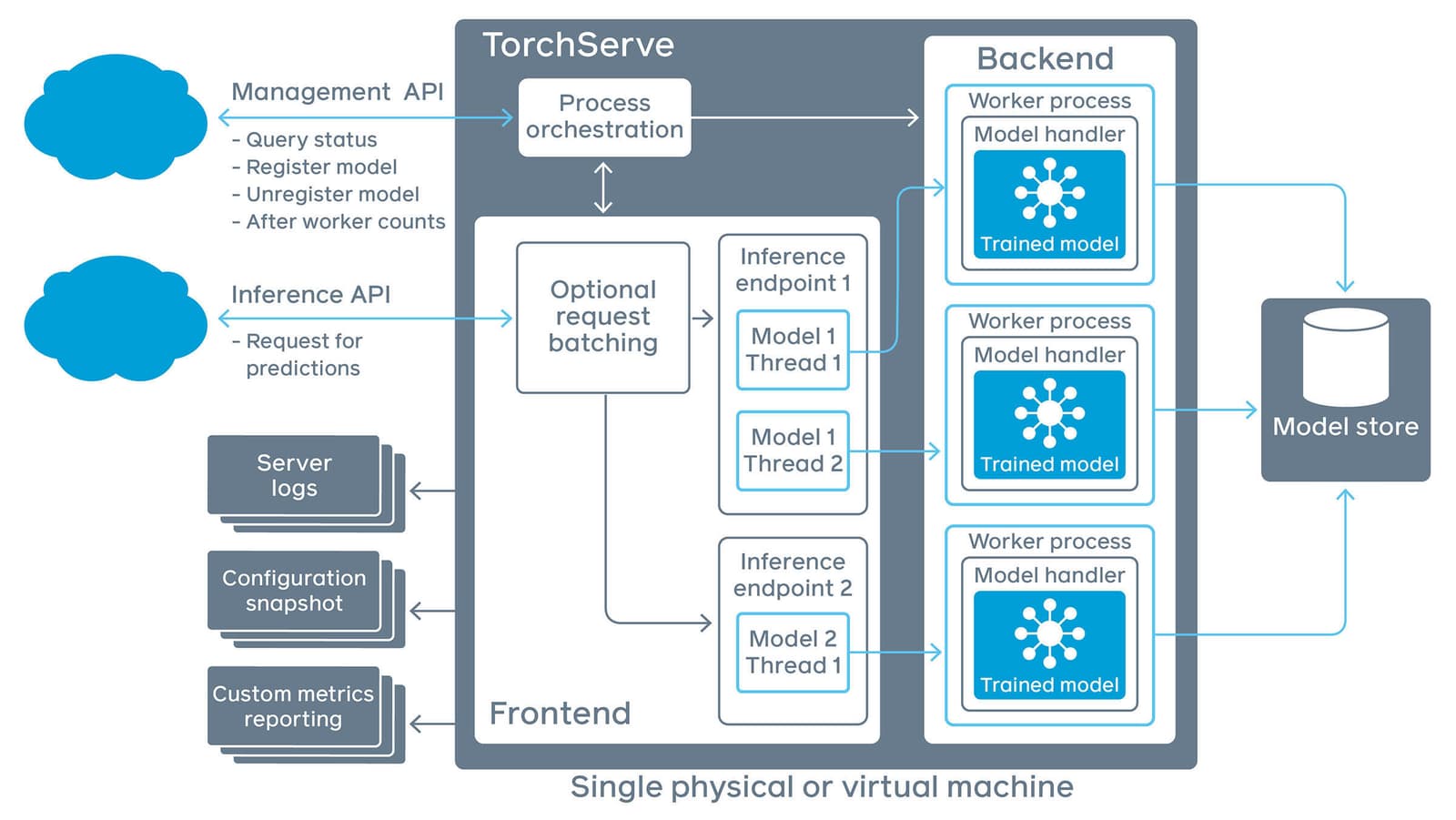
TorchServe is a web server for your PyTorch models, turning them into production-ready API endpoints. It's used to expose trained models over a network via REST or gRPC for inference, handling batching and multi-model serving.
Why it exists
A trained PyTorch model is just a file. To use it in a real application, you need a way to load the model, receive data over a network, run inference, and return the result. Building this service wrapper from scratch for every model is repetitive and error-prone. TorchServe was created to standardize and simplify this model deployment process.
The mental model
Think of TorchServe as a specialized container that you hand your trained model file (.pt) and a handler script to. It then automatically exposes that model as a professional-grade web service. Instead of writing a custom web server with Flask or FastAPI, you configure TorchServe to manage incoming requests, batch them for efficiency, run them through your model, and send back responses. It's the "serve" part of the "train and serve" lifecycle.
How it works
You package your model artifacts—the serialized model weights and a Python script defining pre- and post-processing logic—into a model archive file (.mar). You then start the TorchServe server and use its Management API to register and scale this model. Once loaded, client applications can send data to the Inference API via REST or gRPC. TorchServe manages a queue of incoming requests, can dynamically batch them to optimize GPU/CPU utilization, and routes them to worker threads running the model. It also exposes a Metrics API for monitoring performance.
When to use it
TorchServe provides a quick, standardized way to deploy a PyTorch model with production-grade features out of the box. It is useful for scenarios requiring dynamic request batching, serving multiple models from one server, or versioning models without downtime. Its built-in metrics and logging endpoints simplify production monitoring for teams wanting a solution from the core PyTorch ecosystem.
When not to use it
The primary reason not to use TorchServe for new projects is its "limited maintenance" status. The official project is no longer actively maintained, meaning no planned security patches, bug fixes, or feature updates. This is a significant risk for production systems. For new deployments, consider actively maintained alternatives like NVIDIA Triton Inference Server, KServe, or building a custom service with a framework like FastAPI.
One canonical example
A large e-commerce site like Walmart used TorchServe to serve models at scale. To deploy a new search ranking model, they would package it into a .mar file, register it with their TorchServe cluster via an API call, and shift traffic to it. The server handles incoming search queries, batches them, and runs them through the ranking model, all while providing metrics on latency and throughput.
Interview question
What is the most significant drawback of using TorchServe for a new production deployment today?
- a.It requires manual implementation of dynamic request batching.
- b.Its official project is no longer actively maintained, leading to security and bug fix concerns.Correct
- c.It cannot serve multiple models simultaneously from a single instance.
- d.It only supports gRPC for client communication, not REST.
Why? this is the answer
The card explicitly states that TorchServe's "limited maintenance" status, meaning no active development or security patches, is the primary reason not to use it for new projects. Options A, B, and D describe features that TorchServe actually provides, such as dynamic batching, both REST and gRPC support, and multi-model serving, making them incorrect drawbacks.
Just read this? Test yourself on what you have been reading.
Read the original → docs.pytorch.org
- #mlops
- #pytorch
- #model serving
- #infrastructure
You just looked this up. Could you explain it out loud?
That is the part interviews actually test. Tezvyn takes questions like this one and gives you what the interviewer is really checking, the answer that lands, and the mistake that ends the conversation, in the four minutes before your next meeting.
The iPhone app is on the way
We are building it. Until it lands, nothing here is held back from you: every interview card, your saved cards, streaks and the job board all work in Safari, plus hundreds of free practice quizzes of thirty questions each. Sign in and it all carries over to the app the day it arrives.
Want it as an icon? Tap Share at the bottom of Safari, then Add to Home Screen. It opens full screen and the cards you have read stay available offline.
We are hiring for this. Open roles that interview on mlops — each one lists the topics its interview covers.
See open roles