Toyota Kata: The Practice Routine for Continuous Improvement
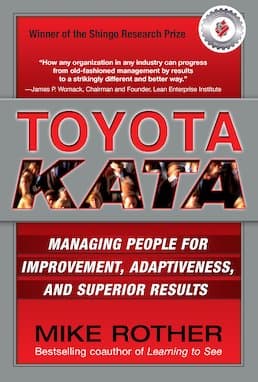
Think of Toyota Kata as a daily workout for your team's problem-solving muscles. It provides a structured routine to move from a current condition to a target condition via rapid, small experiments.
THE MENTAL MODEL: Toyota Kata is not a specific tool but a mental model for practice. The word "kata" comes from martial arts and refers to a structured routine you practice repeatedly to make a skill automatic. Toyota Kata applies this idea to the skill of scientific thinking and continuous improvement, creating a habit for teams and their leaders.
HOW IT WORKS: The system consists of two core routines, or katas.
First, the Improvement Kata is a four-step pattern for teams and individuals. Step 1: Understand the overall vision or direction. Step 2: Grasp the current condition by gathering facts and data. Step 3: Define the next target condition, a specific, measurable, and short-term goal on the path toward the vision. Step 4: Experiment to overcome obstacles that stand between you and the target condition. This is a rapid, iterative cycle of learning.
Second, the Coaching Kata is a routine for managers to teach the Improvement Kata. The coach doesn't give answers but asks a consistent set of five questions during brief, daily check-ins. These questions guide the learner to reflect on their target condition, current state, last experiment, and what they learned. This reinforces the scientific thinking process.
WHEN TO USE IT: Use Toyota Kata for complex challenges where the solution is not obvious and the path forward is uncertain. It excels at helping teams navigate ambiguity by breaking down a large, daunting vision into a series of achievable target conditions, using experiments to learn the way forward.
WHEN NOT TO USE IT: Avoid using this structured process for simple, well-defined problems where a known solution or best practice already exists. It is a system for learning and discovery, not for simple task execution. Using it to solve a trivial problem is inefficient.
ONE CANONICAL EXAMPLE: A development team wants to improve their deployment frequency from once a month to once a day. The path is unclear. Using the Improvement Kata, they set a first target condition: "achieve one deployment per week within the next month." They measure their current process (the current condition) and start running experiments, like automating one part of the test suite. Their manager, using the Coaching Kata, meets with them daily, asking the five questions to ensure they are learning from their experiments and systematically moving toward their target.
Read the original → en.wikipedia.org
Get five bites like this every day.
Tezvyn delivers a daily feed of 60-second tech bites with quizzes to lock in what you learn.