Value Chain Analysis: Find Your Edge by Mapping Your Activities
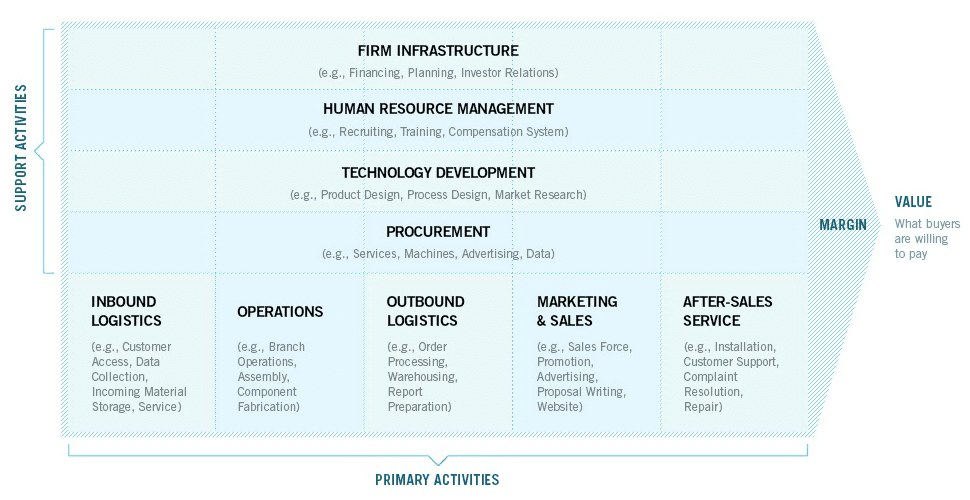
Value Chain Analysis maps a company's activities to find its competitive edge. Instead of a list of costs, it shows how each step adds value, revealing where you can lower costs or justify higher prices.
Why it exists
Companies need a systematic way to understand where their competitive advantage comes from. Without a framework, it's hard to see which specific actions lead to lower costs or a better product, making strategic decisions feel like guesswork. Value Chain Analysis provides that structured view.
The mental model
Think of your business not as a monolithic entity, but as a series of interconnected activities. Each activity is a link in a chain. The key is to see each link not as a cost to be minimized, but as an opportunity to add value that customers will pay for, either through a lower price or a superior product.
How it works
You disaggregate a company into its 'strategically relevant activities.' You analyze how each activity contributes to cost or differentiation and how they are linked together. A company's value chain is part of a larger value system that includes its suppliers (upstream) and distribution channels (downstream). Strategy is reflected in the choices you make about how these activities are configured.
When to use it
Use this framework when you need to identify the precise sources of your competitive advantage. It's essential for strategic planning, helping you decide where to invest resources to either reduce costs or enhance differentiation. It's also useful for understanding a competitor's strategy by mapping out their value chain.
When not to use it
Don't use it as a simple cost-cutting exercise. The goal is not just to make each activity cheaper, but to understand how the whole system creates value. Focusing only on individual activity costs misses the strategic importance of the linkages between them and the overall configuration of the chain.
One canonical example
A low-cost airline's advantage comes from its value chain configuration. Activities like no-frills service, point-to-point routes, and using a single aircraft model are not isolated cost-saving measures. They are a set of choices that link together to create a low-cost value chain that a traditional airline cannot easily replicate without compromising its own.
Interview question
What is the primary strategic insight gained from Value Chain Analysis that distinguishes it from a simple cost accounting exercise?
- a.Determining which activities can be eliminated without impacting product quality.
- b.Identifying the precise cost of each individual operational step.
- c.Benchmarking individual activity costs against industry averages for efficiency gains.
- d.Understanding how interconnected activities collectively create value and competitive advantage.Correct
Why? this is the answer
Value Chain Analysis goes beyond individual costs to reveal how a system of interconnected activities creates overall value and competitive advantage. While it involves disaggregating activities, its core insight is not merely a list of individual costs, which is more aligned with simple cost accounting.
Just read this? Test yourself on what you have been reading.
Read the original → isc.hbs.edu
- #product strategy
- #business strategy
- #competitive advantage
- #michael porter
You just looked this up. Could you explain it out loud?
That is the part interviews actually test. Tezvyn takes questions like this one and gives you what the interviewer is really checking, the answer that lands, and the mistake that ends the conversation, in the four minutes before your next meeting.
The iPhone app is on the way
We are building it. Until it lands, nothing here is held back from you: every interview card, your saved cards, streaks and the job board all work in Safari, plus hundreds of free practice quizzes of thirty questions each. Sign in and it all carries over to the app the day it arrives.
Want it as an icon? Tap Share at the bottom of Safari, then Add to Home Screen. It opens full screen and the cards you have read stay available offline.
We are hiring for this. Open roles that interview on product strategy — each one lists the topics its interview covers.
See open roles