Walk through RLHF's three stages, outputs, and purposes.
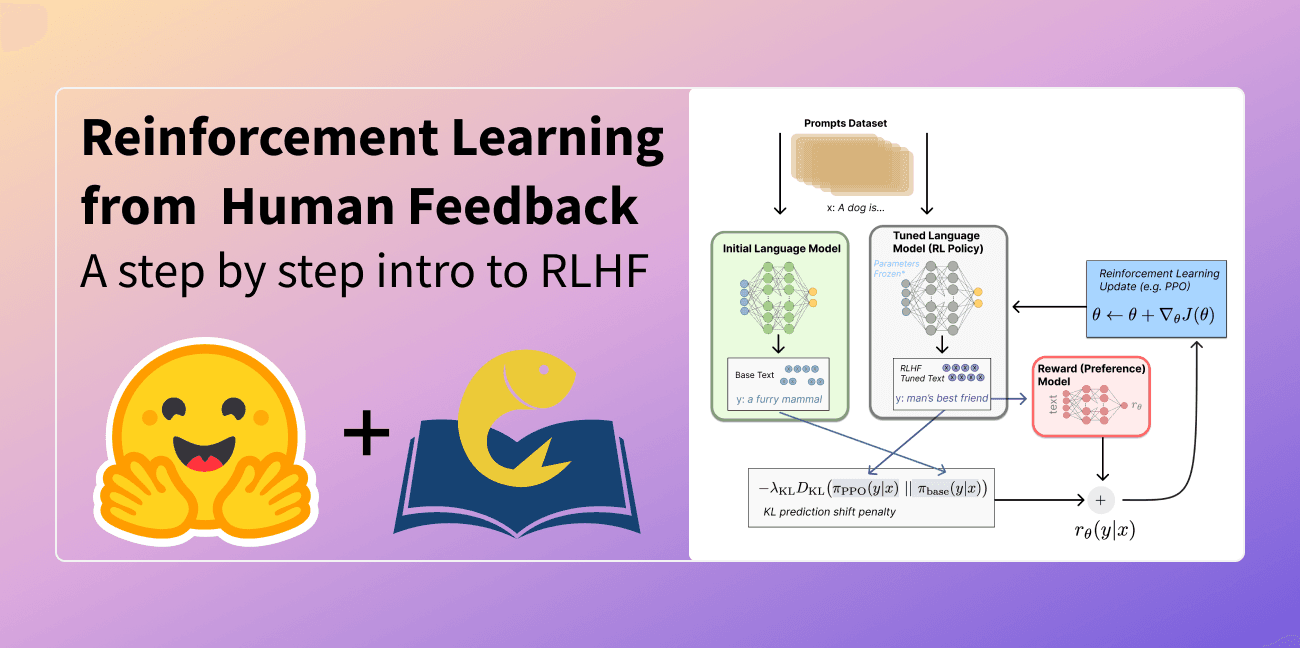
Tests your grasp of the RLHF pipeline end-to-end. A strong answer lists: pretrain an instruction-following LM, train a reward model outputting a scalar preference score, then fine-tune the LM via RL.
What's really being asked
This question tests whether you understand RLHF as a multi-model training pipeline rather than a monolithic algorithm. Interviewers want to see that you know which artifact is produced at each stage, why that artifact is necessary, and how the stages connect. At the senior level, they also care whether you recognize the design space, such as the fact that the initial LM can vary in size and fine-tuning history, and that the reward model can be an end-to-end language model or a modular ranking system.
The full answer
First, pretraining the language model. The output is a base LM, potentially already instruction-tuned, that can generate diverse completions. Its purpose is to provide a capable policy to initialize the RL loop. Second, training the reward model. The output is a model that accepts a text sequence and returns a scalar reward. Its purpose is to capture human preference numerically so automated optimization can occur. Third, RL fine-tuning. The output is the aligned language model. Its purpose is to maximize the learned reward while still generating coherent text, effectively baking complex human values into the policy. A strong candidate mentions that stage two requires expensive human comparison data and that stage three typically uses an algorithm like PPO.
The mistakes people make
A common red flag is describing RLHF as just supervised fine-tuning on human-written answers. Another is conflating the reward model with the final policy, for example saying the reward model is what gets deployed to users. Some candidates also omit the scalar nature of the reward, instead saying the reward model outputs text or rankings without clarifying the scalar conversion. Saying there is only one model trained end-to-end also signals confusion.
What usually comes next
Interviewers often ask why you need a separate reward model instead of using human labels directly in the RL loop. They may ask how you prevent the policy from over-optimizing the reward model, known as reward hacking. Another follow-up is what data is collected in stage two, typically pairwise or ranked comparisons of model outputs. They might also ask which RL algorithms are used, such as PPO, and why.
A concrete example
In InstructGPT, OpenAI started with a smaller GPT-3 base model. They then collected human comparisons of multiple model outputs for the same prompt and trained a reward model to predict those preferences as a scalar value. Finally, they used PPO to fine-tune the base LM against that reward model, producing the final InstructGPT model that better followed instructions and aligned with human intent.
Interview question
In the RLHF pipeline, why is a separate reward model trained on human preference comparisons before the final RL stage?
- a.To synthesize diverse text completions that replace the base model's outputs during RL initialization
- b.To eliminate the need for RL by enabling supervised fine-tuning directly on human-written answers
- c.To serve as the final aligned model that is deployed to users after training
- d.To generalize discrete human comparisons into a continuous scalar score that drives automated policy optimizationCorrect
Why? this is the answer
The reward model captures human preference numerically as a scalar so that automated RL optimization can occur. Option C is a common misconception: the reward model is not the final deployed policy; stage three produces the aligned language model that users interact with.
Just read this? Test yourself on what you have been reading.
Read the original → huggingface.co
- #llms
- #rlhf
- #alignment
- #generative-ai
- #interview
You just looked this up. Could you explain it out loud?
That is the part interviews actually test. Tezvyn takes questions like this one and gives you what the interviewer is really checking, the answer that lands, and the mistake that ends the conversation, in the four minutes before your next meeting.
The iPhone app is on the way
We are building it. Until it lands, nothing here is held back from you: every interview card, your saved cards, streaks and the job board all work in Safari, plus hundreds of free practice quizzes of thirty questions each. Sign in and it all carries over to the app the day it arrives.
Want it as an icon? Tap Share at the bottom of Safari, then Add to Home Screen. It opens full screen and the cards you have read stay available offline.
We are hiring for this. Open roles that interview on llms — each one lists the topics its interview covers.
See open roles