Interview questions in AI & ML, page 21
Agent planning beyond a ReAct loop
ReAct adapts step by step but costs many calls, plan-then-execute drafts a full plan upfront for fewer calls but is brittle to surprises, hierarchical decomposition splits goals…
Batch prediction versus online real-time prediction
Batch is scheduled bulk scoring, online is low-latency per-request scoring; contrast latency, freshness, cost; give a use case each.
How do you speed up a slow detection model?
Quantization, pruning, distillation, lighter backbones, and resolution or batching tweaks, each trading some accuracy or effort for speed.

Describe an ML workflow with massive egress fees and re-architecture to mitigate
Tests whether you recognize egress spikes when storage and compute cross cloud or region boundaries. Great answers sketch a multi-cloud training pipeline, cite per-GB rates, and propose caching or compute placement. Red flag: suggesting compression alone.
Detecting catastrophic forgetting in continual fine-tuning
Maintain a frozen held-out benchmark of original capabilities, evaluate after every fine-tune, track per-capability deltas, and alert on regressions.
Detecting and responding to model and concept drift
Define drift, pick a metric like PSI or falling AUC against labels, then investigate, retrain, validate.
How do you train and evaluate on imbalanced defect data?
Resampling, class weighting, focal loss, and anomaly framing for training; evaluate with precision, recall, PR-AUC, and F-beta, not accuracy.

How do you ensure ML experiment reproducibility beyond random seeds?
Tests system-level reproducibility through data versioning, environment capture, and pipeline automation. Strong answers cover versioned datasets, containerized dependencies, and immutable experiment logs.
Dynamic batching and the throughput-latency trade-off
The server groups concurrent requests into one batch to use the GPU fully, but larger batches and waiting to fill them raise per-request latency and time to first token.
What a feature store solves: skew and consistency
Central repository of computed features, one definition serving training and inference, reuse across models.
CPU vs GPU vs Edge TPU for inference.
CPU is flexible but slow, GPU offers massive parallelism at high power, Edge TPU gives efficient low-power int8 inference but is constrained; choose by latency, power, cost, and model fit.

How would GDPR requirements influence experiment tracking and model management design?
Immutable data lineage, user exclusion lists, audit logs, versioned explainability.
Handling outlier activations in INT8 quantization
Profile activation magnitudes to find a few large-magnitude outlier channels, then keep those in higher precision while quantizing the rest, a mixed-precision decomposition.
ML CI/CD versus traditional software CI/CD
Validates code plus data plus the model, auto-trains and evaluates, adds continuous training and monitoring.
Design a cashierless retail checkout vision system.
Multi-camera coverage, person tracking and re-ID, product detection plus action recognition for take or return, sensor fusion, edge-cloud split, and failure handling.
How would you version control a 50GB dataset in a CI/CD pipeline?
Contrast Git LFS (simple, but 50GB chokes CI clones) with DVC (git metadata plus S3; enables selective pulls and CI cache).
Mitigating demographic bias in a fine-tuned chatbot
Curate or counterfactually augment training data to balance demographics, plus apply post-hoc guardrails or fairness-constrained fine-tuning.
CPU versus GPU serving: cost, latency, throughput
GPUs win on throughput for batched parallel work but cost more; CPUs suit low-volume or small models.
Design drift detection and retraining for a CV model.
Monitor input and prediction distributions plus delayed labels, detect data and concept drift, trigger an automated retrain-validate-deploy pipeline with versioning and rollback.
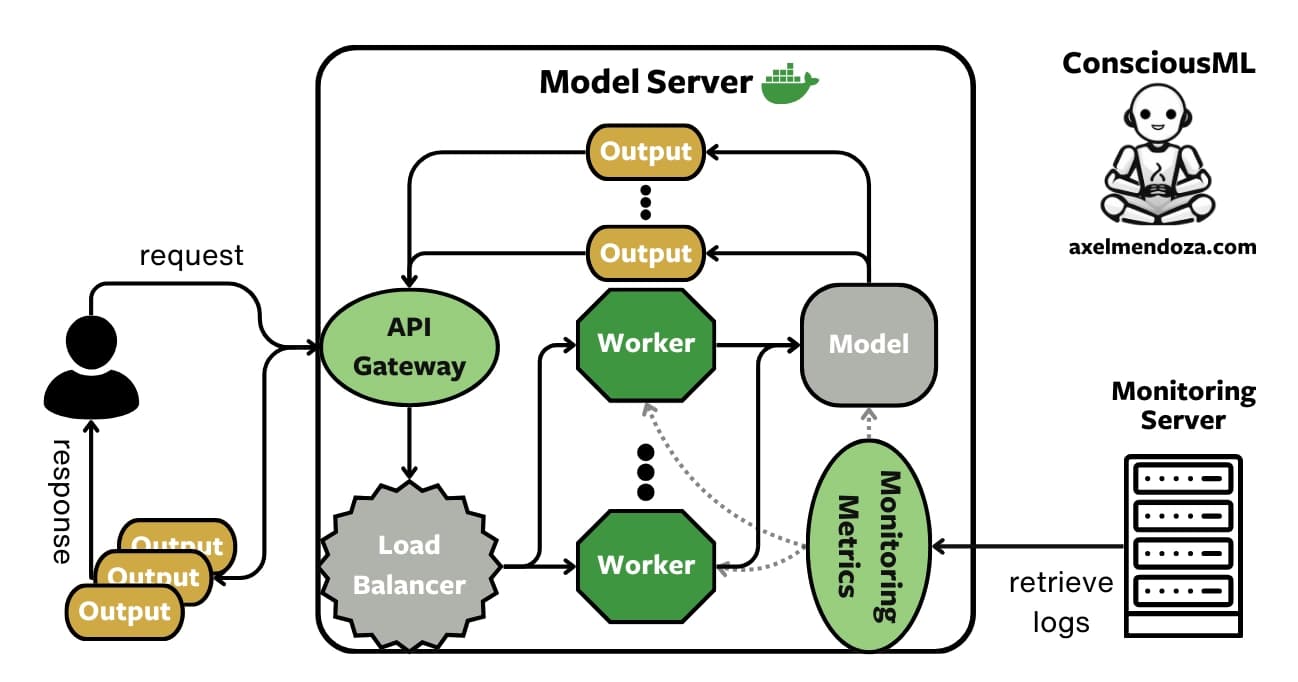
Expose a trained model as a simple web service
Practical MLOps knowledge from model serialization to serving. Package the model into a standard format, containerize it, expose a REST endpoint behind a load balancer, and add monitoring. A bare Flask server without containers or health checks is a red flag.
We are hiring for this. Every open role lists the topics its interview covers, so you can prepare for the real thing rather than guessing.
See open roles