Interview questions in AI & ML, page 6
CNN features for image retrieval
Pass the image through a pretrained CNN and read activations from a late layer as a descriptor; deeper layers encode semantics, earlier layers encode texture.
How would you implement versioning for feature definitions in a feature store?
Tests separation of metadata schema versions from data snapshots for reproducible training. Strong answers cover: immutable schema versions on breaking changes, safe appends without backfill, and time-travel data reads.
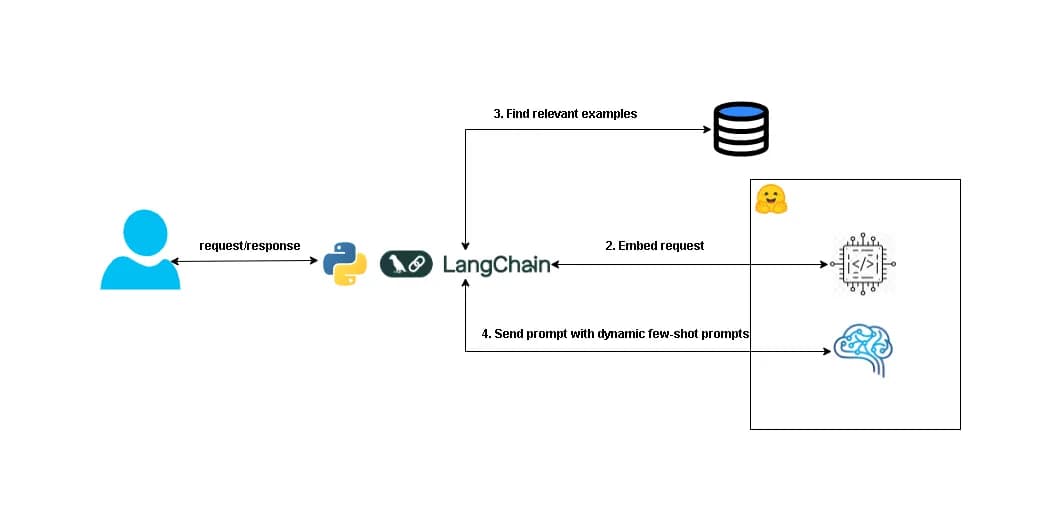
Design dynamic few-shot example retrieval from a vector database
Tests RAG-style prompt engineering with semantic retrieval and latency. Use shared embeddings, approximate nearest neighbors with metadata filters, diversity reranking, and token-bounded prompt templates.
Convert string timestamps to datetime and extract day of week
This tests pandas datetime parsing and accessor fluency. A strong answer uses pd.to_datetime, assigns the result, then extracts the day via .dt.day_name() or .dt.dayofweek. Red flag: manual string splitting or Python loops instead of vectorized ops.
Managing model-as-a-feature pipelines
An upstream embedding model becomes a versioned dependency, creating cascading retraining, version skew, latency stacking, and lineage complexity.
Feature choice for real-time mobile SLAM
Pick ORB for fast FAST keypoints and cheap binary descriptors matched by Hamming distance; accept reduced robustness versus SIFT for real-time, low-power operation.
Describe supervised fine-tuning for a pre-trained language model
Tests if you know SFT aligns a base model to instructions using curated prompt-completion data. A strong answer covers next-token prediction on completions, conversational formats, and small learning rates.

Process a 50GB CSV with only 16GB RAM
Chunk with read_csv chunksize, filter columns via usecols, downcast int64 to int32/int16, skip rows.
Pre-training versus fine-tuning an LLM
Pre-training is broad self-supervised next-token prediction on huge corpora at massive cost; fine-tuning adapts on small labeled data cheaply.
Epipolar constraint for correspondence search
The match for p1 must lie on its epipolar line in the second image, reducing a 2D search to 1D; the relation is encoded by the fundamental matrix.
Design system ensuring point-in-time correctness for training data joins
Tests temporal join design to prevent data leakage from slowly changing dimensions. Strong answers use an AS OF join on entity ID and timestamp, materialize features as of label time, and handle late arrivals. Joining on user_id alone is a red flag.
How do you analyze and reduce large pandas DataFrame memory usage?
This tests in-memory representation and systematic optimization. Start with df.info(memory_usage='deep'), downcast numerics with to_numeric, convert low-cardinality strings to category, and use nullable dtypes.
Disparity and depth in stereo vision
Disparity is the horizontal shift of a point between left and right images; depth is inversely proportional to disparity given baseline and focal length.

Argue for declarative or imperative feature platforms with trade-offs
This tests whether you weigh control flow against data flow. A strong answer argues from org maturity: declarative systems abstract DAG topology, while imperative ones offer Spark control at the cost of manual idempotency. Red flag: ignoring org culture.
Full fine-tuning or LoRA on a tight compute budget?
This tests budget-constrained adaptation for many tasks. A strong answer picks LoRA: it trains only a small number of extra parameters, cutting compute and storage versus full fine-tuning while matching performance.
Fundamental matrix versus essential matrix
Both relate corresponding points across two views via the epipolar constraint; the fundamental matrix works in pixel coordinates, the essential matrix in calibrated coordinates and encodes relative pose.
Why use a Model Registry over dated pickle files?
A strong answer covers versioning, lineage, promotion aliases, and governance.
How does LoRA work and why is it memory-efficient?
LoRA freezes weights and trains A and B so delta-W equals BA, cutting trainable params 10,000x and memory 3x since only A and B get grads.
Incremental Structure from Motion pipeline
Detect and match features, estimate two-view geometry, triangulate, then incrementally add images with PnP and refine via bundle adjustment.
Design a CI/CD pipeline that automates model promotion from Staging to Production
Tests whether you treat model promotion as a gated software delivery workflow. Strong answers use registry state-change triggers, automated drift and performance checks, canary deployment gates, and rollback.
We are hiring for this. Every open role lists the topics its interview covers, so you can prepare for the real thing rather than guessing.
See open roles