Interview questions in AI & ML, page 9
Depthwise separable convolution cost savings
Separable conv splits standard conv into per-channel spatial filtering plus a 1x1 pointwise mix, cutting cost by roughly 1/N plus 1/k².

Difference between data and model parallelism, and when to prefer each
Tests split axis: data parallelism replicates model and shards data; model parallelism shards model across devices. Use data parallelism for throughput; model parallelism when layers exceed GPU memory.

How would you architect a multi-turn conversational RAG system?
This tests memory and query reformulation design beyond single-turn RAG. A strong answer covers 5-10 turn windows, LLM-based rewriting with coreference resolution, hybrid fallbacks, and summarized memory.
What is data leakage in preprocessing and cross-validation?
This tests recognition of data leakage through preprocessing statistics. A strong answer defines leakage, describes scaling using global statistics before CV splits, and states transformers must be fit per training fold.
Diagnosing poor distributed training scaling
Communication overhead (gradient all-reduce, interconnect), data-loading starvation, load imbalance, and small per-GPU batches; profile with the PyTorch profiler and Nsight.
Translation equivariance versus invariance in CNNs
Convolution is equivariant, shifting input shifts feature maps; invariance comes only from pooling and global aggregation. Strict invariance is partial and broken by strided sampling.
How does function calling work in modern LLMs?
Schemas in the prompt; model emits JSON name and arguments; client executes and returns results.
Why is scaling unnecessary for trees but critical for SVM or K-Means?
Tests whether you understand model internals. Trees split on rank order, so scale is irrelevant. SVM and K-Means rely on distance or margin geometry, making magnitude dominate.
Image classification versus object detection
Classification assigns one label to the whole image; detection localizes and labels multiple objects with bounding boxes and class scores.
Robust checkpointing strategy for multi-day training jobs and seamless resumption
Tests production-grade distributed training reliability. Cover async atomic checkpoints, MTBF-based cadence, tiered storage, and recovery drills. Red flag: blocking synchronous writes that ignore silent corruption or straggler finalization.
Walk me through building a weather agent with get_weather
Register get_weather, let the model emit parameters, execute it yourself, feed the result back, then synthesize the answer.
How do you prevent future leakage in time-series preprocessing?
This tests temporal causality in feature engineering and validation. Use only past data for lags and rolling windows and enforce a rolling validation split without shuffling. Red flags are random k-fold CV and global standardization leaking future information.
Intersection over Union for detection
IoU is the area of overlap divided by the area of union of predicted and ground-truth boxes; a threshold decides true positives.

Design training job submission to a shared Kubernetes cluster
Gateway with artifact caching; namespace quotas; GPU schedulers like Volcano; Prometheus metrics and cost attribution.

Describe a ReAct agent architecture for multi-step dependent tool calls
Sketch ReAct's thought-action-observation cycle; keep state in an append-only trajectory; re-plan after each observation.
How would you standardize a 500GB dataset that does not fit in RAM?
This tests two-pass statistics for out-of-core scaling. A good answer outlines: first compute mean and variance via sums and counts; second apply z = (x - mean) / std; mention Dask-ML or PySpark. A red flag is averaging chunk-wise means without weighting.
Stemming versus lemmatization in text preprocessing
Stemming chops affixes fast but crudely, yielding non-words; lemmatization maps to real dictionary base forms using POS, slower but accurate; skip both for embedding or transformer models.
Mean Average Precision in object detection
AP is the area under the precision-recall curve per class; mAP averages AP over classes, and COCO also averages over IoU thresholds.
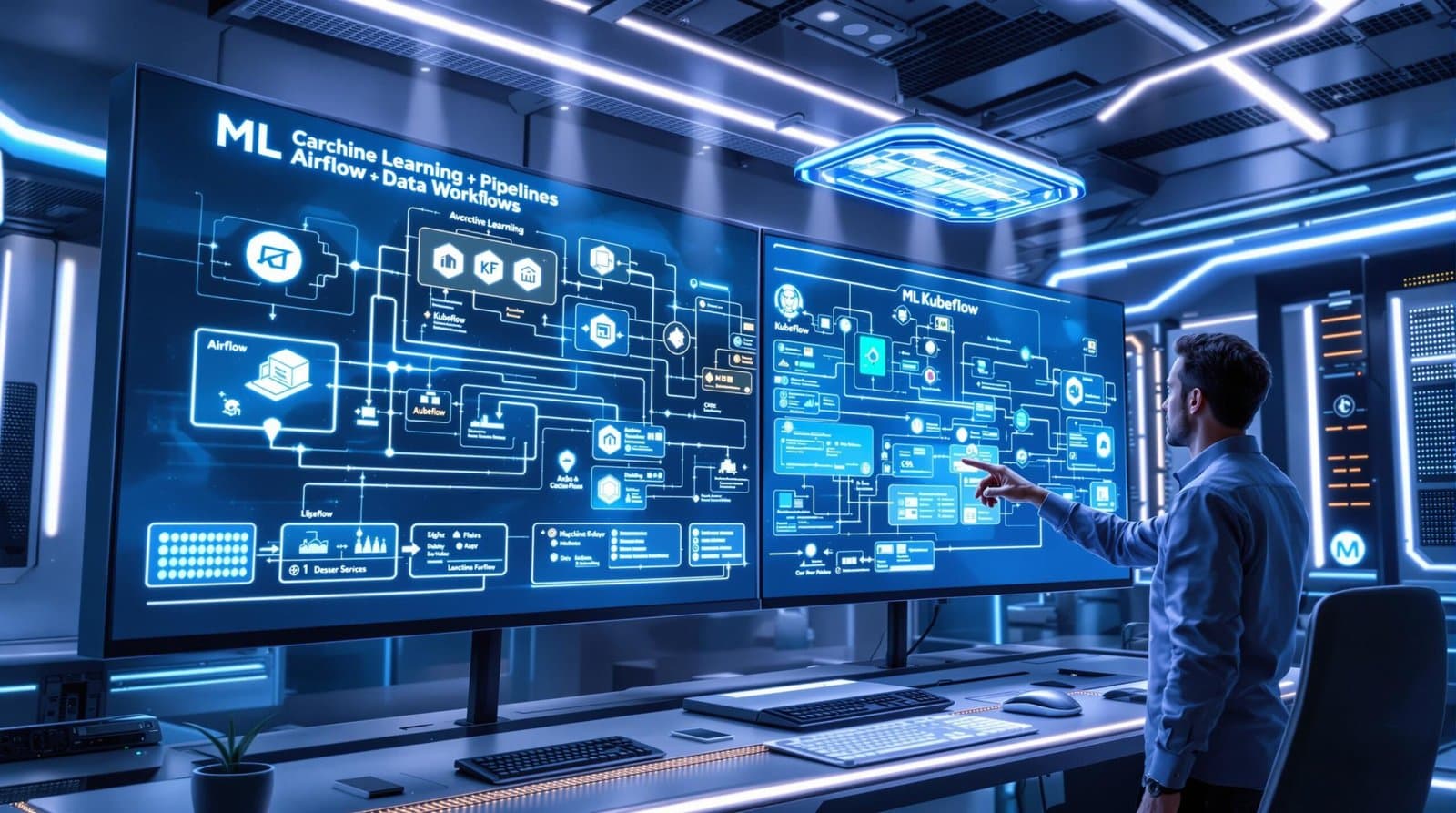
Compare Airflow and Kubeflow for ML training pipelines
Tests orchestrator-to-workload fit. Strong answers contrast Airflow's data integration and Python DAGs with Kubeflow's K8s scaling, container reproducibility, and experiment tracking. Red flag: claiming one is always better without stage-specific reasoning.
What fixes an LLM agent's incorrect JSON arguments for a complex tool?
Tests mixing prompting with system guardrails for valid tool JSON. Outline: few-shot demos plus CoT prompting; schema validation, constrained decoding, and retries. Red flag: weak prompts without validation or structured output.
We are hiring for this. Every open role lists the topics its interview covers, so you can prepare for the real thing rather than guessing.
See open roles