Easy everything in AI & ML, page 4

Differences between on-demand, reserved, and spot EC2 instances?
Tests cost-reliability-commitment tradeoffs for ML infrastructure. Good answers map on-demand to experiments, reserved for production training, and spot to fault-tolerant batch jobs. Red flag: spot for real-time serving or skipping reserved capacity analysis.
How do you attribute cloud costs to ML projects and implement tagging?
Tests knowledge of resource tagging for cost attribution. A strong answer names provider-specific tags or labels, embeds them in infrastructure-as-code, and activates cost allocation reports.
Why was this customer denied: global or local explanation?
This tests matching questions to explanation scope. Global methods show overall behavior; local methods explain one prediction. Specific denials need local methods like SHAP. A red flag is using global summaries like permutation importance or PDPs for a case.
How do you give read-only access to a shared cloud storage bucket?
Bind an IAM role with read permissions to the team at the bucket level, avoid object-level ACLs, and mount read-only on training VMs.
What is a feature store and how does it prevent training-serving skew?
This tests training-serving consistency via centralized feature management. Covers offline batch storage, online serving, shared transformations, and alternatives like ad-hoc ETL. A red flag is calling it just a database and ignoring point-in-time correctness.
What are the essential components of an end-to-end ML platform?
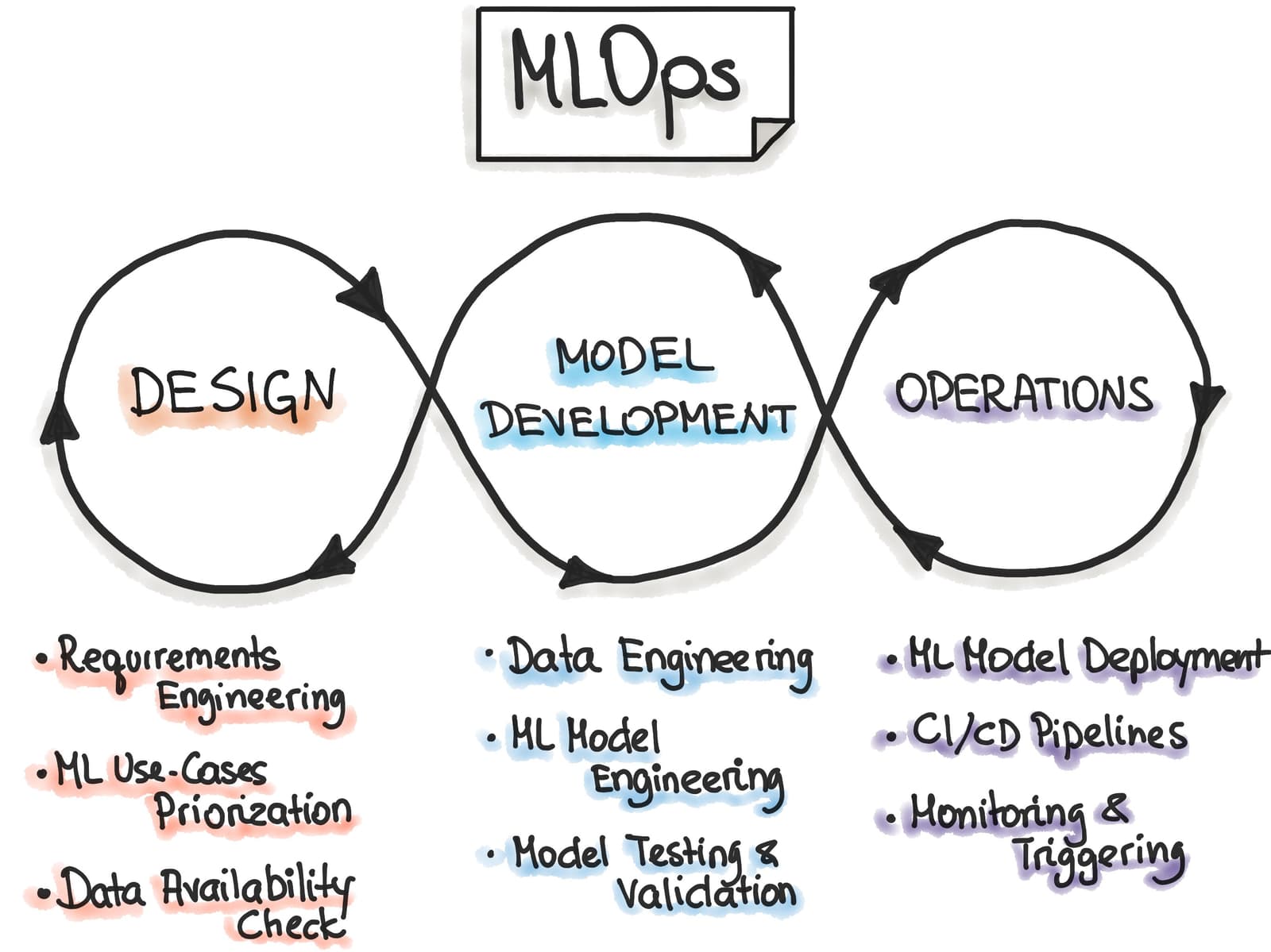
Tests mapping the ML lifecycle to infrastructure. A strong answer walks through six stages: data ingestion, feature store, training pipeline, model registry, deployment/serving, and monitoring with feedback loops.
What triggers automatic full retraining in an ML pipeline?
A strong answer lists four triggers: fresh data, code changes, model drift, and scheduled cadence.

Differences between monitoring a traditional REST API and a production ML model
Contrast latency/errors with ML signals like data drift and training-serving skew against baselines, noting ground truth delays.
Deploy a trained model as a containerized REST API
This tests practical MLOps fluency. A strong answer covers loading the artifact, wrapping it in a web server, building a Dockerfile, and exposing health and predict endpoints. Red flag: conflating training with serving or omitting resource limits.

Describe the difference between online and batch inference.
Online uses autoscaling APIs for millisecond-to-second latency; batch uses scheduled compute for minute-to-hour latency.
Describe the difference between online and batch inference.
Online serves single requests in ms on live endpoints; batch processes data offline with elastic compute.
What is a model registry's purpose in CI/CD4ML and its CI/CD interaction?
Tests if you see the model registry as the bridge between experiments and production, not just storage. A strong answer explains how CI publishes validated artifacts and CD consumes versioned models. Red flag: calling it a passive file dump without versioning.
What automated tests belong in CI before deploying a classification model?
Name data schema checks, performance regression vs baseline, bias audits, and artifact integrity.
Key differences between traditional and ML CI/CD pipelines?
Contrast code deploys with data versioning, model registries, and retraining; note holdout eval.

Difference between data and model parallelism, and when to prefer each
Tests split axis: data parallelism replicates model and shards data; model parallelism shards model across devices. Use data parallelism for throughput; model parallelism when layers exceed GPU memory.
How do you containerize a Python training script for GPU cloud VMs?
This tests reproducible GPU containerization. A strong answer uses an NVIDIA CUDA base image, installs Python dependencies at build time, copies the training script, and runs with --gpus.
How do you structure a Dockerfile to leverage layer caching for dependencies?
Tests Docker layer invalidation and cache-aware instruction ordering. Copy requirements.txt and run pip install before source code so deps cache independently. Red flag: copying everything at once or installing deps after code, busting cache every build.
Walk me through essential Dockerfile commands for a reproducible Python ML environment
Tests your ability to containerize Python ML scripts reproducibly. A strong answer covers FROM with a pinned slim image, WORKDIR, COPY for requirements and code, RUN pip install, and CMD or ENTRYPOINT.

Online vs offline feature store architecture and use cases
This tests latency trade-offs between real-time and batch infrastructure. Contrast fast online lookups against batch offline stores; fraud detection maps to online and model training to offline. Red flag: treating them as interchangeable and ignoring latency.
What problems does a Feature Store solve in ML systems?
Tests understanding of feature store value beyond storage. Great answers cover: feature reuse across teams, managed transformation pipelines, and online/offline consistency to prevent training-serving skew. Red flag: calling it simply a database or cache.
We are hiring for this. Every open role lists the topics its interview covers, so you can prepare for the real thing rather than guessing.
See open roles