Intermediate concepts in Backend Dev
The Node.js Event Loop: Concurrency on a Single Thread
The Node.js event loop lets a single thread handle high concurrency by offloading I/O. It's ideal for web servers and APIs, but the footgun is that any long-running synchronous code will block the entire application, freezing all other requests.
Python Decorators: Functions that Wrap Functions
A decorator is a function that wraps another function, adding behavior without modifying the original code. They're used for caching, logging, or access control. The main footgun is forgetting that decorators run at definition time, not call time.
Event Loop vs Crypto Module
Node's crypto module offers both synchronous and asynchronous versions of CPU heavy operations like password hashing; the sync versions block the single threaded event loop, while async versions offload the work to a background thread pool.
The Relational Model: Data as Simple Tables
The relational model organizes data into simple tables (relations) of rows (tuples), forming the foundation of SQL databases. It's used for structured data where consistency is critical, like in banking.
Python's `yield`: Functions That Pause and Resume
Python's yield creates a generator: a pausable function that produces values on-demand, saving memory. Use it for large files or infinite sequences. The footgun: a generator is a one-time-use iterator; you can't loop over it twice.
JavaScript's Event Loop: Macrotasks & Microtasks
The JavaScript event loop processes tasks like setTimeout callbacks or user clicks from a macrotask queue. A single, long-running macrotask blocks all rendering and user input, freezing the UI. The footgun is assuming setTimeout(fn, 0) runs instantly.
ACID: The Four Guarantees of Database Transactions
ACID is a contract for database transactions: all-or-nothing guarantees for data validity, even during crashes. It's critical for relational databases in finance or e-commerce. The footgun is assuming all databases offer this; many NoSQL systems don't.
The `with` Statement: Python's Automatic Cleanup Crew
A context manager is Python's automatic cleanup crew. It uses the with statement to guarantee setup and teardown code runs, even if errors occur. It's essential for files and database connections.
process.nextTick(): Cutting in Line on the Event Loop
process.nextTick() schedules a callback to run immediately after the current operation, before the event loop continues to timers or I/O. It's used for API consistency or error handling. The footgun is that overusing it can starve the event loop, blocking I/O.
Rust Ownership: Memory Safety Without a Garbage Collector
Rust's ownership model ensures memory safety without a garbage collector. Think of data as having one owner; when the owner goes out of scope, the data is dropped.
Database Normalization: Tidy Tables, Less Redundancy
Database normalization organizes data into smaller, related tables to eliminate redundancy, like separating addresses from orders. It's the standard for transactional (OLTP) systems where data integrity is critical.
Python Coroutines: Functions You Can Pause and Resume
A Python coroutine is a function that can be paused and resumed. It yields control during I/O waits, allowing other tasks to run instead of blocking the program. The main footgun: calling an async function does nothing; you must await it to run it.
Node.js Streams: Processing Data in Chunks, Not Blobs
Think of streams as a data conveyor belt, processing large files or network data in chunks instead of loading it all into memory. Use them for file I/O or network requests.
Rust's Borrow Checker: Memory Safety at Compile Time
Rust's borrow checker is a compiler-time accountant that prevents memory bugs by enforcing ownership rules. It ensures you never access invalid data or have conflicting writes. The main footgun is assuming references are mutable by default; they aren't.
Foreign Keys: The Glue of Relational Databases
A foreign key is a pointer from one table to another, linking related data like a user to their posts. It enforces referential integrity, ensuring a post can't exist without a valid user. The footgun is forgetting this blocks deletions of referenced records.
Python's async/await: Concurrent, Not Parallel
async/await lets a single Python thread juggle multiple tasks, pausing one to work on another while it waits for I/O. It's ideal for network requests or database queries. The footgun: it won't speed up CPU-bound tasks, it only helps with waiting.
Node.js Child Processes: Escaping the Main Thread
A child process lets your Node.js app run external commands without blocking the event loop. Use it for CPU-intensive tasks like image processing or running system utilities. The footgun: using synchronous versions (execSync) will block your entire server.
Rust Traits: Defining Shared Behavior
Rust traits are like contracts that guarantee a type has certain methods, similar to interfaces. This lets you write functions that operate on any type with that behavior, like a summarize method for both articles and posts.
Database Index: The Phonebook for Your Data
An index is like a book's index, letting you jump to the right row without scanning the whole table. It's essential for columns used in WHERE clauses, but over-indexing slows writes since every index must be updated on data changes.
Go's Garbage Collector: The Concurrent Cleaner
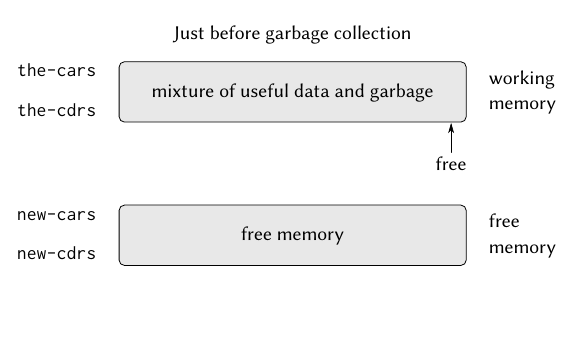
Go's garbage collector is a concurrent cleaning crew, freeing memory while your program runs. It automatically reclaims unused memory, preventing leaks without manual free() calls. The footgun is assuming it's free; excessive allocations create GC pressure.
We are hiring for this. Every open role lists the topics its interview covers, so you can prepare for the real thing rather than guessing.
See open roles