Intermediate interview questions in CI/CD & Automation
Continuous Delivery vs Continuous Deployment: key differences and choosing between them
Tests the human-gate distinction: Delivery readies artifacts but requires manual approval; Deployment pushes automatically. Strong answers cite compliance, blast radius, and maturity. Red flag: conflating terms or claiming full automation fits every app.
What is a build artifact and why build once deploy many crucial?
Tests whether you see artifacts as immutable deployable units. A strong answer says one binary is promoted through all stages, config is externalized, and rebuilding per environment creates drift. Red flag: accepting per-environment rebuilds.

What does shift left mean in CI/CD, and give two concrete examples?
Your grasp of moving verification earlier to reduce cost and risk. Define shift left as earlier-stage testing; cite two concrete examples like pre-commit unit tests and PR-level SAST scans. Never call it "more testing" instead of earlier feedback.

What is Infrastructure as Code (IaC), and how does it support CI/CD?
This tests if you link declarative definitions to repeatable pipelines. A strong answer covers idempotence, versioned templates, and preventing snowflake environments. A red flag is calling IaC mere scripting without CI/CD integration.
Describe Trunk-Based Development principles and CI/CD benefits
Tests if you view TBD as a CI/CD enabler versus GitFlow. Good answers name a single trunk, branches under 24 hours, pre-integrate builds, and feature flags, tying daily commits to releasable code and less merge hell. Red flag: endorsing long-lived branches.
How do feature flags enable unfinished work in Trunk-Based Development?
Commit behind off flags; CI/CD deploys trunk continuously; flags gate exposure for gradual rollouts.
How do you safely merge a 50-commit stale branch with conflicts?
Assess relevance, merge main locally, validate via draft PR and tests, merge off-peak with rollback ready.
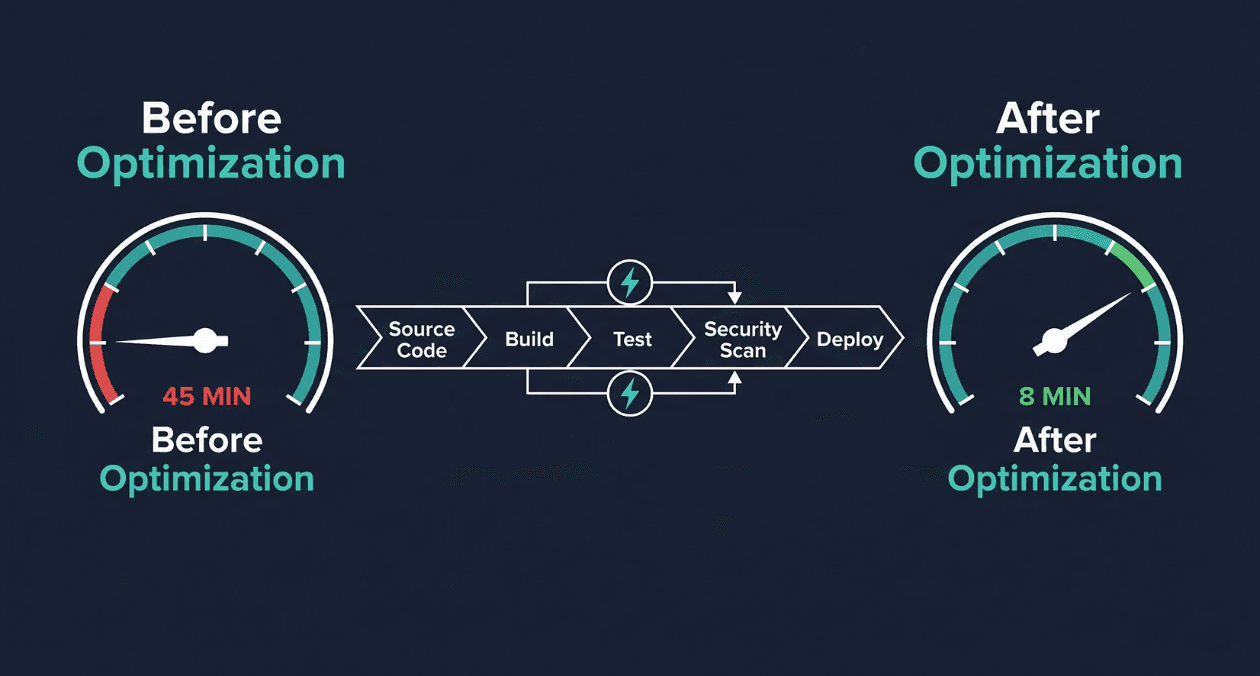
Your build times increased significantly. How do you investigate and optimize?
Tests methodical CI/CD bottleneck analysis and build optimization tactics. Strong answers baseline the timeline, isolate the slowest stage with metrics, then apply parallelism, caching, or dependency pruning.
Explain dependency management and diamond conflicts in automated builds
Tests transitive dependency resolution and conflict strategies in build pipelines. Strong answers mention nearest-wins eviction, strict versioning, shading, or classloader isolation. Red flag: manual jar swaps or pinning without understanding ABI breakage.
Compare ephemeral container agents versus persistent build agents
Ephemeral agents ensure clean state but add cold-start latency; persistent agents speed builds via caching yet risk config drift.
How would you design a multi-arch build process and anticipate challenges?
Mention buildx or cross-compilation, split native and emulated builds, cache per-arch layers.
How would you block merges when PR coverage drops 2%?
Upload coverage to Codecov, set a project status threshold of 2, and require the check in branch protection.
How would you integrate SAST into CI without alert fatigue?
This tests embedding security into workflow without killing velocity. Run SAST per commit, suppress false positives via rulesets, gate on high-severity findings first and block merges only after calibration. A red flag is zero-tolerance blocking on day one.
How do you version Docker images: Git SHA or SemVer?
Your grasp of immutable artifacts and traceability versus human-readable releases. Tag every build with Git SHA for immutability, then apply SemVer aliases only on promoted images. Treating floating tags like latest or v1 as safe production targets.

Explain proxy repositories in artifact managers and the problems they solve
Tests caching and supply-chain resilience in builds. Strong answers cover: local caching of upstream artifacts, shielding CI from external outages, and policy enforcement at the edge.
Promote an artifact from staging to release without rebuilding it
Tests immutable artifact discipline. Answer: promote by copying the binary or retagging the image digest, never recompiling, because rebuilds introduce dependency drift and untested bits.
How would you reuse pipeline steps across projects using PaC principles?
Tests DRY abstractions and coupling in CI/CD. Good answer: versioned reusable templates or libraries with parameterized inputs, consumed by composition. Red flag: raw copy-paste or one global pipeline forcing lockstep deployments.
How would you implement conditional logic in a pipeline?
Use if conditions with contexts like github.ref, separate trigger filters from runtime conditions, and add env rules.
How would you use PaC to introduce pipeline parallelism?
Tests splitting a sequential Jenkinsfile into independent Declarative parallel stages. Group tests and scans in a parallel block with stage-level agents, use matrix for cross-axis work, and version the Jenkinsfile.
Implement a manual approval gate for production deployment in pipeline-as-code
This tests embedding human governance in automated pipelines with auditability. A strong answer covers environment-scoped approvals, timeouts, RBAC, and immutable logs. Red flag: Ad-hoc manual deploys outside the pipeline or missing rollback plans.
We are hiring for this. Every open role lists the topics its interview covers, so you can prepare for the real thing rather than guessing.
See open roles