Intermediate interview questions in Computer Vision

Explain the pinhole camera model and intrinsic matrix K
Tests projective geometry and mapping sensor properties to K. Good answers derive perspective projection via similar triangles, list fx, fy, cx, cy, skew, and explain pixel scaling. Red flag: mixing intrinsics with extrinsics or saying K includes distortion.
Lens distortion and camera calibration
Radial distortion bends straight lines (barrel/pincushion), tangential comes from lens-sensor misalignment; calibrate with a known pattern to estimate intrinsics and distortion coefficients.
How does a Bayer filter capture color and what is demosaicing?
This tests CFA sampling tradeoffs. The answer covers the RGGB mosaic, demosaicing as interpolation of missing channels, and moire or zippering artifacts. A red flag is believing pixels capture full RGB natively or that demosaicing is only averaging.
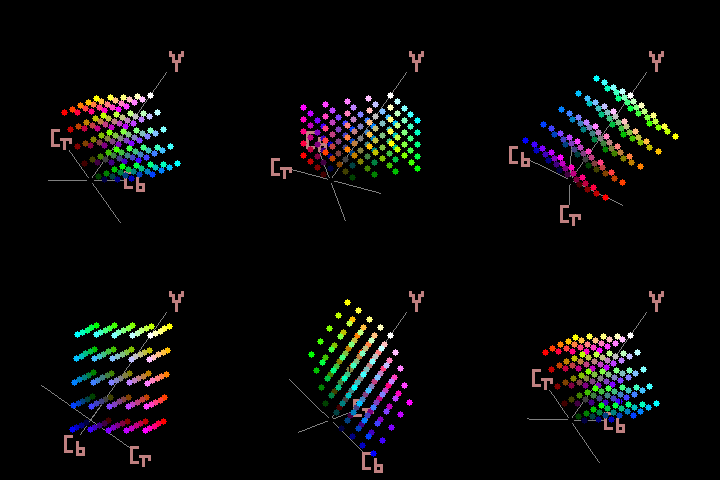
Compare YCbCr and RGB. Why chroma subsampling for compression?
Tests color decorrelation and perceptual redundancy. Contrast correlated RGB with YCbCr's luma-chroma split; eyes resolve brightness better than color, so 4:2:0/4:2:2 cuts chroma bandwidth ~50-75% with little loss.
Removing salt-and-pepper noise
Use a median filter; it replaces a pixel with the neighborhood median so extreme outliers are discarded.
How does the Sobel operator approximate image gradients for edge detection?
This tests discrete gradient approximation via separable convolution. A strong answer covers 3x3 Gx and Gy kernels as smoothed central differences, then combines magnitude as sqrt(Gx^2 + Gy^2) or L1 norm. A red flag is treating them as arbitrary blur filters.

Zero-padding vs reflect vs replicate padding and their visual artifacts
This tests boundary assumptions in convolution. Zero-padding adds black borders causing dark vignettes; reflect padding mirrors edges for continuity; replicate padding repeats edge values outward. A red flag is saying padding choice does not affect outputs.
SIFT scale and rotation invariance
Scale-space extrema via difference-of-Gaussians give scale invariance; a dominant gradient orientation gives rotation invariance; the descriptor is a normalized gradient histogram.
SIFT versus SURF versus ORB
SIFT is most accurate but slow with float descriptors; SURF approximates SIFT for speed; ORB is fast, binary, and free, ideal for real-time and embedded.
Descriptor matching and Lowe's ratio test
Match by nearest-neighbor descriptor distance; Lowe's ratio test keeps a match only if the best is clearly better than the second-best, rejecting ambiguous ones.
Bag of Visual Words model
Cluster many local descriptors (e.g. k-means) into visual words; assign each image's features to words; represent the image as a histogram of word counts for a classifier.
Fundamental matrix versus essential matrix
Both relate corresponding points across two views via the epipolar constraint; the fundamental matrix works in pixel coordinates, the essential matrix in calibrated coordinates and encodes relative pose.
Incremental Structure from Motion pipeline
Detect and match features, estimate two-view geometry, triangulate, then incrementally add images with PnP and refine via bundle adjustment.
The PnP problem in Structure from Motion
PnP recovers a camera's pose from known 3D points and their 2D projections; it registers new frames against the existing point cloud in SfM.
Regularization techniques for an overfitting CNN
Data augmentation expands the effective dataset, dropout prevents co-adaptation, weight decay penalizes large weights, plus early stopping and batchnorm.
ResNet residual blocks and the degradation problem
A residual block learns F(x) and adds the identity input x, so layers fit a residual; this eases gradient flow and solves the degradation problem.
Receptive fields in convolutional networks
Receptive field is the input region affecting a neuron; it grows with depth, larger kernels, and stride. It matters for capturing context in detection and segmentation.
Uses of the 1x1 convolution
A 1x1 conv is a per-pixel linear combination across channels; it reshapes channel depth cheaply and adds nonlinearity. Uses: dimensionality reduction in bottlenecks and channel mixing.
U-Net architecture and its skip connections
U-Net has a contracting encoder, an expanding decoder, and skip connections that concatenate matching-resolution encoder features into the decoder to recover spatial detail lost in downsampling.
How does Mask R-CNN do instance segmentation?
Faster R-CNN backbone plus RPN, then RoIAlign and a parallel mask head predicting per-class binary masks.
We are hiring for this. Every open role lists the topics its interview covers, so you can prepare for the real thing rather than guessing.
See open roles