Intermediate everything in Computer Vision, page 4
Fundamental matrix versus essential matrix
Both relate corresponding points across two views via the epipolar constraint; the fundamental matrix works in pixel coordinates, the essential matrix in calibrated coordinates and encodes relative pose.
Bag of Visual Words model
Cluster many local descriptors (e.g. k-means) into visual words; assign each image's features to words; represent the image as a histogram of word counts for a classifier.
Descriptor matching and Lowe's ratio test
Match by nearest-neighbor descriptor distance; Lowe's ratio test keeps a match only if the best is clearly better than the second-best, rejecting ambiguous ones.
SIFT versus SURF versus ORB
SIFT is most accurate but slow with float descriptors; SURF approximates SIFT for speed; ORB is fast, binary, and free, ideal for real-time and embedded.
SIFT scale and rotation invariance
Scale-space extrema via difference-of-Gaussians give scale invariance; a dominant gradient orientation gives rotation invariance; the descriptor is a normalized gradient histogram.
Removing salt-and-pepper noise
Use a median filter; it replaces a pixel with the neighborhood median so extreme outliers are discarded.
Lens distortion and camera calibration
Radial distortion bends straight lines (barrel/pincushion), tangential comes from lens-sensor misalignment; calibrate with a known pattern to estimate intrinsics and distortion coefficients.

Zero-padding vs reflect vs replicate padding and their visual artifacts
This tests boundary assumptions in convolution. Zero-padding adds black borders causing dark vignettes; reflect padding mirrors edges for continuity; replicate padding repeats edge values outward. A red flag is saying padding choice does not affect outputs.
How does the Sobel operator approximate image gradients for edge detection?
This tests discrete gradient approximation via separable convolution. A strong answer covers 3x3 Gx and Gy kernels as smoothed central differences, then combines magnitude as sqrt(Gx^2 + Gy^2) or L1 norm. A red flag is treating them as arbitrary blur filters.
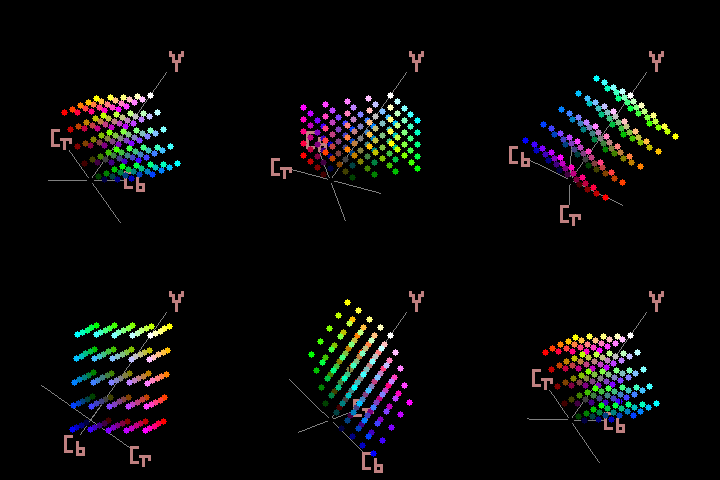
Compare YCbCr and RGB. Why chroma subsampling for compression?
Tests color decorrelation and perceptual redundancy. Contrast correlated RGB with YCbCr's luma-chroma split; eyes resolve brightness better than color, so 4:2:0/4:2:2 cuts chroma bandwidth ~50-75% with little loss.
How does a Bayer filter capture color and what is demosaicing?
This tests CFA sampling tradeoffs. The answer covers the RGGB mosaic, demosaicing as interpolation of missing channels, and moire or zippering artifacts. A red flag is believing pixels capture full RGB natively or that demosaicing is only averaging.

Explain the pinhole camera model and intrinsic matrix K
Tests projective geometry and mapping sensor properties to K. Good answers derive perspective projection via similar triangles, list fx, fy, cx, cy, skew, and explain pixel scaling. Red flag: mixing intrinsics with extrinsics or saying K includes distortion.
COCO: The Messy Real-World Vision Benchmark
COCO is the standard benchmark for detecting overlapping objects in cluttered scenes. Use it to test object detectors and segmentation. Strong scores here do not mean your model works on specialized domains like medical or satellite imagery.
U-Net: Segmentation with Less Data
U-Net retrofits fully convolutional networks to segment images precisely with fewer training examples. It runs a 512 by 512 frame in under a second on a 2015 GPU, fitting latency-sensitive pipelines.

Non-Maximum Suppression: One Box Per Object
Non-Maximum Suppression (NMS) ensures each detected object gets just one bounding box. It sorts all proposed boxes by confidence, keeps the best one, and discards others that overlap it too much.
Image Convolution: A Sliding Feature Detector
An image convolution is a sliding filter that scans an image to detect features like edges or textures. It's the core building block of modern computer vision, used in image classification and object detection.

Neural Network Pruning: Making Models Smaller and Faster
Neural network pruning makes models smaller and faster by removing unimportant connections, like trimming a bonsai tree. It's essential for deploying large models on devices with limited memory, like phones.
Meta-Learning: Learning How to Learn
Meta-learning is 'learning to learn.' Instead of training on data, it learns from the performance of other models, using metadata from experiments to improve the learning process itself. This helps algorithms become more flexible and solve new problems faster.

3D Object Detection: Seeing in Depth, Not Just Pixels
3D object detection adds depth to a 2D flat view, understanding an object's true size, distance, and orientation. It's vital for autonomous cars and robotics that need spatial awareness.
Semantic Scene Classification: Understanding Context, Not Just Objects
Scene classification tells you the context of an image ("this is a forest"), not just the objects in it ("there's a tree"). It's used by self-driving cars to identify a highway vs. a residential street and by apps to organize photos.
We are hiring for this. Every open role lists the topics its interview covers, so you can prepare for the real thing rather than guessing.
See open roles