Interview questions in Content & Copywriting, page 5
Build a simple A/B test for a headline
Assign each visitor a sticky bucket, serve the matching headline variant, log impressions and conversions per variant.
What CTA metric wins an A/B test and how to log it?
This tests connecting instrumentation to business outcomes via a click metric and tracked event. An answer picks click or conversion rate, fires an event with variant ID, and notes uniqueness. A red flag is using views without linking the event to the button.
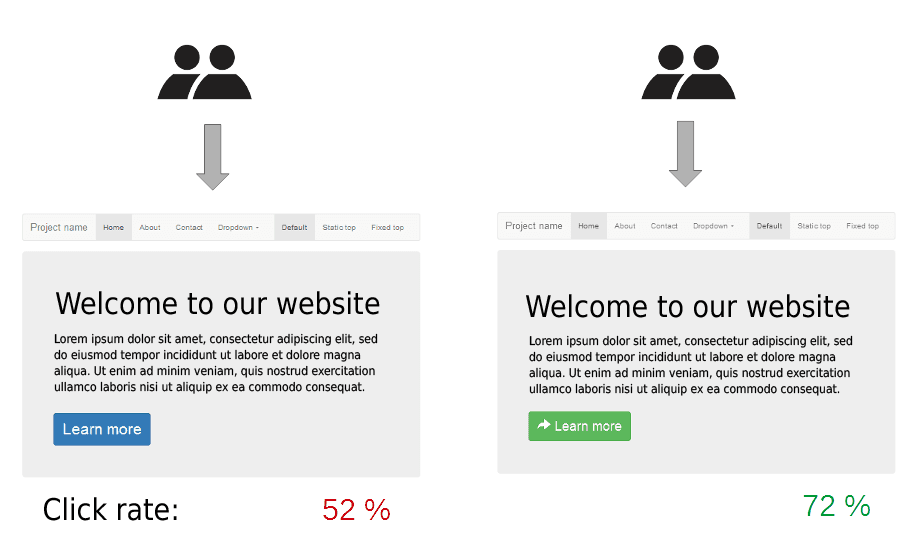
Explain statistical significance in copy A/B tests and why one day fails.
This checks if you distinguish signal from noise. A strong answer defines statistical significance as confidence a difference is real, warns that one-day samples are small and skewed by variance, and cites false positive risk.

How does cookie clearing affect A/B results and consistency?
This tests bucketing integrity when state changes re-randomize users. Explain that re-bucketing contaminates the sample and triggers SRM; propose deterministic server-side assignment, fingerprinting, or authenticated IDs.

Compare A/B/n testing with multi-armed bandits for headline optimization
Contrast A/B/n with dynamic MAB allocation; A/B/n optimizes final inference, MABs optimize reward; flag real-time infra.
Manage localized copy across many A/B tests
A keyed versioned string store, a translation workflow with per-locale status, and pooling or hierarchical analysis for small languages.
How do you diagnose a confounded A/B test with slower page load?
This tests confounding beyond p-values. A strong answer isolates the bug, checks if slower load hurt or helped conversions, and judges whether copy or latency caused the lift. A red flag is defending a 5% win because p < 0.05 while ignoring randomization.

Track a 'Request a Demo' button click
End-to-end click instrumentation. A strong answer covers: a DOM listener on the button, a custom event name like request_demo, and a payload with page path and button ID.
How would you track which headline wins in an A/B test?
Tests end-to-end experiment instrumentation across the stack. Outline: deterministically bucket users, serve variant A or B, emit click events, and aggregate by variant.
Measure active engagement time accurately
Accumulate time only while the tab is visible and the user active, via Page Visibility and activity events; flush with sendBeacon on unload.
Track scroll depth: Intersection Observer vs scroll events
Place sentinels at depth thresholds and fire once via Intersection Observer, off the main thread; scroll listeners fire constantly and need throttling.

Outline a data pipeline for web events to a data warehouse
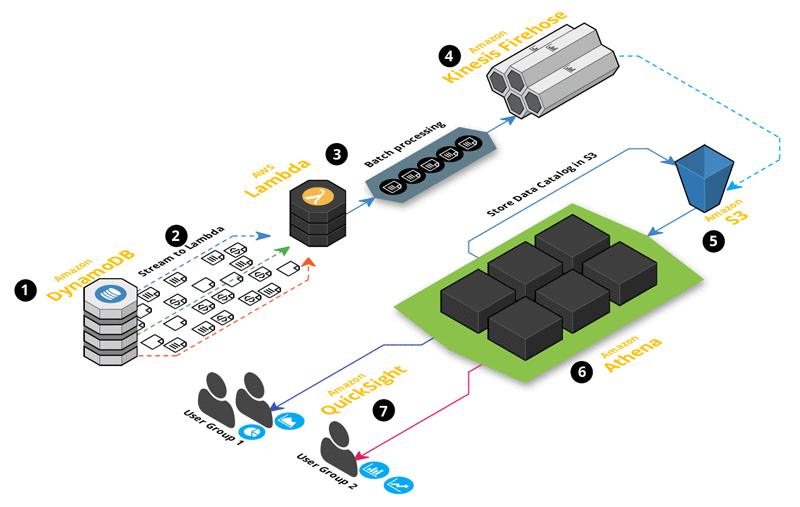
Tests end-to-end streaming design from web clients to warehouse. Strong answers list five stages: client capture, broker buffering, stream processing, object storage, and warehouse load. Red flag: proposing only batch cron jobs or ignoring schema registries.

Design anonymous-to-authenticated user journey stitching for ROI
Tests identity resolution and privacy-compliant attribution. Strong answers cover first-party UUID stitching, consent-gated probabilistic matching, async CDP merge, and TTL deletion. Red flag: treating anonymous IDs as non-personal data or skipping consent.
Design a real-time top-10 dashboard for a global news site
Stream ingestion, windowed aggregation, Redis top-N cache, and TTL eviction.
Multi-armed bandit vs A/B testing for headlines
Bandits shift traffic toward winners using updated per-arm reward state; A/B holds fixed splits until a fixed-horizon decision.

What HTML attributes and elements make a banner accessible to screen readers?
This tests semantic HTML for decorative and informative images. A strong answer names img alt, heading levels, and a landmark region such as aside with aria-label. A red flag is relying on CSS or divs without text alternatives.

Describe the technical steps for displaying and enforcing a cookie consent banner.
Tests privacy-first frontend architecture. Outline: check consent record, render banner if absent, classify scripts as essential or non-essential, persist choice, and inject tracking only after explicit opt-in.
Accessibility pitfalls in SPAs and programmatic fixes
Cover route-change focus reset, ARIA live regions, semantic landmarks in dynamic markup, and keyboard trap prevention.

Display a dynamic uptime claim without hurting Core Web Vitals
Tests separation of data and rendering paths for dynamic claims. Pre-compute the metric in a background job, cache at the edge, and inject via SSR to avoid blocking the main thread. A red flag is synchronous DB lookups or CSR that delays interactivity.
Design a copyright detection system for video uploads
Tests scalable content-identification design. Strong answers cover event-driven ingestion, perceptual hashing and audio fingerprinting versus a reference index, plus tiered enforcement. Red flag: MD5 or pixel-perfect matching that fails after re-encoding.
We are hiring for this. Every open role lists the topics its interview covers, so you can prepare for the real thing rather than guessing.
See open roles