Advanced everything in Design & UX, page 2
Measuring design system documentation effectiveness
Search-with-no-results, time-to-first-component, support-ticket deflection, tied to analytics and registry data.
Designing a multi-step wizard form pattern
A wizard controller owns step index and shared data, each step validates itself and reports up, accumulated data persists across steps.
Architecting a composable DataTable API
Separate a headless data/state core from rendering, use a column-definition config with custom cell renderers, expose composition over dozens of flags.
Headless components and a headless Combobox
A headless component owns state, logic, and accessibility but renders no UI, exposing state and prop-getters so consumers supply markup.
Architecting global and local theming with context
A top-level provider supplies global tokens, nested providers merge local overrides, components read the nearest theme, often backed by CSS variables.
Architect a developer-portal personalization engine
A user profile of role and level, content tagged with the same taxonomy, a matching/ranking layer, and a rendering pipeline ordering tutorials.
Multi-armed bandit vs A/B testing for headlines
Bandits shift traffic toward winners using updated per-arm reward state; A/B holds fixed splits until a fixed-horizon decision.
Manage localized copy across many A/B tests
A keyed versioned string store, a translation workflow with per-locale status, and pooling or hierarchical analysis for small languages.
Design a programmatic SEO landing-page system
Structured data plus templates, genuinely unique per-page data, static build-time generation, quality gates and indexation control.
Design a next-best-article recommender
Content-based on article embeddings, collaborative on behavior, a hybrid blend, popularity or onboarding fallbacks for new users.
Structuring release notes for breaking API changes
Lead with a summary and why, group breaking changes with before/after migration steps, give deprecation timelines and an upgrade path.
TF-IDF Analysis
TF-IDF weights a term by how often it appears in a document against how rare it is across the corpus, surfacing words distinctive to that document rather than ones common everywhere, which powers keyword extraction and search ranking.

Outline operational and cultural changes for proactive UX research in engineering
Embed UXRs in roadmapping, build shared repositories, reward insight-driven pivots, teach generative literacy.
Compare embedded vs centralized research models and propose a hybrid
Tests org trade-offs between squad autonomy and research consistency. Strong answers contrast embedded speed with centralized standards, then propose a hybrid of embedded generalists and centralized specialists.
Design a globally compliant, low-latency research backend architecture
Partition by region with local storage, ingest at the edge, aggregate anonymized metrics cross-border.

How does continuous discovery change the researcher's role with engineering?
Tests whether you view researchers as trio enablers rather than study owners. A strong answer covers shifting from running studies to coaching engineers on interviews and assumption testing via shadowing and paired sessions.
How do you use research to build a case for architectural investment?
Quantify churn, tie UX debt to revenue, propose phased rollout, anchor to strategy.
What metrics and models link onboarding to long-term retention?
Track activation-to-D90 metrics; use Cox/AFT or diff-in-diff; control censoring.

Explain statistical power and respond to extending a null A/B test
This tests statistical power and p-hacking judgment. A strong answer defines power as detecting a true effect, rejects extending the test to chase significance, and requires pre-registered sample sizes. Agreeing to run until it hits significance is a red flag.
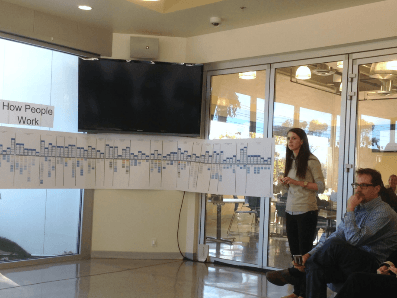
What analytical frameworks structure synthesis beyond thematic analysis?
Tests if you model problems structurally, not just code themes. Strong answers pair mental models to map user goals with JTBD to prioritize unmet needs by importance and satisfaction. Red flag: naming frameworks without explaining how they reshape synthesis.
We are hiring for this. Every open role lists the topics its interview covers, so you can prepare for the real thing rather than guessing.
See open roles