Easy everything in Design & UX, page 2
Publishing a component to a private NPM registry
Configure package.json fields and scoped name, build dist, set registry auth, npm publish with access restricted.
Structuring Storybook stories for visual states
One named story per state with explicit args, plus argTypes and controls.
Designing a responsive Grid with breakpoint props
Accept per-breakpoint column props, map them to CSS Grid and media queries or container queries, expose a gap prop.
Building a flexible Card with optional content
Use optional props or named slots for image, title, and text, conditionally render present ones, and prefer composition for ordering.
Composing Input and Button into a SearchForm
Wrap Input and Button in a form, expose value/placeholder props, emit onSearch on submit, keep it controlled.
Build a simple A/B test for a headline
Assign each visitor a sticky bucket, serve the matching headline variant, log impressions and conversions per variant.
Programmatically create an ad via a marketing API
Authenticate, create a campaign with an objective, an ad set with budget and targeting, a creative with the copy, then the ad linking them.

Describe lightweight user validation without a dedicated researcher
This tests if you value direct user feedback over expert-only evaluation without researchers. A strong answer covers recruiting fresh users and observing real use for intuitiveness.

How would you integrate user research into agile sprints without disrupting velocity?
Tests embedding continuous discovery into agile rather than front-loading research. Strong answers mention parallel tracks, backlog stories derived from insights, and lightweight discount-usability methods.

Which ARIA attribute fixes an icon-only button missing its screen reader name?
Tests knowledge of accessible names for interactive elements lacking visible text. Answer: aria-label on the button describing its function, plus aria-hidden on the decorative icon. Red flag: suggesting alt text on the SVG or title attributes as the fix.
How would you usability-test a feature-flagged staging component?
Tests if you know usability testing works early. Strong answer: realistic tasks with careful wording to avoid priming; facilitator observes behavior and asks followups without influencing participant; staging is just another interface.

How do you share research findings with engineers so they stay actionable?
Tests whether you respect engineering workflows. Offer tiered formats like quick decks, shared docs, or raw notes; embed insights into tickets; anchor findings to user quotes for trade-offs. Red flag: forcing live attendance or sharing long standalone decks.
What research do you give an engineer starting a new feature?
This tests distilling research into actionable engineering guidance. A strong answer gives the engineer a validated problem statement and user context, delivered in the ticket or a five-minute sync. A red flag is handing over a full research deck or raw notes.
How do you reliably deliver a survey to 10,000 users?
Tests systems thinking for outreach at scale. Strong answers cover idempotent delivery, rate-limited async sending, PII handling and retention, plus observability into delivery and response rates.
Design a database schema for a research participant panel
Your ability to normalize relational data without over-engineering. Propose a participants table for contact and demographics; a participation_history table with foreign keys; and a consent_log table.
Are 1-5 satisfaction ratings continuous or discrete?
Tests knowledge of measurement scales. A strong answer calls 1-5 ratings discrete and ordinal, notes intervals may be unequal, and prefers medians or non-parametric tests over means unless equal spacing is defensible.
Explain what a p-value represents in an A/B test and interpret 0.03
This tests frequentist hypothesis testing literacy. It is the chance of seeing a result this extreme if the null of no effect were true; 0.03 means 3% chance of such data under the null, not 97% chance the variant wins. Red flag: saying 97% likely.
Mean, median, and mode: which measure for task completion times?
This tests whether you know task times are skewed and sample size drives the mean-versus-median choice. A strong answer cites the under-25 rule, contrasts mean outlier sensitivity with median robustness, and dismisses mode. Red flag: defaulting to the mean.
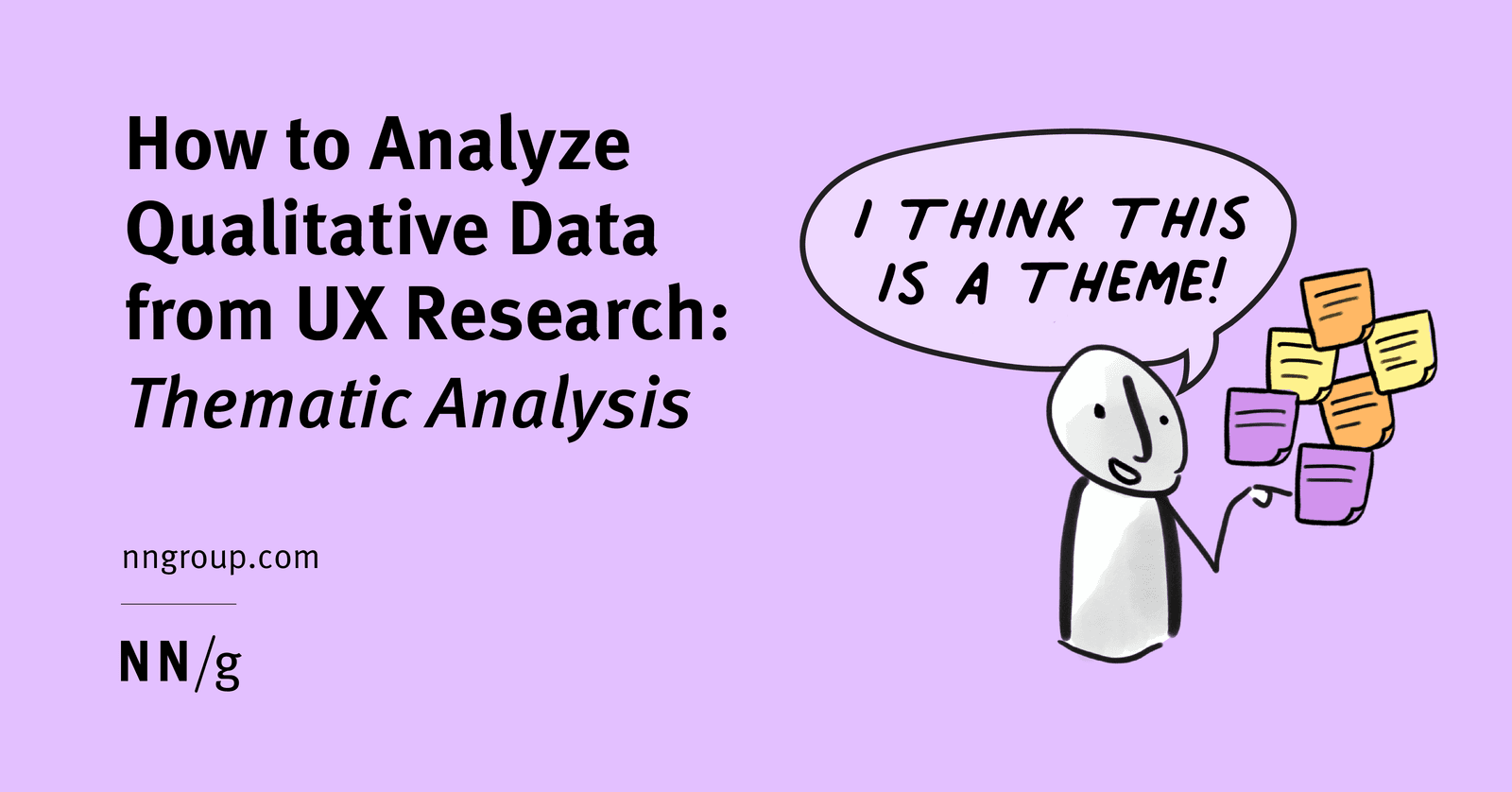
Explain coding in qualitative analysis and your codebook process
Tests systematic tagging of observations/quotations to discover themes, not ad-hoc skimming. Strong answers mention uploading transcripts to software or affinity diagramming, and stress that themes emerge across multiple participants.
Walk me through your next steps after five user interviews
Extract observations onto sticky notes, cluster into themes as a team, then prioritize for next steps.
We are hiring for this. Every open role lists the topics its interview covers, so you can prepare for the real thing rather than guessing.
See open roles