Interview questions in DevOps & Cloud, page 20
CSV vs JSON vs Parquet for analytics
CSV and JSON are row-based, human-readable, and bulky; columnar Parquet/ORC compress well and read only needed columns; choose columnar for analytics.
Blue/green vs canary release: differences and when to choose each.
This tests release-automation risk mitigation. A strong answer contrasts instant full-environment swaps with gradual traffic shifts, pairing blue/green with hotfixes and canary with risky changes. A red flag is calling them identical or ignoring blast radius.
Reliability patterns for queue-based job processing?
Retries with backoff and jitter for transient faults, dead-letter queues plus a poison-message limit, idempotent handlers and visibility timeouts.
Root and NET_ADMIN under Pod Security Standards
Set runAsUser 0 and capabilities add NET_ADMIN in the container securityContext; this is rejected by Restricted and Baseline, so the namespace must use the Privileged profile.
Partitioning order events in a data lake
Partition by the columns queries filter on, typically date hierarchy and category, balancing granularity to avoid too many tiny files.
Walk me through deploying a new version using a GitOps workflow
Merge updates manifests; the GitOps controller compares desired state in Git to live state and reconciles.
Mitigating risk from an unproven external dependency?
Timeouts and circuit breakers to fail fast, bulkheads to isolate resources, fallbacks or cached/degraded responses.
Binding a ClusterRole with a RoleBinding
A RoleBinding referencing a ClusterRole grants those rules only within the binding's namespace; reuse built-in roles like view per-team without duplicating definitions.
Diagnosing and fixing data skew in Spark
This is data skew, caused by uneven key distribution concentrating rows on few partitions; mitigate with salting, broadcast joins, repartitioning, or adaptive execution.
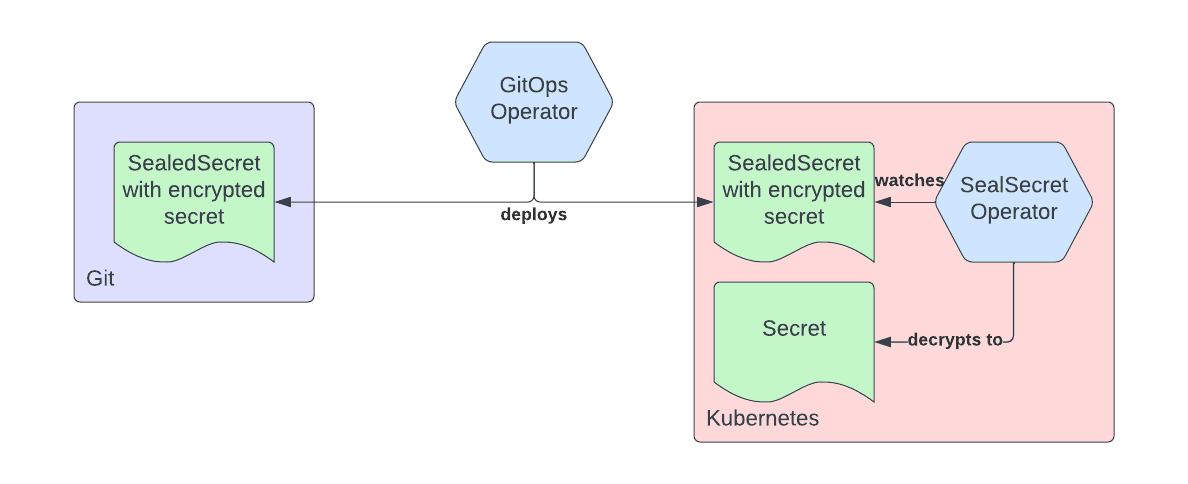
How do you secure secrets in a GitOps repository?
Tests whether you treat Git as source of truth while excluding plaintext credentials. A strong answer covers encrypting at rest with SOPS or Sealed Secrets, external stores like Vault, and operator workflows.
Zero-downtime index migration on a hot table?
Build the index concurrently to avoid table locks, run off-peak with monitoring, and keep it reversible since dropping an index is cheap.
Multi-tenant isolation with a monitoring exception
Apply default-deny ingress per tenant namespace, allow same-namespace traffic, then add an ingress rule permitting the monitoring namespace via namespaceSelector on the metrics port.
Handling late data in streaming windows
Use event-time windows with watermarks to bound lateness, allow a grace period before finalizing, and route data later than that to a side output.

Two common GitOps repository layouts for multiple environments
Tests GitOps state-store trade-offs beyond single-cluster demos. Contrast a monorepo with directory overlays against repo-per-env; weigh polling overhead, blast radius, and promotion flow. Recommending branch-per-env destroys immutability and invites drift.
Replication and consistency for active-active regions?
Choose per data class between synchronous (low RPO, higher latency) and async replication, address write conflicts, and reason via CAP and PACELC.
Viewing pod logs and durable log collection
Kubectl logs (with -c, --previous, -f) reads container stdout/stderr; because that storage is ephemeral, run a node-level logging agent as a DaemonSet shipping logs to a central store.
Idempotency in data ingestion pipelines
Idempotency means re-running a step yields the same result with no duplicates; it matters because retries and at-least-once delivery are inevitable; achieve it with deduplication keys or upserts.
Automate a canary release with a 1% 5xx error threshold
This tests wiring an SLO into an automated canary loop. A strong answer covers traffic splitting via a mesh or ingress, an analysis query to Prometheus for 5xx rate, and auto-promote or abort logic.
Design a chaos experiment for a payment dependency?
Define a measurable steady state, hypothesize it holds when payments fail, limit blast radius to a small traffic slice, and auto-abort on SLO breach.
kube-state-metrics versus node-exporter
Kube-state-metrics exposes API object state (deployment replicas, pod phase, restarts) from the control plane, while node-exporter exposes OS-level hardware metrics (CPU, memory, disk) per…
We are hiring for this. Every open role lists the topics its interview covers, so you can prepare for the real thing rather than guessing.
See open roles