Interview questions in DevOps & Cloud, page 25
The reconciliation loop in an Operator
Reconcile compares desired spec to observed state and converges them, idempotently; triggered by resource changes, watched dependents, and periodic resync.
How do you implement security policies as code across CI pipelines?
This tests operationalizing Policy as Code for security scanners at scale. Strong answers cover centralized version-controlled rules consumed by CI pipelines with automated gates and exception workflows. Red flag: teams maintaining independent scanner configs.
Designing shallow vs deep health checks
Shallow checks confirm the process is alive; deep checks verify dependencies; use shallow for liveness/load-balancer routing and deep sparingly to avoid…
Strangler Fig with serverless and an event bus
API Gateway acts as the routing facade, new features run as Lambda functions, an event bus decouples and fans out to new services, and traffic shifts feature by feature until the monolith…
Finalizers for clean external cleanup
A finalizer is a key blocking deletion; deletion sets deletionTimestamp, the operator does cleanup then removes the finalizer so the object is purged.
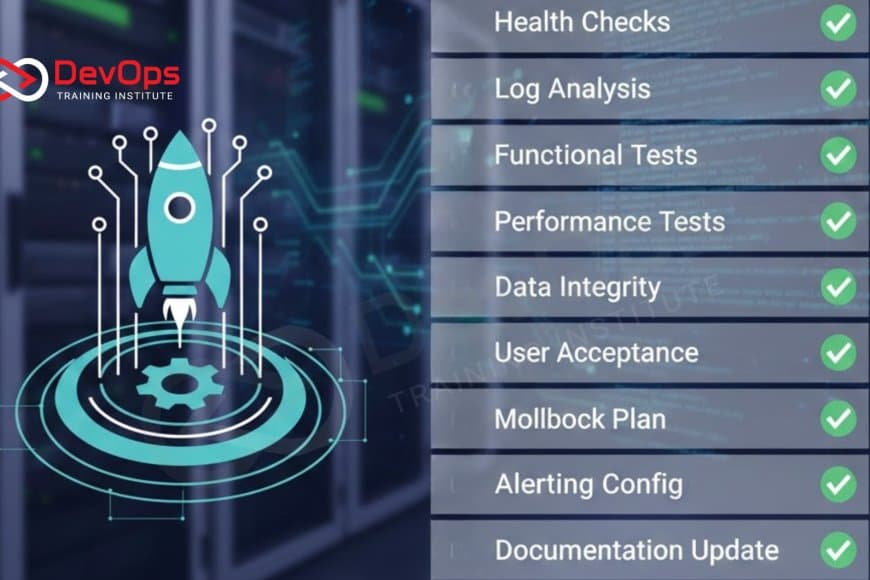
How do you add a basic post-deployment health check in CI/CD?
Tests deployment validation beyond exit-code success. Outline: add a post-deploy stage that probes an HTTP endpoint, checks status code and latency, validates critical dependencies, and triggers rollback on failure.
First-SRE 90-day plan at a startup
Listen and measure first, pick one high-impact service, define SLIs/SLOs and basic alerting, then show reduced toil or incidents to leadership.
Optimize cost of a big-data analytics platform
Storage tiering and lifecycle plus compression and partitioning; compute via spot instances, right-sizing, and efficient file formats; query and pipeline optimization to scan less data.
Adding a required field to a live CRD
Don't make it required immediately; add it optional with a default, introduce a new version with conversion, migrate existing objects, then tighten.
Explain .gitignore and its impact on faster, reliable, secure CI builds
Exclude build artifacts to shrink clones and stabilize cache keys; block secrets from runners.
OpenTelemetry agent and gateway architecture
Agents run per-node for local collection and host enrichment; gateways are central, horizontally scaled pools for batching, tail sampling, and routing.
Event bus versus message queue for triggers
A queue is point-to-point buffered work for one consumer group; an event bus routes and filters one event to many decoupled subscribers. Event bus wins when many independent services must react.
When to build an Operator vs a Helm chart
Charts handle install-time templating; operators add continuous day-two logic like failover, backups, and scaling for stateful apps.
What is Git LFS and what are its CI/CD trade-offs?
This tests whether you understand Git's object model limits. A strong answer covers pointer indirection, smudge filters, and the shift of download burden to the LFS server in CI. A red flag is claiming LFS eliminates large file transfers entirely.
Key roles in incident response
Incident Commander coordinates and decides but does not fix; Communications Lead handles stakeholders; Operations/SMEs do hands-on diagnosis and remediation.
Design a multi-tenant model serving platform
Share infrastructure to cut cost while enforcing tenant data isolation, fair resource allocation against noisy neighbors, and per-tenant performance via quotas and autoscaling.
Keeping operator .status accurate under failures
Status can lag or go stale during partitions and crashes; make reconcile idempotent, observe true state each loop, use conditions and observedGeneration, handle conflicts.
What is static analysis in automated builds, with examples?
This tests if you treat static analysis as a pre-runtime quality gate. A strong answer says it shifts feedback left via non-execution scans, citing cyclomatic complexity or unhandled promise rejections.
Breaking tunnel vision during an incident
Call out the assumption, ask for disconfirming evidence, list parallel hypotheses, split responders to investigate them, and anchor on what changed and the data.
Difference between metrics and logs
Metrics are aggregated numeric time series good for trends and alerting; logs are discrete timestamped event records good for detailed root-cause analysis.
We are hiring for this. Every open role lists the topics its interview covers, so you can prepare for the real thing rather than guessing.
See open roles