Interview questions in DevOps & Cloud, page 3
Explain the three pillars of observability
Metrics are cheap aggregated time series for detecting and alerting, logs are discrete event records for detail and context, traces follow one request across services to localize latency.
Dockerfile CMD versus ENTRYPOINT
ENTRYPOINT sets the fixed executable; CMD sets default args or the default command; run-time args override CMD but append to ENTRYPOINT. Use together to make a fixed binary with overridable defaults.
Designing an auto-scaling web tier
Front with a load balancer, define a launch template, an auto-scaling group across AZs, and target-tracking policies.
Describe using a pre-push Git hook for checks and its CI limitations.
It tests client-side automation versus server-side policy. An executable .git/hooks/pre-push script runs tests and exits non-zero to block, noting hooks are not cloned, skipped via --no-verify, and local-only. A red flag is treating them as policy gate.
What are the Four Golden Signals?
Name latency, traffic, errors, and saturation; explain each briefly; describe measuring latency as a distribution separating success from failure.
Optimize Dockerfile layer caching for npm install
Copying all source first invalidates the npm install layer on any code change; instead copy package.json and lockfile, run npm install, then copy the rest.
On-Demand vs Reserved vs Spot pricing
On-Demand for unpredictable bursty work, Reserved or Savings Plans for steady baseline, Spot for interruptible fault-tolerant jobs.
Describe Trunk-Based Development principles and CI/CD benefits
Tests if you view TBD as a CI/CD enabler versus GitFlow. Good answers name a single trunk, branches under 24 hours, pre-integrate builds, and feature flags, tying daily commits to releasable code and less merge hell. Red flag: endorsing long-lived branches.
Why use latency percentiles over the average?
Averages hide the tail and are skewed by outliers, so most users can suffer while the mean looks fine; use percentiles; prioritize p99 when tail users are high-value or fan-out…
Multi-stage builds for compiled languages
Build in a stage with the full toolchain, then COPY --from only the artifact into a tiny final base, shrinking image size and attack surface.
Managing state across ephemeral instances
Keep instances stateless, externalize sessions to Redis, data to managed databases, files to object storage.
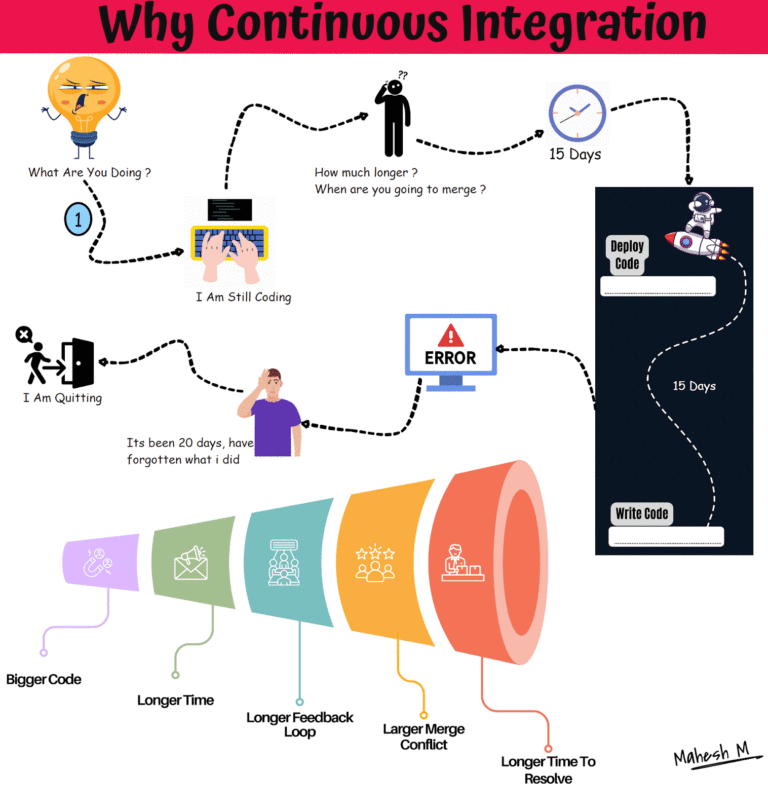
How do feature flags enable unfinished work in Trunk-Based Development?
Commit behind off flags; CI/CD deploys trunk continuously; flags gate exposure for gradual rollouts.
Structured vs unstructured logging: why it matters
Unstructured logs are free-text lines hard to parse; structured logs are machine-readable key-value or JSON records; structure enables reliable querying…
Debug a running container with the Docker CLI
Docker inspect for full state and config, docker logs -f to follow output live, docker exec -it <id> sh or bash for an interactive shell.
The instance metadata service explained
A local endpoint exposing instance identity, region, and temporary role credentials.
How do you safely merge a 50-commit stale branch with conflicts?
Assess relevance, merge main locally, validate via draft PR and tests, merge off-peak with rollback ready.
How does distributed tracing work?
Trace ID ties one request together, span IDs are individual operations, context propagates via headers.
What is a dangling image and how to prune it
A dangling image is an untagged layer (<none>:<none>) orphaned when a tag moves to a rebuilt image; list with docker images -f dangling=true, remove with docker image prune.
Optimizing low-latency VM-to-VM networking
Cluster placement groups, enhanced networking and SR-IOV, larger instances for more bandwidth.
How do you fully remove leaked credentials from Git history?
This tests Git history rewriting and incident response. Rotate the secret first, then use git-filter-repo to purge the file, force-push main, and require all teammates to re-clone before resuming. A red flag is recommending git revert or skipping rotation.
We are hiring for this. Every open role lists the topics its interview covers, so you can prepare for the real thing rather than guessing.
See open roles