Easy concepts in iOS & Swift
Variables and Constants in Swift
Swift has two ways to store a value: var declares a variable you can reassign later, and let declares a constant whose value is set once and can never change, and Swift's convention is to default to let unless you have a specific reason to need var.
Swift Control Flow: Directing Your Code's Path
Control flow statements are the traffic signals of your code. They use keywords like if, for, and switch to make decisions and repeat actions, rather than just running top-to-bottom. This is how you show a list of items or check if a user is logged.
Value vs. Reference Semantics in Swift
Value types are like emailing a document copy; changes don't affect the original. Reference types are like a shared Google Doc link; everyone edits the same instance. In Swift, structs are copies, while classes are shared references.

The Result Type: Modeling Success and Failure
The Result type is a sealed box for an operation's outcome: it holds either a success value or a failure error. It's used in asynchronous code like network requests to create clean, explicit completion handlers. The footgun is forgetting to handle both cases.
Protocol Extensions: Default Behavior for Free
Protocol extensions give conforming types default functionality "for free," like a standard toolkit with every blueprint. Use them to add common behavior to your protocols or even extend system types.
Xcode Project: Your App's Blueprint and Toolbox
An Xcode project is a self-contained kit for your app, holding all files, assets, and build instructions. It's the central repository for source code, build settings, and dependencies. The footgun: moving files in Finder without telling Xcode breaks builds.

Interface Builder: Visual UI Design for iOS/macOS
Interface Builder is Xcode's visual editor for building UIs. You drag-and-drop components like buttons and screens, which are saved as .xib files. It's used to quickly lay out app screens without writing UI code.
Asset Catalogs: Your App's Smart Media Library
An Asset Catalog is a smart folder for your app's visuals, automatically serving the right version (like high-res or dark mode) for the user's device. It's the standard way to manage images, icons, and colors in Xcode.
UIView: The Building Block of iOS UIs
A UIView is the fundamental building block for iOS UIs. Think of it as a rectangular canvas for drawing content, handling touches, or containing other views. You use it everywhere, from simple buttons to complex layouts.
The UIViewController Lifecycle: From Creation to On-Screen
Think of a UIViewController as an actor with cues to enter, perform, and exit. Its lifecycle methods are your script for setting up data, updating the UI, and cleaning up resources.
UIStackView: Layouts Without Manual Constraints
A UIStackView is an invisible container that arranges views in a single column or row, saving you from writing manual layout constraints. It's ideal for toolbars or forms. The main footgun is forgetting it's non-rendering—you can't set its background color.
SwiftUI's View: A Blueprint, Not a Building
A SwiftUI View is a lightweight blueprint for a piece of your UI, not the UI element itself. It's used to compose everything from a single button to an entire screen. The common mistake is treating it like a heavy UIView class; it's a cheap.
SwiftUI Stacks: Arrange Views Vertically, Horizontally, and in Layers
SwiftUI stacks are your core layout tools for arranging views. Use VStack for vertical columns, HStack for horizontal rows, and ZStack for layering. They're essential for any UI, from simple rows to complex overlays.
iOS App States: From Launch to Suspension
An iOS app is like a person with different states of alertness: focused (Active), distracted (Inactive), or napping (Background/Suspended). This lifecycle dictates how your app behaves during interruptions.
The AppDelegate: Your App's Central Command
Think of the AppDelegate as your app's command center, receiving critical notifications from the OS. It handles core events like launch, termination, or receiving a push notification. The footgun is bloating it with logic that belongs elsewhere.
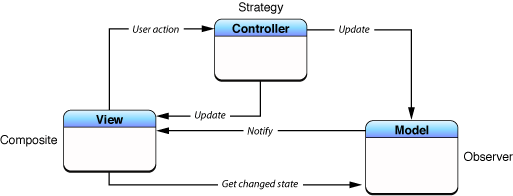
Model-View-Controller (MVC): Separating App Logic from UI
MVC organizes code by separating data (Model) from the user interface (View), using a Controller as the go-between. This is the foundational pattern for many UI frameworks, like Cocoa and UIKit. The main footgun is the "Massive View Controller."
UINavigationController: Stack-Based Screen Management
UINavigationController manages screens like a deck of cards: you push new ones on top and pop them off to go back. It's standard for hierarchical navigation. The footgun is manually changing the stack; always use the provided push/pop methods.
UITabBarController: Your App's Main Switchboard
A UITabBarController manages a row of buttons at the bottom of the screen to switch between an app's main sections. Use it for distinct, non-sequential modes like 'Recents,' 'Contacts,' and 'Voicemail'. The footgun is using it for a step-by-step process.
Storyboard Segues: Visual UI Flow in iOS
A Storyboard Segue is a visual arrow connecting two screens in your iOS app, defining a navigation path without writing code. Use them to transition from a list to a detail view. The biggest mistake is forgetting to use prepare(for:sender:) to pass data.
TabView: SwiftUI's Built-in Tab Bar
TabView lets you show different views in the same space, switched by a tab bar. It's the standard for top-level app navigation, like switching between "Home," "Search," and "Profile." The footgun is nesting them; they are for main sections only.
We are hiring for this. Every open role lists the topics its interview covers, so you can prepare for the real thing rather than guessing.
See open roles