Easy everything in Mobile Dev, page 12

JSONDecoder: Turning JSON into Swift Types
JSONDecoder is your translator for turning raw JSON data into native Swift structs or classes. It's the standard way to parse API responses, letting you work with typed, safe objects.
URLRequest: The Blueprint for a Network Call
URLRequest is the recipe for a network call, not the call itself. It bundles the URL, HTTP method, headers, and body. You hand this 'order form' to URLSession to execute. The footgun is thinking URLRequest sends the request—it only describes it.
URLSession: The Core of iOS Networking
URLSession is the engine for all network requests in Apple apps. Use it to fetch API data, download images, or upload files. The biggest footgun is blocking the main UI thread, which freezes your app; always perform network tasks asynchronously.
Swift's Codable: Effortless JSON & Data Parsing
Codable is a compiler magic trick that automatically converts Swift objects to and from formats like JSON. It's used constantly for parsing API responses or saving data to disk. The footgun: decoding fails if JSON keys don't exactly match your property names.
FileManager: Your App's Interface to the File System
FileManager is your app's librarian for the file system. Instead of using raw paths, you ask it to find, create, or delete files and directories. Always handle potential errors, as file operations can easily fail.
App Sandbox: A Digital Playpen for Your App
The App Sandbox is a digital playpen for your app, restricting it to its own files and resources. It's a core security feature on iOS and macOS, preventing apps from accessing user data or system files without explicit permission.
UserDefaults: Your App's Junk Drawer for Settings
UserDefaults is a simple key-value store for persisting small bits of data, like a dictionary that saves itself. Use it to remember user preferences like enabling dark mode or a username. The footgun: don't use it for large files or sensitive data.
TabView: SwiftUI's Built-in Tab Bar
TabView lets you show different views in the same space, switched by a tab bar. It's the standard for top-level app navigation, like switching between "Home," "Search," and "Profile." The footgun is nesting them; they are for main sections only.
Storyboard Segues: Visual UI Flow in iOS
A Storyboard Segue is a visual arrow connecting two screens in your iOS app, defining a navigation path without writing code. Use them to transition from a list to a detail view. The biggest mistake is forgetting to use prepare(for:sender:) to pass data.
UITabBarController: Your App's Main Switchboard
A UITabBarController manages a row of buttons at the bottom of the screen to switch between an app's main sections. Use it for distinct, non-sequential modes like 'Recents,' 'Contacts,' and 'Voicemail'. The footgun is using it for a step-by-step process.
UINavigationController: Stack-Based Screen Management
UINavigationController manages screens like a deck of cards: you push new ones on top and pop them off to go back. It's standard for hierarchical navigation. The footgun is manually changing the stack; always use the provided push/pop methods.
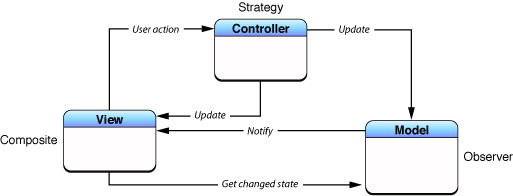
Model-View-Controller (MVC): Separating App Logic from UI
MVC organizes code by separating data (Model) from the user interface (View), using a Controller as the go-between. This is the foundational pattern for many UI frameworks, like Cocoa and UIKit. The main footgun is the "Massive View Controller."
The AppDelegate: Your App's Central Command
Think of the AppDelegate as your app's command center, receiving critical notifications from the OS. It handles core events like launch, termination, or receiving a push notification. The footgun is bloating it with logic that belongs elsewhere.
iOS App States: From Launch to Suspension
An iOS app is like a person with different states of alertness: focused (Active), distracted (Inactive), or napping (Background/Suspended). This lifecycle dictates how your app behaves during interruptions.
SwiftUI Stacks: Arrange Views Vertically, Horizontally, and in Layers
SwiftUI stacks are your core layout tools for arranging views. Use VStack for vertical columns, HStack for horizontal rows, and ZStack for layering. They're essential for any UI, from simple rows to complex overlays.
SwiftUI's View: A Blueprint, Not a Building
A SwiftUI View is a lightweight blueprint for a piece of your UI, not the UI element itself. It's used to compose everything from a single button to an entire screen. The common mistake is treating it like a heavy UIView class; it's a cheap.
UIStackView: Layouts Without Manual Constraints
A UIStackView is an invisible container that arranges views in a single column or row, saving you from writing manual layout constraints. It's ideal for toolbars or forms. The main footgun is forgetting it's non-rendering—you can't set its background color.
The UIViewController Lifecycle: From Creation to On-Screen
Think of a UIViewController as an actor with cues to enter, perform, and exit. Its lifecycle methods are your script for setting up data, updating the UI, and cleaning up resources.
UIView: The Building Block of iOS UIs
A UIView is the fundamental building block for iOS UIs. Think of it as a rectangular canvas for drawing content, handling touches, or containing other views. You use it everywhere, from simple buttons to complex layouts.
Asset Catalogs: Your App's Smart Media Library
An Asset Catalog is a smart folder for your app's visuals, automatically serving the right version (like high-res or dark mode) for the user's device. It's the standard way to manage images, icons, and colors in Xcode.
We are hiring for this. Every open role lists the topics its interview covers, so you can prepare for the real thing rather than guessing.
See open roles