Intermediate everything in Product Management, page 10

How would you model a 10% Day-1 retention improvement's impact on LTV?
Tests whether you model retention as a survival curve, not a single point. A strong answer builds a cohort curve, propagates D1 lift to D30/D90 via decay, and sums revenue. Red flag: claiming 10% D1 gain equals 10% LTV growth without curve assumptions.

Walk me through a magic link login system and its security considerations
Tests auth architecture and threat modeling for passwordless flows. Strong answers map request-token-email-verify-session, then harden with short expiry, single-use tokens, rate limits, and device binding.

How would you enforce a 3-project freemium limit and handle upgrades?
Tests entitlement and growth tradeoffs. Strong answers use API-level enforcement, atomic checks to prevent concurrent overages, soft upsell prompts preserving context, and async billing webhooks. Red flag: UI checks or limits in the projects table.

Design referral tracking from invite to conversion
Tests data modeling for multi-stage conversion tracking. Strong answers separate codes from conversion events, model status transitions, and enforce unique constraints. Weak answers merge invite and reward into one table or store denormalized counts on users.

What are the key architectural differences between freemium and free trial models?
Contrast tiered entitlements against trial timers and revocation; discuss free-user overhead and conversion tracking.
How would you instrument an application to calculate Customer Lifetime Value?
Tests whether you tie revenue and cost events to persistent identity and model cohort retention. Outline: track purchases, CAC, and churn with persistent IDs; project value via retention curves.
Design a system to handle subscription renewals
States include active, past_due, and cancelled; transitions are payment success, dunning exhaustion, and grace expiry; use idempotent webhooks.
How do you ensure consistent A/B test variants across sessions and devices?
Tests stable identity and delayed attribution. Fix: one stable user ID for SDK bucketing, persisted across devices via login or first-party cookies, attached to every conversion event. Never use per-device randomization or third-party cookies.
Compare fan-out-on-write vs fan-out-on-read for an activity feed
Tests whether you tie feed architecture to read/write ratios and follower distribution. Strong answers contrast push O(1) reads with celebrity storms against pull O(1) writes with read amplification, then propose a hybrid threshold.

Outline architecture for a weekly email digest of unread notifications
This tests batch processing and scheduled delivery at scale. Pre-aggregate unread counts, shard digest jobs across a distributed scheduler, and cache unsubscribes for fast filtering. Never scan the notifications table at send time for millions of users.
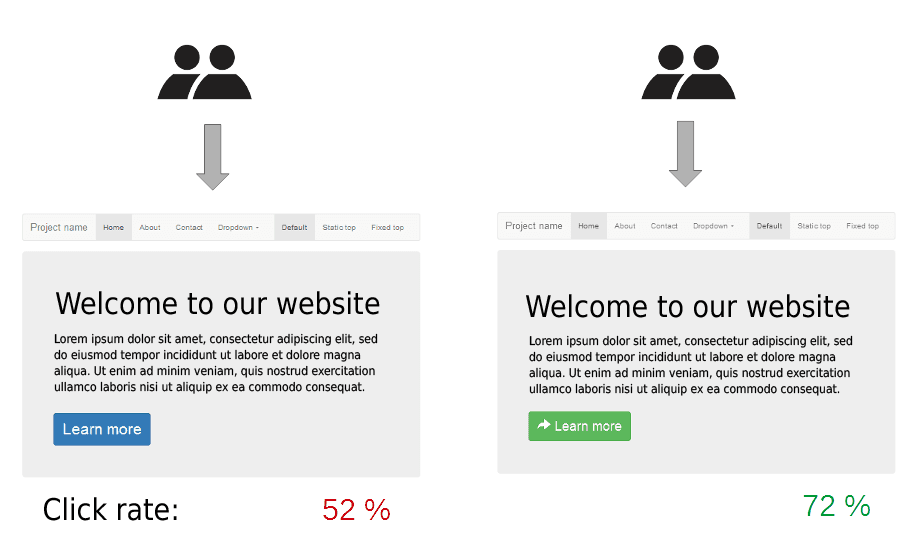
Design an A/B test for a Buy Now button
This tests experiment plumbing: deterministic bucketing, sticky storage, and logging. A strong answer covers user-ID hashing, cookie persistence, and impression-plus-conversion events.

Design a role-based personalized onboarding system
Tests separation of content and logic for scalable personalization. Strong answer: CMS-backed rule engine, multi-channel delivery, event-driven triggers, and per-segment metrics. Red flag: hardcoding role-specific UI components in the client.

How would you design resumable multi-step onboarding state management?
This tests cross-device onboarding resume. A strong answer uses debounced server sync for cross-device resume with localStorage fallback, covers anonymous users, and handles conflicts. Red flag: pure client or server storage ignoring offline gaps or privacy.

How would you validate that early Project creation drives retention?
Tests causal rigor on behavioral predictors. Good answer: define D30 retention and the 24-hour treatment; pull timestamps and covariates; cohort-compare with propensity matching; show lift with confidence intervals and propose an A/B nudge.

Architect an A/B test for paid-ad signup flows
Tests pre-auth bucketing and funnel attribution. Hash a stable anonymous ID for fast assignment; stream events via Kafka into hourly aggregates; run t-tests on signup rates. Red flag: assigning after signup starts or DB lookups per assignment.

How would you implement a last-touch attribution model for user signups?
Tests your ability to translate marketing concepts into warehouse SQL. A strong answer covers UTM/pageview events, sessionized tables, and a windowed join for the last touch within 30 days of signup.
Explain statistical power, MDE, and sample size impact
Power is the chance of detecting a true effect; MDE is the smallest lift worth measuring; raising power or shrinking MDE inflates sample size.
When increasing CTA clicks, what side-effects and guardrails should you consider?
This tests balancing growth with business safety. Name guardrails like retention, revenue, fraud, load time; set NI thresholds pre-launch; and include SRM checks. A red flag is treating guardrails as optional success metrics instead of hard stop limits.

Develop a testable hypothesis for a 40% email verification drop-off
This tests structured hypothesis formation under uncertainty. Strong answers: segment the 40% drop by device and latency; build a Customer Theory from data; isolate one lever; draft a four-part MECLABS hypothesis. Red flag: skipping diagnosis to guess fixes.
Design the data model and backend for a 7-day trial at scale
Tests state machine design for time-bound entitlements at scale. A strong answer covers: an idempotent enrollment API, a trial ledger with timezone-aware expiration, and an event-driven expiration pipeline.
We are hiring for this. Every open role lists the topics its interview covers, so you can prepare for the real thing rather than guessing.
See open roles