Intermediate everything in Product Management, page 8

Describe leading vs lagging indicators with technical performance examples.
Tests your ability to distinguish predictors from outcomes. A strong answer defines causality, offers a leading metric like cache hit rate, and a lagging metric like P99 latency. Red flag: offering only business metrics or confusing activity with outcomes.

Propose a scalable entitlement architecture for complex rules
Tests separation of hot-path reads from async policy work. Great answers: edge-cache plan tokens; stream quota usage async; isolate rules in a microservice. Red flag: doing a DB lookup or sync quota check per request.

How would you detect and mitigate free trial abuse?
Device fingerprinting, rate limits, progressive verification, and behavioral scoring; weigh precision vs false positives and effort.

Design a pricing-page A/B test for $10 vs $15 plans
This tests sticky bucketing and revenue attribution. Hash user IDs to lock variants, persist assignments server-side, and join experiment logs to subscriptions via shared IDs. Red flag: client-side randomization that flickers or breaks billing context.

How would you pivot system architecture from enterprise to startups?
Mapping a business pivot to tech tradeoffs across systems, features, and ops. Cut bloat for speed; shift to self-serve multi-tenant SaaS; automate ops and swap high-touch support for self-serve signup. Calling it simple scale-down not value-chain redesign.
What architecture makes secure real-time collaboration a defensible moat?
Tests turning marketing claims into technical differentiation. Covers defense in depth, zero-trust networking, client E2EE with user keys, verified components, and compliance automation. Red flag: generic tool lists without explaining replication difficulty.
What metrics and instrumentation prove your CI/CD feature saves DevOps time?
Propose pipeline duration and queue time as leading metrics and rollback frequency as lagging.

Frame technical trade-offs: 50 chart types versus 5 perfected cores
Tests anchoring technical trade-offs to the value proposition over feature count. Great answers quantify maintenance and DX costs of 50 types, argue depth-first serves "easiest" better, and propose staged validation.
How do you translate a non-technical product vision into SLIs and SLOs?
This tests converting qualitative goals into measurable reliability metrics. A good answer identifies user journeys, picks SLIs like latency or yield, sets thresholds from user pain not hardware limits. Red flag: infra metrics like CPU minus user impact.
How do you analyze and present performance trade-offs against a trust vision?
Tests if you frame technical risk through the trust vision. Strong answers quantify speed versus trust cost, present mitigated options with staged rollouts, and assign business risk owners.

How would you design a system to monitor competitors' technical changes?
Monitor public bundles and DNS; diff over time; alert on strategic pivots like new checkout APIs.
How would you scope a one-quarter v1 against a three-quarter solution?
Tests bounded technical debt via stable interfaces. A strong answer defines a thin core, pushes complexity into swappable modules, documents debt ledger, and negotiates scope cuts. Red flag: promising to refactor later without concrete boundaries or ownership.
How would you out-engineer a competitor's new data-intensive feature?
This tests strategic design under competition. Strong answer maps competitor's bottleneck, applies distributed sharding or streaming, picks asymmetric edge caching, and locks in latency SLAs. Red flag: no bottleneck analysis or ignoring quantified moats.
How would you leverage microservices to out-maneuver a monolithic competitor?
Tests turning architecture into product velocity. Exploit competitor's release cycle with independent service teams shipping features in days not months via domain boundaries. Red flag: seeing microservices as purely technical or suggesting big-bang rewrite.

How do you assess trade-offs between a simpler implementation and validated design?
Tests whether you separate user outcomes from implementation fidelity. Great answers quantify deviation against the core job, model cost and speed savings, and propose a scoped experiment with rollback criteria.

Describe a technical MVP approach to validate user engagement quantitatively
Pick a KPI and cheapest viable prototype, like a fake door; instrument events with a control group; set kill criteria upfront.
How would you instrument front-end and back-end to quantify reported slowness?
This tests translating vague complaints into end-to-end telemetry. A strong answer covers front-end Web Vitals, back-end traces, and segments by user or page to isolate pain points. A red flag is focusing only on server CPU or logs without real user timings.

How would you use telemetry and logs to refine SAM calculation?
Tests bridging telemetry to SAM. A strong answer maps API usage and feature flags to fit, uses performance logs to expose delivery limits, and rebuilds SAM from qualified accounts. Red flag: calling all logs demand without checking constraints.

How do you analyze a major technology trend for product impact?
This tests strategic discernment. A strong answer frames a time-boxed analysis across feasibility, user-value, cost, and risk, separating hype from capability. Red flag: jumping to build or dismiss without structured criteria or user evidence.
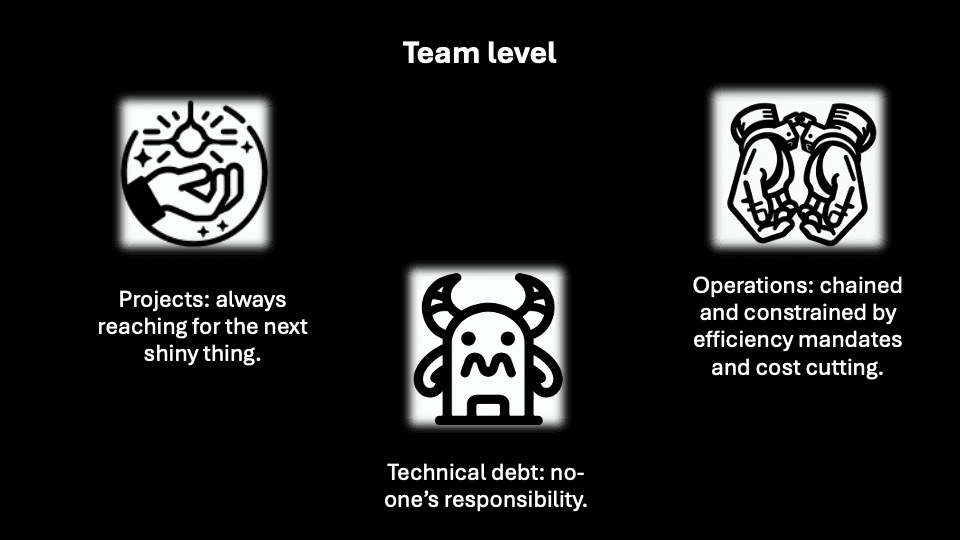
How would you frame a major refactoring proposal using product strategy?
Reframing tech debt as delivery risk, not engineering chore. Tie refactoring to velocity loss and firefighting; shift accountability from dev-vs-ops fights to product ownership.
We are hiring for this. Every open role lists the topics its interview covers, so you can prepare for the real thing rather than guessing.
See open roles