All bites
The whole library, newest first. Filter by what you are here for, or pick a topic if you already know.
4247 bites
Page 128

Data Dashboards: The Single-Page Business Story
A data dashboard is the executive summary for your metrics, telling a story on a single page with key visualizations. It consolidates data from multiple reports, providing a high-level view to monitor business performance.

Color Theory: Guiding the Eye in Data Visualization
Color in a chart is a cognitive shortcut, telling the viewer's brain what to notice and how to feel. Use it to highlight trends (green for growth) or group categories. The footgun is using too many colors, which creates noise and obscures insights.
GSM: Connect Your Goals to Real Metrics
The GSM framework turns fuzzy goals into concrete numbers by linking what you want (Goal), to observable behaviors (Signal), to a specific measurement (Metric). It's used to define KPIs for new features. The footgun is choosing easy-to-measure vanity metrics.
Pre-attentive Attributes: How Your Brain Sees Data First
Pre-attentive attributes are visual properties your brain processes instantly, before conscious thought. They're used in data visualization to make key information 'pop,' like using color to highlight an outlier.
Bullet Graphs: Packing Context into a Single Bar
A bullet graph packs rich context into one bar, showing a metric against its target and qualitative ranges. Use it on dashboards for single KPIs like sales-to-quota or latency vs. SLA. The footgun is clutter, which defeats its at-a-glance purpose.
RFM Analysis: Find Your Best Customers
RFM analysis segments customers by scoring their Recency, Frequency, and Monetary value. This helps identify your best customers (high RFM), those at risk (low R/F), and new high-spenders.
Evidence-Based Management: Metrics Over Gut Feel
EBM replaces 'I think' with 'I know because the data shows...' It's about making decisions using evidence, not just intuition. Use it to prioritize features with user data or optimize processes by measuring cycle time. The footgun is metric fixation.
Go's Design Philosophy: Engineering Over Novelty
Go's design philosophy is engineering over novelty, built to solve Google's problems with slow builds and complexity in massive codebases. It excels at large, networked systems where maintainability and fast compilation are critical.
Rust's Philosophy: Documentation and Community First
Rust's philosophy is deeply tied to its learning resources and community, ensuring developers are well-supported. This is evident in its official book, which is bundled with the language installation itself.
Goroutines
A goroutine is a lightweight function managed by Go's own runtime scheduler rather than the operating system, letting a single program run hundreds of thousands of concurrent tasks cheaply instead of the handful an OS thread model allows.
Go Interfaces: Describe Behavior, Not Data
Go interfaces define behavior, not data. A type satisfies an interface implicitly by implementing its methods, without an implements keyword. This enables writing flexible functions, like io.Writer handling files or HTTP responses.
Rust Ownership: Memory Safety Without a Garbage Collector
Rust's ownership model ensures memory safety without a garbage collector. Think of data as having one owner; when the owner goes out of scope, the data is dropped.
Rust's Borrow Checker: Memory Safety at Compile Time
Rust's borrow checker is a compiler-time accountant that prevents memory bugs by enforcing ownership rules. It ensures you never access invalid data or have conflicting writes. The main footgun is assuming references are mutable by default; they aren't.
Rust Traits: Defining Shared Behavior
Rust traits are like contracts that guarantee a type has certain methods, similar to interfaces. This lets you write functions that operate on any type with that behavior, like a summarize method for both articles and posts.
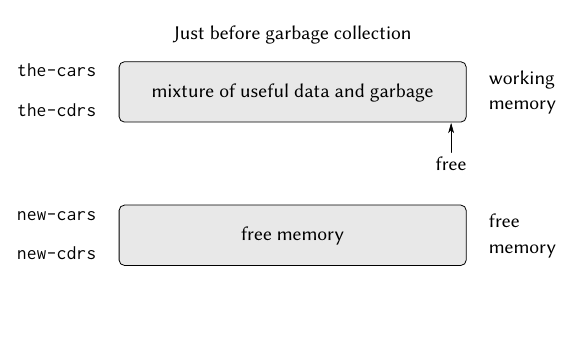
Go's Garbage Collector: The Concurrent Cleaner
Go's garbage collector is a concurrent cleaning crew, freeing memory while your program runs. It automatically reclaims unused memory, preventing leaks without manual free() calls. The footgun is assuming it's free; excessive allocations create GC pressure.
Rust's Two Error Types: Recoverable vs. Unrecoverable
Rust splits errors into two camps: recoverable (Result) and unrecoverable (panic!). This compile-time distinction forces you to handle expected failures, like a missing file, while crashing on programmer bugs, like an out-of-bounds access.
Zero-Cost Abstractions: Pay at Compile Time, Not Runtime
Zero-cost abstractions let you write high-level code that compiles to the same machine code as low-level optimizations. This is key in Rust for safe APIs without runtime overhead.
Go vs. Rust: Variable Mutability by Default
Rust variables are immutable by default; Go's are mutable. Rust forces you to opt-in to changeability with mut for compile-time safety. Go prioritizes convenience, trusting the developer.
Go Slices: A Window into an Array
Think of a Go slice not as a list, but as a lightweight window into an underlying array. It's used everywhere for managing sequences of data. The footgun: since slices can share memory, modifying one can unexpectedly alter another.
Go's `defer`: Guaranteed Cleanup
Go's defer statement guarantees cleanup by running a function call just before the parent function returns. It's perfect for closing files or unlocking mutexes right where you acquire them. The footgun: multiple defers run in last-in, first-out order.