All bites
The whole library, newest first. Filter by what you are here for, or pick a topic if you already know.
4247 bites
Page 88
Automate Storage Costs with Lifecycle Policies
Object storage lifecycle policies are automated rules that move or delete data as it ages to save money. They're ideal for logs or backups, transitioning them to cheaper "cold" storage over time.
Cloud Monitoring: Metrics, Time Series, and Resources
Cloud monitoring metrics are numerical measurements of a resource over time. They are used to build dashboards, trigger alerts when a threshold is crossed, and analyze performance for services like VMs or databases.
Cloud Alerting: Your System's Automated Smoke Detector
Cloud alerting is your system's smoke detector, watching key metrics and screaming when something's wrong before it becomes a fire. It's used to flag high CPU, failing health checks, or security anomalies.

Data Swamp: When a Data Lake Becomes Unusable
A data swamp is a data lake turned digital landfill, so disorganized that finding useful information is nearly impossible. This happens when data is dumped without metadata or quality checks, making it a costly, insecure liability instead of a valuable asset.
ML Model Registry: A Version Control System for Models
A model registry is like Git for machine learning models: a central hub to version, store, and manage them. It's crucial for MLOps, letting teams track which version is in production, compare performance, and roll back. The footgun is using it as just storage.

Cloud Operating Model: Your Org's Playbook for the Cloud
A Cloud Operating Model is your org's playbook for balancing new cloud capabilities with existing systems. It's used to manage the transition to the cloud with minimal disruption. The footgun is assuming your old processes will work unmodified.
Cloud Disaster Recovery: Planning for Failure
Cloud DR isn't about backups; it's a business continuity plan defining acceptable downtime (RTO) and data loss (RPO). It's for when a whole region fails or a bad deploy corrupts data. The footgun is having a plan but never testing it, creating false security.
Kappa Architecture Unifies Batch and Stream
Kappa treats batch as a special case of streaming: store every event in an immutable log, compute views in real time, and replay the log when logic changes. It removes Lambda's dual codebase but forces you to pay for infinite retention and replay costs.

Digital Images as Grids of Pixels
Think of a digital image as a mosaic of tiny colored tiles called pixels. This 'raster' method stores the exact color of each point, making it perfect for photos. The footgun: scaling up reveals the grid, causing blurriness or pixelation.

Pinhole Camera Model: Projecting 3D to 2D
The pinhole camera model is a simple formula for how a 3D world flattens into a 2D image. It's the basis for 3D reconstruction and augmented reality, relating an object's real-world position to its pixels.
RGB Color Model: Mixing Light, Not Paint
Think of RGB as mixing colored spotlights. Red, green, and blue light are added together to create the colors on your screen. The main footgun is confusing this with print's subtractive model, where mixing colors makes black, not white.

Image Histograms: Visualizing an Image's Tonal DNA
An image histogram is a bar chart of an image's brightness, showing pixel counts from pure black to pure white. It's used in photo editing to instantly judge exposure, revealing clipped shadows or blown highlights.
Camera Resectioning: Finding a Camera's Pose in 3D Space
Camera resectioning is like a detective's trick: use a photo of known objects to find the exact 3D position and orientation of the camera. It's key for AR and robotics. The footgun is assuming this finds all camera flaws; it only finds pose, not lens.
Lens Distortion: Why Straight Lines Curve in Photos
Lens distortion makes straight lines appear curved in an image, a result of imperfect lens geometry. It's critical to correct in computer vision for tasks like 3D reconstruction, but is often ignored in regular photography.

HSL and HSV: Intuitive Ways to Represent RGB Color
HSL and HSV are not new colors, but new ways to organize RGB. Think of them as cylindrical coordinates for color, making it easier for humans to select shades. You see them in every color picker.
Color Depth: Bits Per Pixel vs. Bits Per Channel
Color depth is the number of bits storing a pixel's color, like a digital paint box's size. It's key for image formats and displays, affecting file size and fidelity. The footgun is confusing total bits per pixel (bpp) with bits per channel (bpc).
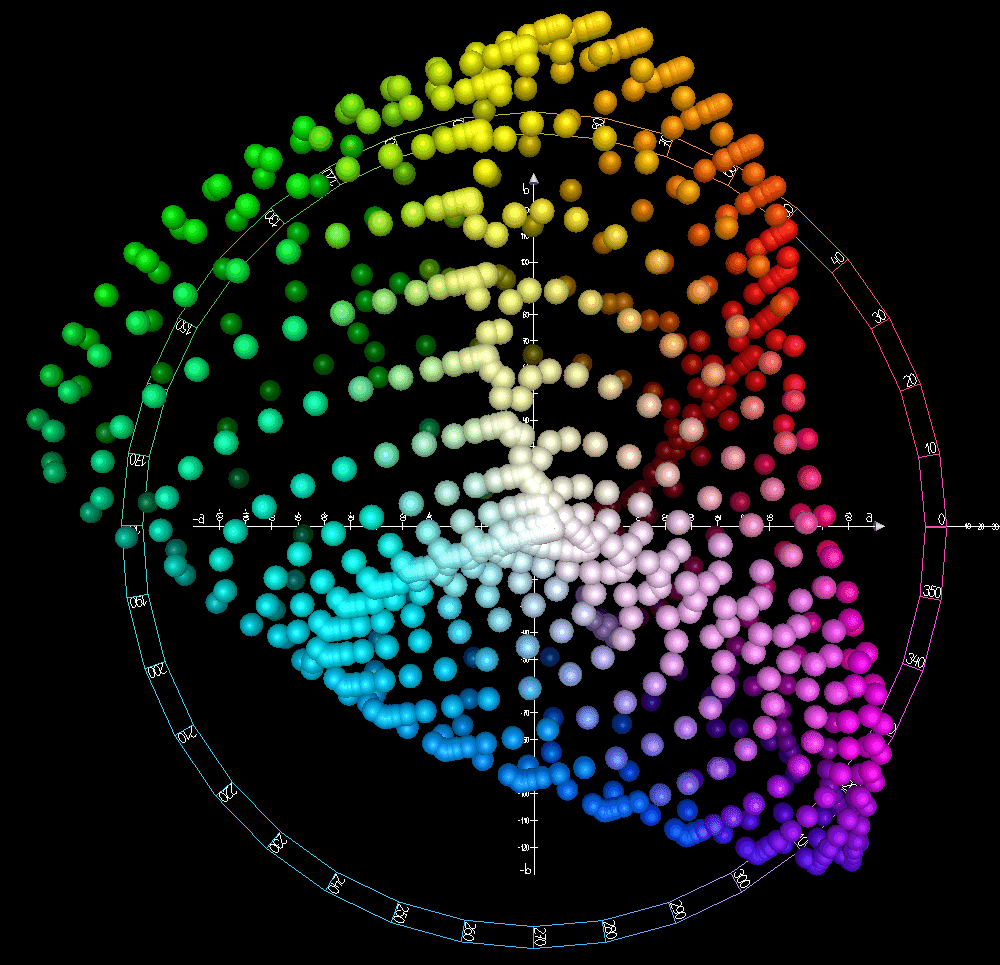
CIELAB Color Space: Measuring Color Beyond RGB
CIELAB models color not by how a screen displays it (like RGB), but by how a human perceives it: lightness, red/green, and yellow/blue. It's used in industry to measure and match colors precisely. The footgun is assuming it's perfectly 'perceptually uniform'.

Radiometry: Measuring Light as Physics, Not Perception
Radiometry measures light's physical power, not how humans perceive it. It's for objective energy measurement in computer vision or physics simulations, using watts, not lumens. The footgun is confusing it with photometry, which is weighted for human vision.

BRDF: Modeling How Surfaces Reflect Light
A BRDF is a function that describes a surface's appearance by defining how it reflects light from any incoming direction to any viewing direction. It's used in rendering engines to create materials like brushed metal or velvet.

Bayer Filter: Faking Full Color with a Filter Grid
A Bayer filter is a hack for capturing color with one sensor: a checkerboard of red, green, and blue filters is placed over the sensor grid. This is how most digital cameras work. The footgun is that the raw output must be 'demosaiced' to create.