All bites
The whole library, newest first. Filter by what you are here for, or pick a topic if you already know.
4330 bites
Page 102
What is static analysis in automated builds, with examples?
This tests if you treat static analysis as a pre-runtime quality gate. A strong answer says it shifts feedback left via non-execution scans, citing cyclomatic complexity or unhandled promise rejections.
What is a build artifact? Give Java, JS, and C++ examples.
Define artifacts as compiled outputs; list JAR/WAR for Java, webpack bundle for JS, and binary/.so for C++; note immutability.
Design a selective build strategy for a large monorepo
Tests monorepo dependency graph reasoning. Good answers model a DAG, compute reverse deps of the changed library, rebuild only affected targets via Bazel or Nx, and cache remotely. Red flag: directory triggers, full rebuilds, or testing the library alone.
What is an artifact repository and why not just a shared filesystem?
Tests your grasp of immutability, metadata, and access control for build artifacts. A strong answer covers versioning, checksums, RBAC, and API retrieval that NFS lacks. Red flag: saying a shared filesystem is simpler and therefore enough for production.
How would you create and distribute reusable IaC components at scale?
This tests platform engineering governance at scale. A strong answer proposes a versioned module registry, policy-as-code guardrails, automated validation pipelines, and self-service documentation.
Design short-lived dynamic database credentials and their security benefits
This tests automated least-privilege credential lifecycle design. A strong answer covers a secrets broker with database plugins, short TTL leases tied to workload identity, and automatic revocation. Red flag: manual rotation or long-lived CI variables.
What strategies reduce DAST scan time while maintaining security coverage?
It tests balancing security depth with CI velocity through DAST tuning. A strong answer covers incremental scans, parallel workers, scoped targets, and shift-left complements.
Design a workflow for managing security scanner vulnerabilities
This tests scaling security without developer noise fatigue. A strong answer covers centralized ingestion, severity SLAs with exploitability, auto-triage rules, and CI gates on critical findings only. A red flag is forcing manual review of all scanner output.
Design a golden path CI/CD pipeline for a Go API
Propose build, test, SAST, containerize, deploy stages with hooks or config overlays for flexibility.
Describe the key stages of a typical ML lifecycle
It tests end-to-end systems thinking beyond notebook prototyping. Strong answers list: problem framing, data processing, model development, deployment, and monitoring with retraining. A red flag is skipping data validation or post-deployment observability.
What are the primary differences between traditional DevOps and MLOps?
Tests if you know MLOps extends CI/CD to data and probabilistic assets. Contrast code artifacts with models and datasets. Distinguish commit triggers from drift or retraining triggers. Red flag: treating models as static binaries and ignoring data lineage.
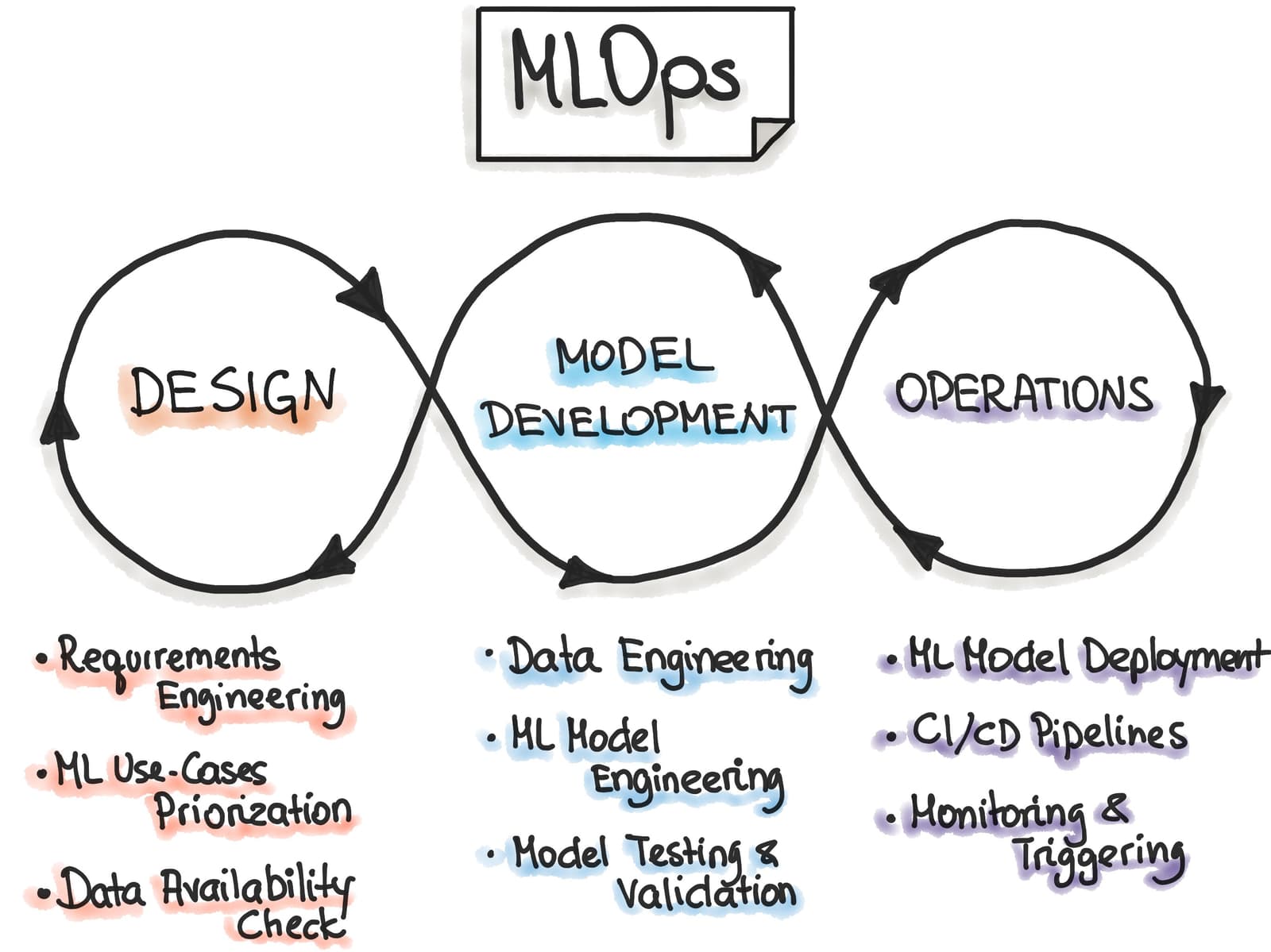
Why version code, data, and models in MLOps?
Tests immutable lineage across code, data, and models. Strong answers cover content-addressed data, git commits, a model registry linking both, and CI triggers on any change. Red flag: saying git alone handles data and models.
Explain ML pipelines and typical CI/CD/CT components
Tests if you separate code CI/CD from model CT and grasp ML automation. Cover source control, build, tests, deploy for code; data validation, training, evaluation, promotion for CT. Red flag: treating ML like software CI/CD and ignoring data or registry gates.
What production metrics and auto-thresholds trigger model retraining?
This tests production monitoring maturity. A strong answer covers technical drift metrics, business KPIs tied to model decisions, and automated thresholds that page or trigger CI/CD retraining.

Design an MLOps platform for a mid-sized company: components and build-vs-buy trade-offs
Tests pragmatic scoping and build-vs-buy reasoning. Strong answers rank data estate, feature store, registry, CI/CD/CT, and monitoring above exotic serving, buying commodity and building differentiators. Red flag: custom orchestrators or missing governance.
Design a robust automated testing strategy for ML models before production
Statistical offline thresholds, shadow-canary launches, input drift detection, and rollbacks tied to KPIs.

How do you guarantee identical feature engineering for training and real-time inference?
Tests unifying feature engineering across batch and online paths to eliminate skew. Answer: shared transformation libraries, versioned feature stores, and logged feature validation. Red flag: separate training and serving code without a single source of truth.
Design ingestion for clickstream and batch product metadata
Use a data lake for raw data, a feature store for joins, columnar formats for batch, and row formats for events.

ETL vs ELT: when to prefer each for ML?
Tests architecture tradeoffs. Contrast ETL's pre-load transformation with ELT's in-warehouse transformation, map structured legacy to ETL and raw lakes to ELT, and cite ML iteration needs. Red flag: calling one better ignoring compute placement or volume.
What data validation strategy prevents new categories from breaking your encoder?
Lock categorical domains in a schema, reject unseen categories before encoding, and use an OOV bucket as fallback.