All bites
The whole library, newest first. Filter by what you are here for, or pick a topic if you already know.
4330 bites
Page 106

How do you monitor thousands of per-customer models as a fleet?
Tests fleet-level statistical aggregation versus per-instance alerting. Strong answers propose tiered telemetry, cohort baselining for drift, and hierarchical alerting to prevent fatigue.
Stages of an end-to-end ML pipeline
Ingest, validate, preprocess and feature engineer, train, evaluate against a baseline, then register and package for deployment, with gates between stages.
What triggers automatic full retraining in an ML pipeline?
A strong answer lists four triggers: fresh data, code changes, model drift, and scheduled cadence.
How would you implement automated data validation before training?
Enforce schema contracts, halt training on failure, quarantine bad batches, and alert owners.
How do you programmatically promote a retrained model to production?
Compare on held-out data using significant metric uplift, schema, latency, and drift checks before shadow release.

Design concept drift detection with automated retraining safeguards
Baseline monitors raise CloudWatch alarms; EventBridge triggers retraining with cooldowns; model registry gates promotion.
How would you architect dynamic training resource provisioning?
Routes jobs to right-sized instances, provisions managed jobs using spot, and auto-tears down on completion.
Automated rollback for a failed model deploy
Detect failure via health and metric checks, automatically route traffic back to the last known-good version (blue-green or canary), keep the registry entry but unpromote, and alert.
What are the essential components of an end-to-end ML platform?
Tests mapping the ML lifecycle to infrastructure. A strong answer walks through six stages: data ingestion, feature store, training pipeline, model registry, deployment/serving, and monitoring with feedback loops.
What is a feature store and how does it prevent training-serving skew?
This tests training-serving consistency via centralized feature management. Covers offline batch storage, online serving, shared transformations, and alternatives like ad-hoc ETL. A red flag is calling it just a database and ignoring point-in-time correctness.

What trade-offs decide managed ML platforms versus open-source Kubernetes?
Weigh total cost plus hidden engineering headcount, lock-in vs flexibility, and audit feature gaps.
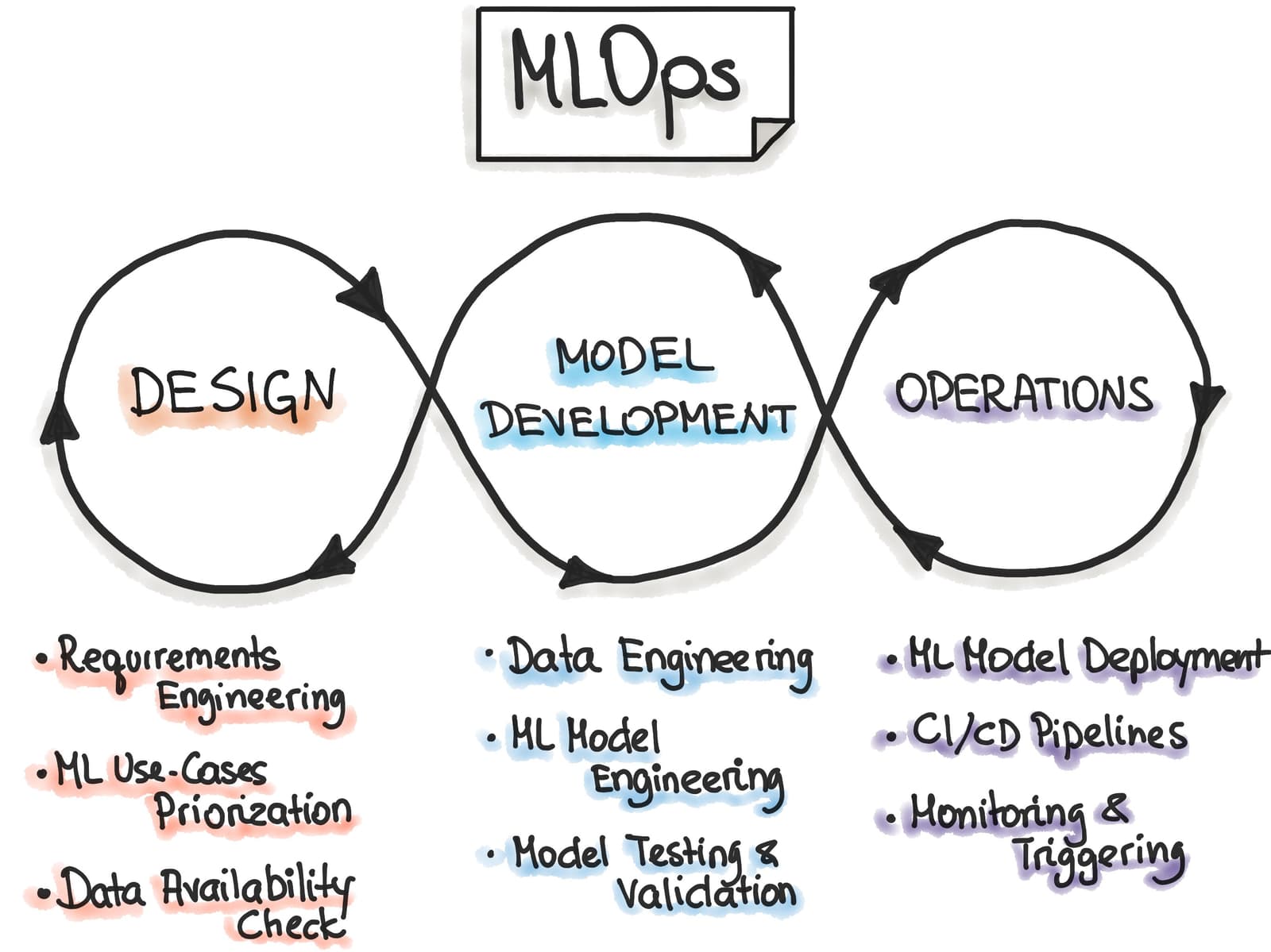
How would you design a reproducible ML training pipeline?
Tests if you can version ML's three moving parts: code, data, and environment. Good answers cover Git for code, DVC or lakehouse versioning for data, and Docker plus locked dependencies for environments.
Serving for online and batch predictions
A low-latency online path (synchronous, autoscaled, real-time features) and a high-throughput batch path (parallel, cost-optimized, large jobs) sharing one model artifact and feature definitions.

Design a multi-tenant ML platform with isolation, security, and cost attribution
Tests mapping tenancy to compute, network, and identity primitives. Strong answers compare hard vs soft isolation, use namespaces or node pools with network policies and IAM, and enforce chargeback via resource quotas and labels.

Propose an architectural solution for contended GPU training resources
Tests multi-tenant GPU scheduling design at scale. Great answers tier jobs by checkpointability, apply quota-based preemption, mix spot and on-demand instances, and use MIG or time-slicing to bin-pack. Red flag: buying GPUs without scheduling logic.
How do you give read-only access to a shared cloud storage bucket?
Bind an IAM role with read permissions to the team at the bucket level, avoid object-level ACLs, and mount read-only on training VMs.
Why was this customer denied: global or local explanation?
This tests matching questions to explanation scope. Global methods show overall behavior; local methods explain one prediction. Specific denials need local methods like SHAP. A red flag is using global summaries like permutation importance or PDPs for a case.
Describe securing an automated ML pipeline and CI/CD integration points
Tests ML supply-chain depth versus bolt-on appsec. Strong answers stage checks across
How would you programmatically monitor a deployed model for demographic bias?
Tests operationalizing fairness beyond static audits. Track group metrics like parity and equalized odds; slice by protected attributes; alert on drift; route violations to review. Red flag: treating fairness as a one-time check versus continuous monitoring.

What is the wrong and right way to manage ML database secrets?
This tests secret management hygiene for ML pipelines. A strong answer rejects hardcoded secrets and env vars, then proposes AWS Secrets Manager with IAM retrieval, TLS, caching, and rotation. A red flag is suggesting .env files, ConfigMaps, or CLI arguments.