All bites
The whole library, newest first. Filter by what you are here for, or pick a topic if you already know.
4330 bites
Page 178
Diagnosing a Widening Code Review Band in a CFD
This tests data interpretation and problem-solving. A great answer defines the bottleneck, hypothesizes causes (capacity, PR size), proposes diagnostics, then offers solutions. A red flag is blaming individuals or jumping to a single, unverified solution.
CFD 'Code Review' band is widening. What does it mean?
This tests your ability to interpret a CFD and propose actions. A widening 'Code Review' band means work enters faster than it leaves. Diagnose the bottleneck (e.g., review quality, reviewer availability), then propose solutions.
How would you apply Little's Law to optimize Kanban WIP limits?
Tests whether you can operationalize queueing theory in Kanban. A strong answer cites L equals lambda times W, fixes throughput, then solves for a WIP limit that yields a target cycle time.
How would you apply Little's Law to a Kanban system?
This tests your ability to use metrics for process improvement. A great answer defines Little's Law for Kanban (Cycle Time = WIP / Throughput), explains how reducing WIP shortens cycle times, and gives a numerical example.
Apply Little's Law to a Kanban system to optimize flow
Tests applying queuing theory to software delivery. Define Little's Law as WIP = Throughput × Cycle Time. Explain how reducing WIP limits directly shortens cycle time for a stable throughput.
What is a Scrum of Scrums purpose and what technical info is shared?
Multi-team sync for blockers, dependencies, API changes, integration risks; not a status meeting.
What is a Scrum of Scrums, and what do you share there?
Tests your understanding of scaling agile and representing your team's technical risks. A good answer defines it as a coordination meeting, not a status report, and focuses on sharing/receiving info on cross-team dependencies and blockers.
What is a Scrum of Scrums and what's shared there?
This tests your understanding of scaling Agile. A good answer defines it as a coordination meeting for multiple teams, focusing on sharing inter-team blockers, dependencies, and integration points, not just status.
Purpose of a shared Definition of Done for multi-team products
This tests empirical transparency across teams building one Increment. A shared DoD forces cross-team integration and testing before Sprint end. Letting teams keep separate DoDs hides integration debt and breaks transparency.
What is the purpose of a shared 'Definition of Done'?
Tests your ability to ensure quality and transparency across multiple teams. A shared 'Definition of Done' is a formal description of quality for the integrated Increment. It ensures all work is combinable and shippable.
Purpose of a Shared Definition of Done for Multiple Teams
This tests your ability to maintain quality and transparency across multiple teams. Explain that a shared Definition of Done ensures a consistent quality standard for a usable, integrated Increment, impacting testing by requiring integration and end-to-end…
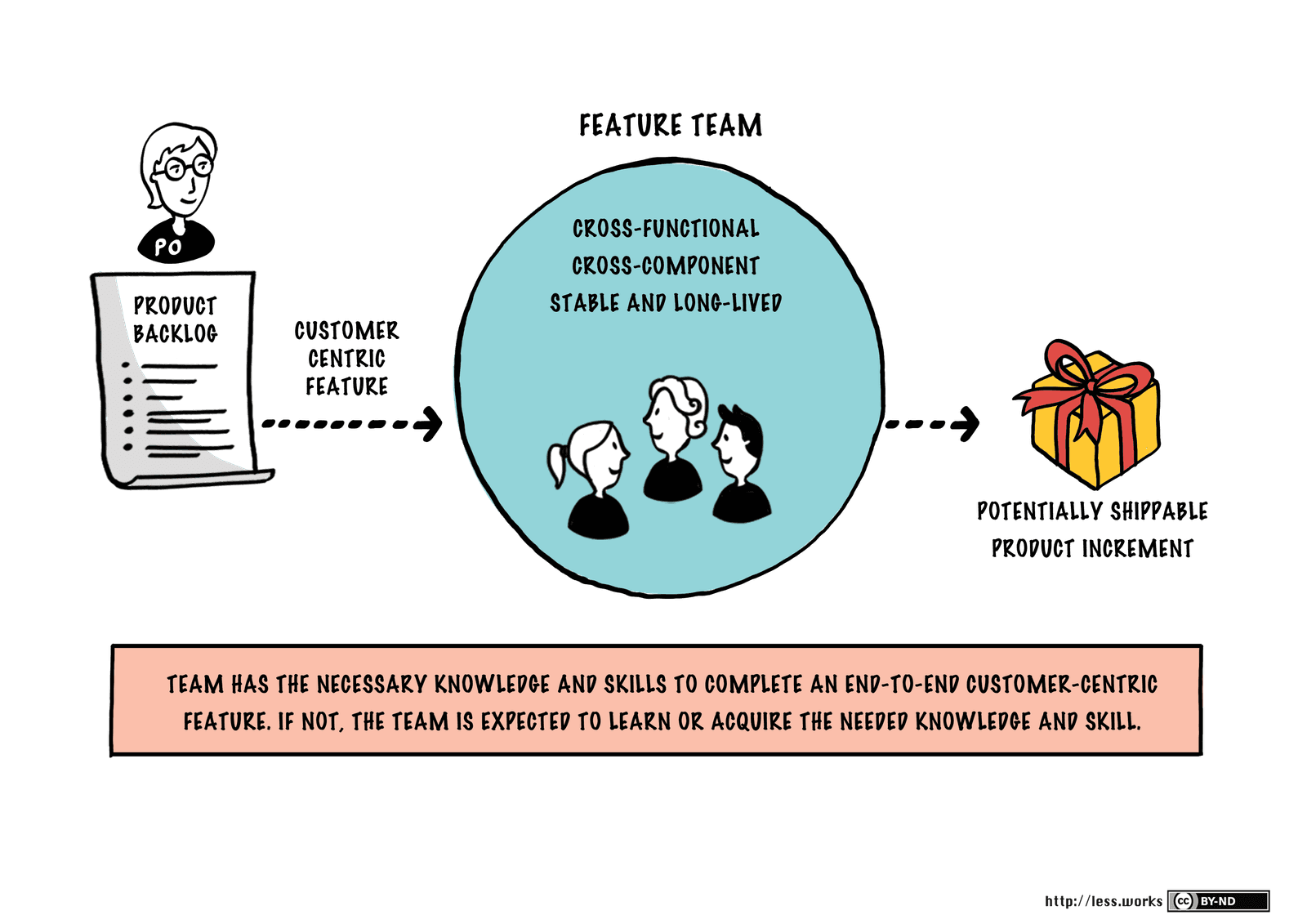
What codebase and CI/CD prerequisites enable LeSS feature teams?
Tests technical enablers for LeSS feature teams. Strong answers cover sub-10-minute CI, trunk-based development, comprehensive test automation, and decoupled architecture. Red flag: claiming coordination replaces shared ownership and continuous integration.
Technical Prerequisites for LeSS Feature Teams
Tests if you can link agile structure to technical architecture. A great answer covers codebase design for shared ownership, a fast CI pipeline for frequent integration, and a robust automated testing strategy.
Technical Prerequisites for LeSS Feature Teams
This tests your grasp of the engineering practices that enable agile scaling. A great answer covers continuous integration for shared ownership, robust test automation, and a loosely coupled architecture. A red flag is focusing only on Scrum ceremonies.

How would you estimate a cross-cutting initiative in PI Planning?
Tests decomposition of cross-cutting work into team enablers with visible dependencies. Good answer: teams estimate own slices in normalized points, map dependencies on the ART board, and reserve IP buffer.
Estimating Cross-Team Initiatives in PI Planning
This tests your ability to lead multi-team estimation. A good answer covers decomposing work, bottom-up team estimates, mapping dependencies, and synthesizing a risk-assessed plan. A red flag is a single top-down estimate that ignores team capacity.
Estimating large, cross-team initiatives in PI Planning
Tests your ability to facilitate collaborative estimation. Break the initiative into features for teams to estimate, then use an ART board to map dependencies. A red flag is providing a single, top-down number without team input.
Describe a SAFe rule that hinders agility and how to mitigate it
Cite one rigid workflow pattern, show how it delays feedback, then propose a lighter cross-team substitute.
How would you handle a SAFe rule that hinders agility?
Tests your ability to pragmatically adapt process instead of just complaining. A great answer identifies a specific SAFe rule, explains how it can backfire, and proposes a concrete alternative that still achieves the original goal.
How can a SAFe rule hinder agility, and how would you mitigate it?
Tests your ability to pragmatically adapt process. First, name a specific SAFe rule and a scenario where it fails. Then, propose a mitigation that still achieves the rule's original goal, like alignment. A red flag is just complaining about bureaucracy.