All bites
The whole library, newest first. Filter by what you are here for, or pick a topic if you already know.
4330 bites
Page 180
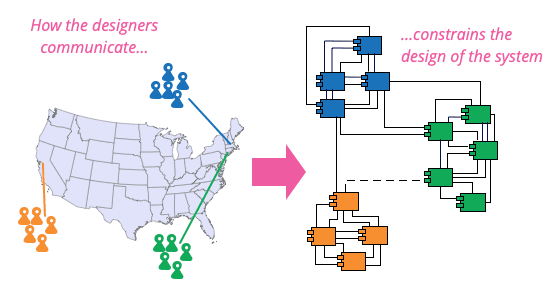
How to apply Conway's Law to design team structures?
Tests if you can use Conway's Law proactively (the 'Inverse Conway Maneuver'). Outline: define the target architecture, then align small, autonomous teams to its components. A red flag is seeing the law only as a constraint, not a tool for intentional design.
Trade-offs: product teams vs project teams and funding model impacts
This tests funding impact on architecture. Contrast temporary project teams funded by scope versus product teams funded by problems; tie rolling budgets to ownership and refactoring. Red flag: claiming agile ceremonies fix org design while ignoring funding.
Trade-offs: Product-Based vs. Project-Based Teams
This tests your grasp of how funding models impact team ownership and code quality. Contrast project (temporary, build-only) vs. product (durable, continuous) teams, linking the latter to better knowledge retention and architecture.
Trade-offs: Product-Oriented vs. Project-Oriented Teams
This tests your understanding of how team structure and funding models impact long-term software quality. A great answer contrasts temporary, scope-funded project teams with durable, problem-funded product teams, highlighting the latter's benefits for…
Two senior developers clash on implementation, derailing sprint planning. Your role?
Park or timebox the debate, reframe positions into shared interests with structured dialogue, and drive to a decision or spike.

How do you resolve a heated technical debate between two developers?
Tests your ability to facilitate conflict, moving a team from argument to a structured decision. A great answer involves de-escalating, using a technique like conflict mapping to understand the core issue, and guiding the team to a resolution.
How do you facilitate a heated technical disagreement between two seniors?
Tests your ability to de-escalate conflict and guide a team to a data-driven decision. Acknowledge the issue, separate the people from the problem, use a structured process, and focus on shared goals. A red flag is immediately picking a side or escalating.
Explain backlog refinement: purpose, participants, and outcomes
Tests if you treat refinement as team-wide prep, not a solo PO task. Strong answers cite the full team and stakeholders, with outcomes being ready stories and estimates. Red flag: saying only the PO and Scrum Master attend or that it replaces sprint planning.
Explain backlog refinement: purpose, participants, and outcomes
Tests your grasp of continuous planning for predictability. A good answer defines the purpose (clarify, estimate, prioritize), participants (whole team + PO), and outcomes (a 'Ready' backlog). A red flag is describing it as a one-off pre-sprint meeting.
Explain a backlog refinement meeting's purpose, participants, and outcomes
Tests understanding of a core Scrum ceremony. A good answer defines the goal (clarifying future work), names participants (Dev Team, PO), and lists outcomes (estimated stories).
Why do teams use story points instead of hours or days?
Define against a baseline; explain they absorb uncertainty so velocity stabilizes for planning.
Explain story points vs. time-based estimation.
This tests your grasp of Agile philosophy. A good answer defines points as relative effort (complexity, volume, risk), contrasts this with the pitfalls of time, and links it to predictable team velocity. A red flag is mapping points directly to hours.
Explain story points and why they're used over time-based estimates
Tests your grasp of relative vs. absolute estimation. Define story points as a relative measure of effort, complexity, and uncertainty. Explain they foster team consensus and provide a more stable velocity than time-based estimates.
What is the primary difference between Sprint Review and Sprint Retrospective?
Tests separation of product feedback from process improvement. Review: stakeholders inspect the Increment and adapt the backlog. Retrospective: Scrum Team only inspects its process and plans improvements. Red flag: calling either a status report or demo.
Sprint Review vs. Retrospective: Purpose and Participants
This tests your understanding of Scrum's dual feedback loops for product versus process. A great answer defines Review as inspecting the Increment with stakeholders, and Retrospective as inspecting the team's process without them.
Sprint Review vs. Sprint Retrospective: Purpose and Participants
Tests if you distinguish inspecting the product (Review) from the process (Retro). A good answer defines purpose (what vs. how), participants (stakeholders vs. team-only), and outcomes (backlog vs. process improvements).

How do you spike a story to de-risk it and define deliverables?
Whether you see spikes as time-boxed research, not feature work. Propose a fixed duration, define the specific question, deliver a decision record or prototype, and revise the story estimate. Never treat a spike as production code or skip the time box.
How would you use a spike to de-risk a story?
Tests your use of Agile spikes for de-risking, not for building features. A good answer defines the goal, sets a strict time-box, and clarifies the deliverable is knowledge (e.g., a POC), not production code. A red flag is merging spike code into main.
How do you use a spike to de-risk a story?
This tests your ability to use agile spikes for targeted de-risking, not just vague research. A strong answer defines the specific question the spike will answer, proposes a strict time-box, and lists concrete deliverables like a decision or a better estimate.
What is the primary purpose of a WIP limit in Kanban?
Tests whether you see Kanban as a flow system, not just a board. A great answer says WIP limits constrain multitasking to reduce cycle time and improve throughput by prioritizing finishing over starting. Red flag: saying limits are for tracking progress.