All bites
The whole library, newest first. Filter by what you are here for, or pick a topic if you already know.
8668 bites
Page 171
Name three Linux namespaces and explain what each one isolates.
Name three of PID, Network, Mount, UTS, IPC, User, Cgroup, Time; say what each hides; cite CLONE_NEW* or /proc/pid/ns.
How do Docker images and containers differ and relate?
This tests your grasp of the immutable template versus mutable runtime boundary. A good answer: an image is a read-only layered template with code and dependencies; a container is a runnable instance with a writable layer on top.
Docker Content Trust: Signed Image Verification
Docker Content Trust is a cryptographic tamper-evident seal for image tags. It lets you verify who published an image before pulling from any registry. The footgun is that without DOCKER_CONTENT_TRUST=1, unsigned tags pull silently with no warning.
Container Images Are Stacked Deltas
Images stack read-only layers like transparent sheets, one per Dockerfile step, topped by a thin writable layer. This enables cache reuse and fast pulls. The footgun: removing a file in a later layer hides but does not delete it; those bytes still ship.
OLM: Kubernetes' App Store for Operators
OLM is the app store for Kubernetes Operators: it installs, updates, and resolves dependencies declaratively. Use it when managing third-party or custom Operators across clusters.
ResourceQuota: Namespace Resource Budgets
ResourceQuota is a namespace budget: it rejects pods once total requests hit the cap. Use it to keep multi-tenant clusters fair. The footgun: it counts requested resources, not real usage, and pods missing requests may be rejected without LimitRange defaults.
ConfigMap decouples config from container images
A ConfigMap is a key-value store that injects configuration into pods without rebuilding the image. Use it for feature flags, database hostnames, or any non-secret settings. Editing one does not restart existing pods, so stale config is the common footgun.
EndpointSlice: Splitting the Monolithic Endpoints List
EndpointSlice shards a service's pod backends into smaller chunks instead of one massive list. This keeps kube-proxy and DNS fast when services scale to thousands of pods. Do not edit them by hand; the controller owns them and will overwrite your changes.
Pod QoS Classes: Guaranteed, Burstable, BestEffort
Kubernetes QoS classes are eviction priorities, not performance guarantees. Under node pressure, the kubelet kills BestEffort pods first, then Burstable, then Guaranteed. Omitting limits does not grant infinite headroom; it makes your pod die first.
OCI: The USB-C of Containers
OCI is the USB-C of containers: open standards that let any compliant runtime execute any image. It prevents vendor lock-in by decoupling image format from runtime. The footgun is treating "Docker image" as proprietary rather than an OCI-compliant bundle.

Design a type-safe polymorphic component that renders as different HTML elements
Tests TypeScript generics and prop forwarding in design systems. Answer: generic as constrained to keyof JSX.IntrinsicElements, merged with ComponentPropsWithoutRef<C>, omit clashes, forward ref with ElementRef.
What WAI-ARIA attributes and keyboard interactions make Tabs accessible?
This tests mastery of the W3C Tabs pattern. A strong answer covers role tablist tab tabpanel, aria-selected, aria-controls, and arrow-key roving focus with optional auto-activation. A red flag is treating tabs as buttons and relying only on the Tab key.

How would you structure a flexible Card component API?
Tests composition-over-configuration thinking in design systems. A strong answer uses compound components or slots so consumers reorder or omit title, image, and body freely without prop drilling. Red flag: rigid boolean props that freeze layout order.

Two strategies to prevent style leakage in reusable components and their trade-offs
This tests style encapsulation in design systems. A strong answer contrasts Shadow DOM, which fully isolates CSS via a shadow root, with scoped naming like BEM or CSS Modules. Red flag: proposing global resets or !important as a solution.
When should data in a reusable component be a prop or state?
This tests controlled versus uncontrolled patterns. Great answers ask who owns the data: props when parent must drive or observe it, state only for private details.
How do you handle a one-off token exception for a campaign?
Tests balancing speed and systemic consistency. Strong answers outline a governance fast-track with sunset clauses, document the exception, and isolate it via campaign overrides instead of mutating core tokens. Red flag: permanently hardcoding the one-off.

Describe a robust architecture for implementing theming using design tokens
Three tiers, CSS custom properties for live switching, and layered overrides.
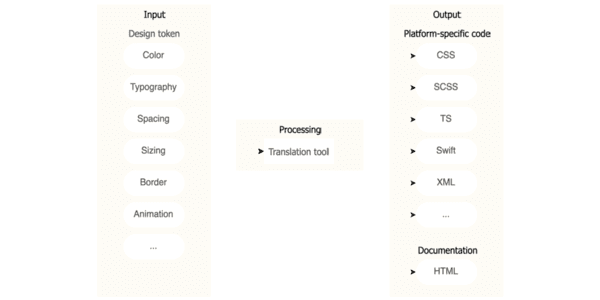
Design token pipeline serving Web, iOS, and Android
This tests cross-platform design system architecture and governance. A strong answer uses W3C JSON tokens in option, decision, component layers, with Style Dictionary generating Web, iOS, and Android outputs. Red flag: using Figma or CSS as source of truth.

Implement a typographic scale using design tokens and accessible properties
Token-driven typography and accessibility. Start with base size (14-16px) and ratio token, compute sizes, then bundle font-size with line-height, letter-spacing, weight, and family in composite tokens. Red flag: ignoring line-height, spacing, or composites.
What is a design token versus a CSS or Sass variable?
Whether you understand abstraction layers in design systems and cross-platform interoperability. Define tokens as vendor-neutral design decisions that generate platform-specific code; contrast with CSS variables (runtime, web-only) and Sass (compile-time…