All bites
The whole library, newest first. Filter by what you are here for, or pick a topic if you already know.
8668 bites
Page 195
How do you safely merge a 50-commit stale branch with conflicts?
Assess relevance, merge main locally, validate via draft PR and tests, merge off-peak with rollback ready.
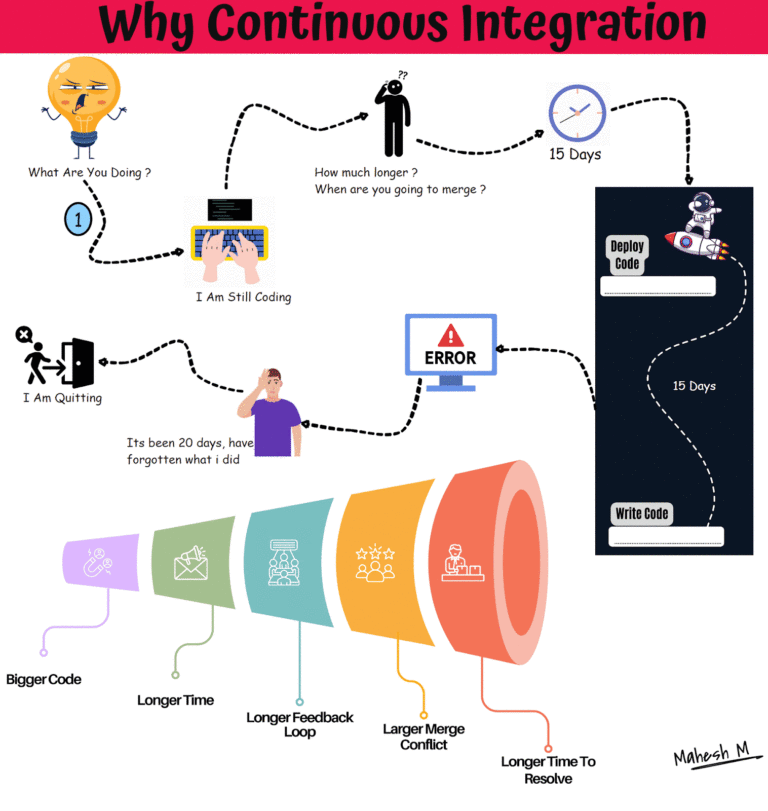
How do feature flags enable unfinished work in Trunk-Based Development?
Commit behind off flags; CI/CD deploys trunk continuously; flags gate exposure for gradual rollouts.
Describe Trunk-Based Development principles and CI/CD benefits
Tests if you view TBD as a CI/CD enabler versus GitFlow. Good answers name a single trunk, branches under 24 hours, pre-integrate builds, and feature flags, tying daily commits to releasable code and less merge hell. Red flag: endorsing long-lived branches.
Describe using a pre-push Git hook for checks and its CI limitations.
It tests client-side automation versus server-side policy. An executable .git/hooks/pre-push script runs tests and exits non-zero to block, noting hooks are not cloned, skipped via --no-verify, and local-only. A red flag is treating them as policy gate.
Difference between git merge and git rebase before a pull request
Rebase rewrites SHAs, duplicating CI builds; merge keeps identity and triggers one build.

How does your CI/CD strategy differ between monoliths and microservices?
Contrast monolith unified builds with microservice independent deploys, side-by-side versions, and service gates.
Pipeline is green but lead time grows. Three areas to investigate?
This tests distinguishing pipeline health from delivery flow efficiency. A strong answer targets pre-merge wait states, slow green pipeline stages, and post-merge deployment friction, using time-in-stage metrics.
What is a build artifact and why build once deploy many crucial?
Tests whether you see artifacts as immutable deployable units. A strong answer says one binary is promoted through all stages, config is externalized, and rebuilding per environment creates drift. Red flag: accepting per-environment rebuilds.
Describe the typical CI pipeline sequence from push to deploy
This tests stage ordering and failure handling. A strong answer lists build, test, and deploy stages; notes intra-stage parallelism and inter-stage sequencing; and mentions early termination on failure.
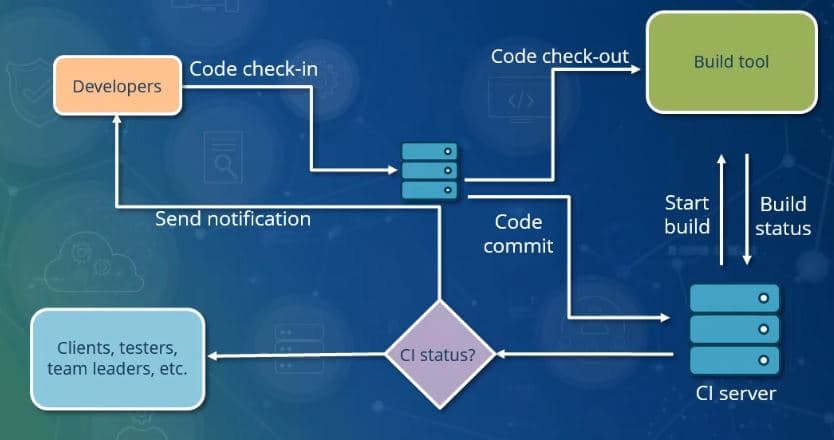
What is CI, and what is its single most important goal?
Frequent merges to a shared branch with automated build and test; top goal is a workable integrated codebase.
Platform Orchestrator: Infrastructure's Travel Agent
A platform orchestrator is infrastructure's travel agent: describe an app and it provisions compute, databases, and caches across clouds automatically. It shines once teams outgrow per-service Terraform. Adopt it too early and it becomes a bottleneck.
Backstage: The Developer Portal Framework
Backstage is a framework for building a developer portal, not a ready-made dashboard. It centralizes ownership, docs, and tooling when microservice sprawl hides context. The footgun is treating it as a product you deploy without upkeep; the catalog rots.
Security Champions: Embedded Team Defense
A security champions program embeds trained developers inside teams to catch risks early. It scales AppSec without hiring a specialist for every squad. The footgun is treating champions as free labor instead of investing in their training and time.
IAST: Inside-Out Runtime Security Scanning
IAST is an inside-out security scanner: an agent in your running app watches data flow to catch vulnerabilities with few false positives. It runs during functional tests, giving precise line-of-code findings. If your tests skip a route, IAST stays blind to it.
Container Image Security Scanning
A container image is a frozen filesystem; scanning unpacks layers to flag known CVEs before deployment. Run it in CI/CD after every build and continuously in production registries. Scanning only at build time misses new CVEs in running images.
Dynamic Secrets: Temporary On-Demand Credentials
Dynamic secrets are temporary credentials minted on demand, not static passwords living in config files. A CI job requests a 15-minute database lease instead of a long-lived env var.
Vault: Centralized Secrets with Dynamic Leasing
Vault is a secrets firewall: it centralizes credentials and issues short-lived leases instead of static keys. Use it when apps need DB passwords not hardcoded. The footgun is using Vault without audit logs, leaving secrets unmonitored.
Terraform Modules: Reusable Infrastructure Blueprints
A Terraform module is a reusable container for related resources, letting you stamp out infrastructure from one blueprint instead of copying HCL. Teams share VPC patterns or tagging standards with them.
GitLab CI/CD: Pipeline as Code
Your .gitlab-ci.yml file turns your repo into an assembly line. Pushes trigger build and test jobs across runners. One missing rules clause can spawn jobs on every branch and explode compute costs.
Dependency Resolution: The Build's Constraint Solver
Dependency resolution finds compatible package versions across transitive requirements. It runs whenever npm, Maven, or pip installs in CI. The footgun is trusting ranges without a lock file; tomorrow's resolve can silently install different code.