Apply differential privacy to user behavior queries and explain epsilon trade-offs
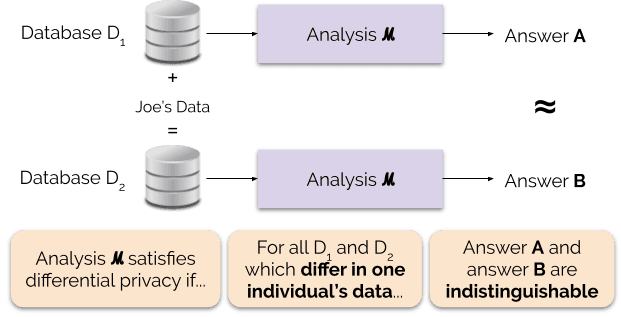
Mastery of formal privacy guarantees and noise-based query systems. Inject Laplace or Gaussian noise scaled to query sensitivity; track cumulative epsilon across queries; lower epsilon tightens privacy but increases variance and error bars.
What's really being asked
This question tests whether you understand differential privacy as a mathematical framework rather than a vague concept. The interviewer wants to see that you know how noise is calibrated, why sensitivity matters, and how the privacy budget epsilon creates a hard constraint that degrades gracefully into statistical uncertainty. Senior candidates should demonstrate they can operationalize DP in a real query system.
The full answer
First, sensitivity analysis. You must explain that the noise scale depends on how much one individual can change the query result. For a count query the sensitivity is one; for a sum it is the maximum possible value. Second, noise injection. You add noise drawn from a Laplace distribution with scale sensitivity over epsilon for pure epsilon-DP, or Gaussian noise for approximate DP. Third, privacy budget accounting. Every query consumes epsilon from a global budget via composition theorems; once exhausted, no more queries are allowed or the guarantee breaks. Fourth, the epsilon-accuracy trade-off. Epsilon is the privacy loss parameter. Typical values in practice range from 0.1 to 10, with smaller values meaning stricter privacy. As epsilon shrinks, the standard deviation of the noise grows linearly, so confidence intervals widen and point estimates become less reliable. Fifth, system design. You would expose a limited query API, precompute sensitivity bounds, and possibly use mechanisms like sparse vector or private aggregation to optimize budget use.
The mistakes people make
Confusing differential privacy with anonymization, pseudonymization, or k-anonymity. Claiming that removing names or user IDs is sufficient. Proposing to add a fixed amount of noise regardless of query sensitivity. Ignoring composition and allowing unlimited queries on the same dataset. Suggesting that epsilon is just a confidence level like in statistics. Another red flag is saying noise makes the data useless without quantifying the error bounds.
What usually comes next
How would you handle a query with unbounded sensitivity like average purchase amount? What happens if researchers need interactive queries versus a one-time release? How do you allocate budget across a team of researchers? Can you explain the difference between pure epsilon-DP and epsilon-delta approximate DP? How would you communicate confidence intervals to researchers who are not privacy experts?
A concrete example
Suppose researchers want to know how many users clicked a button. The true count is 50000. The sensitivity of a count query is 1 because adding or removing one user changes the count by at most 1. With epsilon 1.0, you add Laplace noise with scale 1.0, giving a standard deviation of about 1.41. The reported answer might be 50001 or 49998, which is highly accurate. If you tighten epsilon to 0.1, the scale becomes 10 and the standard deviation becomes about 14.1. Now the result could be 50012 or 49985, still useful at aggregate scale but no longer precise enough to infer any single user's action. If researchers ask 100 such questions, basic composition consumes 100 epsilon total, so you might instead use advanced composition to keep the total budget at perhaps 10 while each query uses a smaller per-query epsilon.
Interview question
When operationalizing pure epsilon-DP for a query system, why must noise scale be set to sensitivity divided by epsilon instead of a dataset-wide constant?
- a.A fixed constant protects all queries equally and simplifies composition across the privacy budget
- b.Larger datasets require proportionally larger noise to prevent reconstruction by repeated querying
- c.Epsilon acts as a statistical confidence level, so noise must shrink as query sensitivity increases
- d.Sensitivity bounds the worst-case individual impact, and epsilon directly controls the privacy loss parameterCorrect
Why? this is the answer
Noise must scale with sensitivity because it measures how much one individual can alter the result, while epsilon quantifies the privacy-utility trade-off; a fixed constant fails because high-sensitivity queries would leak information about individuals.
Just read this? Test yourself on what you have been reading.
Read the original → en.wikipedia.org
- #differential privacy
- #privacy engineering
- #data governance
- #statistical queries
- #senior
You just looked this up. Could you explain it out loud?
That is the part interviews actually test. Tezvyn takes questions like this one and gives you what the interviewer is really checking, the answer that lands, and the mistake that ends the conversation, in the four minutes before your next meeting.
The iPhone app is on the way
We are building it. Until it lands, nothing here is held back from you: every interview card, your saved cards, streaks and the job board all work in Safari, plus hundreds of free practice quizzes of thirty questions each. Sign in and it all carries over to the app the day it arrives.
Want it as an icon? Tap Share at the bottom of Safari, then Add to Home Screen. It opens full screen and the cards you have read stay available offline.
We are hiring for this. Every open role lists the topics its interview covers, so you can prepare for the real thing rather than guessing.
See open roles