CycleGAN: Image Translation Without Paired Data
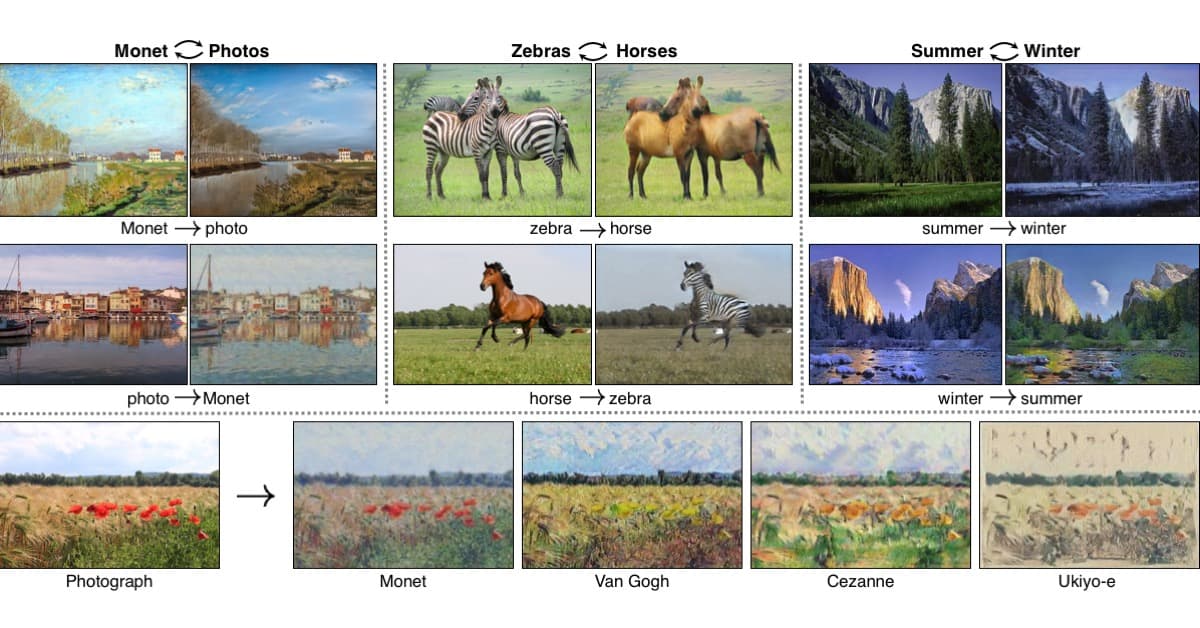
CycleGAN translates images between domains (e.g., photos to paintings) without direct 'before' and 'after' examples. It's used for style transfer or turning horses into zebras. The footgun is that it hallucinates details, making it unsafe for critical tasks.
Why it exists
Image to image translation models historically needed paired training examples, the exact same scene captured in both styles, like a photo and its hand painted twin. That pairing is often impossible to collect, since nobody has a photo of the same horse as a zebra. CycleGAN exists to learn a translation between two visual domains from two unrelated, unpaired collections of images, with no example ever showing the same subject in both.
The mental model
Imagine learning to translate between two languages with only a shelf of English novels and a separate shelf of French novels, no dictionary linking them line by line. You could learn a translator that produces fluent French, but nothing stops it from drifting away from the original meaning. CycleGAN's fix is a round trip test: translate a sentence to French and back to English, and it must land on the original sentence. That constraint, cycle consistency, keeps content intact while only the style changes.
How it works
CycleGAN trains two generators and two discriminators together. One generator maps domain X to domain Y, for example horses to zebras, and a discriminator tries to tell its output apart from real zebra photos, pushing the generator toward realism. A second generator maps Y back to X, and the cycle consistency loss penalizes the model whenever running an image through both generators fails to reconstruct the original input. That loss forces the network to preserve pose, layout, and structure, changing only surface appearance like color and texture.
When it matters
CycleGAN is the right tool for stylistic transformations where two image sets exist but no aligned pairs do: photo to painting style transfer, season transfer, or object transfiguration like horses to zebras. It stops being safe the moment factual accuracy matters, because the network optimizes for plausible style, not truth, and it can hallucinate details, adding, removing, or distorting structures that were never there, a serious hazard for anything like MRI to CT translation in medical imaging.
A concrete example
Trained on an unpaired set of horse photos and zebra photos, CycleGAN learns to paint stripe patterns onto a horse's body while keeping its exact pose and background untouched, and to remove stripes from a zebra to produce a plausible horse, purely from the cycle consistency constraint, never having seen one animal photographed in both forms.
Interview question
Why is CycleGAN generally unsuitable for critical applications like medical image analysis?
- a.It is designed only for stylistic changes, not for preserving anatomical accuracy.
- b.It requires perfectly paired "before" and "after" images, which are scarce in medical contexts.
- c.The model's inherent ability to hallucinate details makes its outputs unreliable for diagnosis.Correct
- d.Its training process is too computationally intensive for typical medical imaging workflows.
Why? this is the answer
The card explicitly states that CycleGAN "hallucinates content" and "can add, remove, or distort important features," making it "extremely dangerous for applications like medical image analysis." Option B describes a problem that CycleGAN was invented to solve, not a limitation of CycleGAN itself.
Just read this? Test yourself on what you have been reading.
Read the original → junyanz.github.io
You just looked this up. Could you explain it out loud?
That is the part interviews actually test. Tezvyn takes questions like this one and gives you what the interviewer is really checking, the answer that lands, and the mistake that ends the conversation, in the four minutes before your next meeting.
The iPhone app is on the way
We are building it. Until it lands, nothing here is held back from you: every interview card, your saved cards, streaks and the job board all work in Safari, plus hundreds of free practice quizzes of thirty questions each. Sign in and it all carries over to the app the day it arrives.
Want it as an icon? Tap Share at the bottom of Safari, then Add to Home Screen. It opens full screen and the cards you have read stay available offline.
We are hiring for this. Open roles that interview on computer vision — each one lists the topics its interview covers.
See open roles