Data Parallelism: One Task, Many Data Chunks
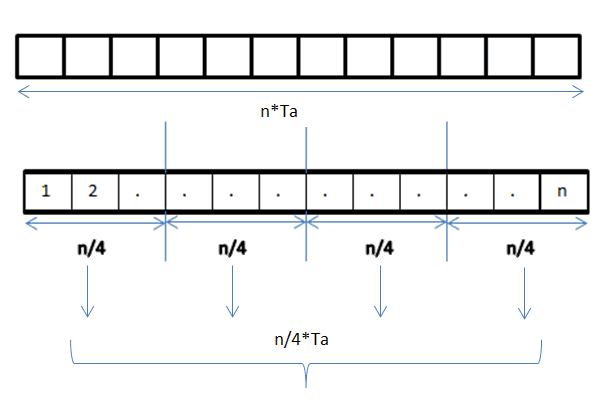
Data parallelism splits a huge dataset across multiple processors, each running the same task on its own chunk. It's how large models are trained on massive datasets, with each GPU handling a different batch of data.
Why it exists
Modern datasets, especially in machine learning, are often too massive to fit into the memory of a single processor or be processed in a reasonable amount of time. Data parallelism was developed to overcome this physical limitation by dividing the data load across multiple processing units.
The mental model
Imagine you have a million photos to label as 'cat' or 'not cat'. Instead of one person going through them one by one, you hire 100 people. You give each person a stack of 10,000 photos and the exact same set of instructions ('label cats'). They all work at the same time on their own stack. That's data parallelism: same task, different data chunks.
How it works
A large dataset is partitioned into smaller, independent chunks. These chunks are distributed across multiple processing nodes, such as GPUs in a cluster. Each node then executes the exact same program on its local data chunk. After the computation is complete, there is typically a synchronization or aggregation step where the results from all nodes are combined to form the final output. For example, gradients from each node might be averaged together.
When to use it
Use data parallelism when you have a large amount of data and a single, computationally intensive operation to perform on all of it. This is the default strategy for training large neural networks, where the same model architecture processes different batches of data. It's also common in scientific computing for operations on large matrices and in big data analytics for running queries over massive tables.
When not to use it
Avoid data parallelism if the problem is better described as a collection of different, independent tasks. In that scenario, task parallelism is a better fit. It's also inefficient if the individual data chunks are not independent and require frequent, high-volume communication between nodes. The communication overhead can quickly become the bottleneck, negating any speedup from parallel processing.
One canonical example
Training a large language model (LLM) is the classic use case. The model's architecture and weights (the 'task') are replicated on every GPU. The massive training dataset is split into mini-batches. Each GPU independently processes a different mini-batch to compute gradients. Afterwards, all GPUs synchronize by communicating their gradients, which are then averaged to update the model's weights. This cycle repeats for thousands of steps.
Interview question
For which type of computational problem is data parallelism most appropriate?
- a.Executing a variety of distinct, unrelated operations simultaneously across different processors.
- b.Dividing a large dataset among multiple processors, each running the same program on its assigned portion.Correct
- c.Problems where individual data segments are heavily interconnected, demanding constant inter-processor data exchange.
- d.Tasks that involve processing a small, manageable dataset on a single, powerful computing unit.
Why? this is the answer
Data parallelism is designed for scenarios where a single, computationally intensive operation needs to be performed on a massive dataset, with each processor handling a different chunk. Option A describes task parallelism, while Option C highlights a situation where data parallelism would be inefficient due to communication overhead.
Just read this? Test yourself on what you have been reading.
Read the original → en.wikipedia.org
- #parallel computing
- #llms
- #system design
- #distributed systems
You just looked this up. Could you explain it out loud?
That is the part interviews actually test. Tezvyn takes questions like this one and gives you what the interviewer is really checking, the answer that lands, and the mistake that ends the conversation, in the four minutes before your next meeting.
The iPhone app is on the way
We are building it. Until it lands, nothing here is held back from you: every interview card, your saved cards, streaks and the job board all work in Safari, plus hundreds of free practice quizzes of thirty questions each. Sign in and it all carries over to the app the day it arrives.
Want it as an icon? Tap Share at the bottom of Safari, then Add to Home Screen. It opens full screen and the cards you have read stay available offline.
We are hiring for this. Every open role lists the topics its interview covers, so you can prepare for the real thing rather than guessing.
See open roles