Describe the technical setup and trade-offs of large-scale unmoderated checkout usability testing
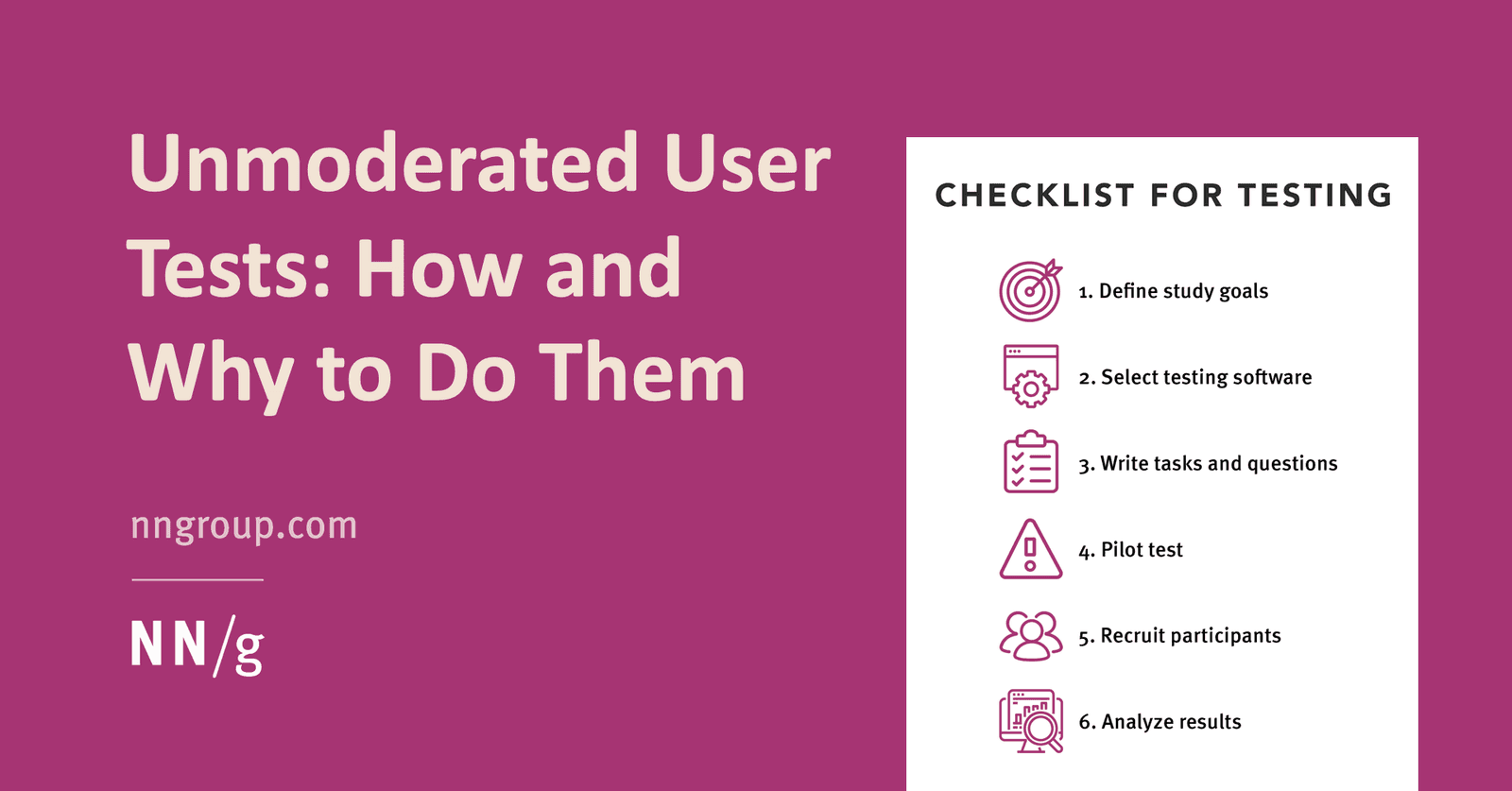
Instrumenting remote UX studies and judging when scale kills realism.
Clickstream logging, success rates, surveys; contrast speed with moderator engagement.
Unmoderated early prototypes or ignoring motivation gaps.
What's really being asked
This question evaluates whether you can architect a remote quantitative usability study at scale and defend the method against its inherent weaknesses. Interviewers want to see that you understand instrumentation beyond simple screen recording and that you know unmoderated testing is not just a cheaper version of moderated testing but a different tool with different validity constraints.
A GOOD ANSWER COVERS four layers in order. First, the task platform and capture layer: remote unmoderated software such as UserTesting or Maze, combined with full session recording, clickstream or heatmap analytics, and console error logging to catch technical failures. Second, the metrics layer: task success rates, time on task, drop-off funnels, error recovery rates, and standardized post-task questionnaires like the Single Ease Question or System Usability Scale to produce comparable quantitative data. Third, the recruitment layer: a screened panel with demographic and behavioral quotas, plus validation questions to filter out speeders or bots. Fourth, the trade-off analysis: unmoderated studies deliver speed, geographic reach, and sample sizes in the hundreds, but they sacrifice moderator-driven probing, real-time error recovery, and the social pressure that keeps participants engaged during ambiguous or imaginative tasks like simulated shopping.
COMMON WRONG ANSWERS include proposing unmoderated tests for low-fidelity prototypes that require moderator explanation, treating the method as universally cheaper without acknowledging data quality risks, or listing only qualitative outputs like video replays instead of quantitative instrumentation. Another red flag is ignoring the imagination problem, where participants without real purchase motivation glance at a few products and pick one arbitrarily, producing falsely optimistic completion times.
LIKELY FOLLOW-UPS include how you would handle a participant who gets stuck without a moderator, which metrics would definitively signal a checkout flow failure, and under what conditions you would insist on a moderated study despite the higher cost.
A concrete example
For a checkout flow on a live e-commerce site, you might recruit two hundred participants from a screened panel, assign them a task to purchase a specific item using a test credit card, and instrument the flow with event logging for cart additions, shipping entry, payment submission, and confirmation. You would capture task completion rate, average time per step, error rate on address validation, and SEQ scores. You would then compare these numbers against a moderated benchmark of ten participants to check whether the unmoderated sample is completing the task faster because the flow is genuinely better or because they are clicking randomly without reading.
Interview question
Why should you benchmark a large-scale unmoderated checkout study against a moderated one?
- a.Standardized surveys like SEQ can only be interpreted after a moderated baseline is established
- b.Legal compliance requires moderated validation whenever test credit cards are used
- c.To distinguish genuine flow improvements from falsely optimistic times caused by unmotivated clickingCorrect
- d.Unmoderated platforms cannot technically capture clickstream or console error data
Why? this is the answer
The card explains that unmoderated participants often lack purchase motivation and may click randomly, producing artificially fast completion times; a moderated benchmark helps determine if speed reflects a better flow or just disengagement. Option D is wrong because unmoderated tools are explicitly capable of clickstream and console logging.
Just read this? Test yourself on what you have been reading.
Read the original → nngroup.com
- #ux research
- #usability testing
- #quantitative methods
- #product sense
- #trade-off analysis
You just looked this up. Could you explain it out loud?
That is the part interviews actually test. Tezvyn takes questions like this one and gives you what the interviewer is really checking, the answer that lands, and the mistake that ends the conversation, in the four minutes before your next meeting.
The iPhone app is on the way
We are building it. Until it lands, nothing here is held back from you: every interview card, your saved cards, streaks and the job board all work in Safari, plus hundreds of free practice quizzes of thirty questions each. Sign in and it all carries over to the app the day it arrives.
Want it as an icon? Tap Share at the bottom of Safari, then Add to Home Screen. It opens full screen and the cards you have read stay available offline.
We are hiring for this. Open roles that interview on ux research — each one lists the topics its interview covers.
See open roles