Feature Teams: Ship Value, Not Layers
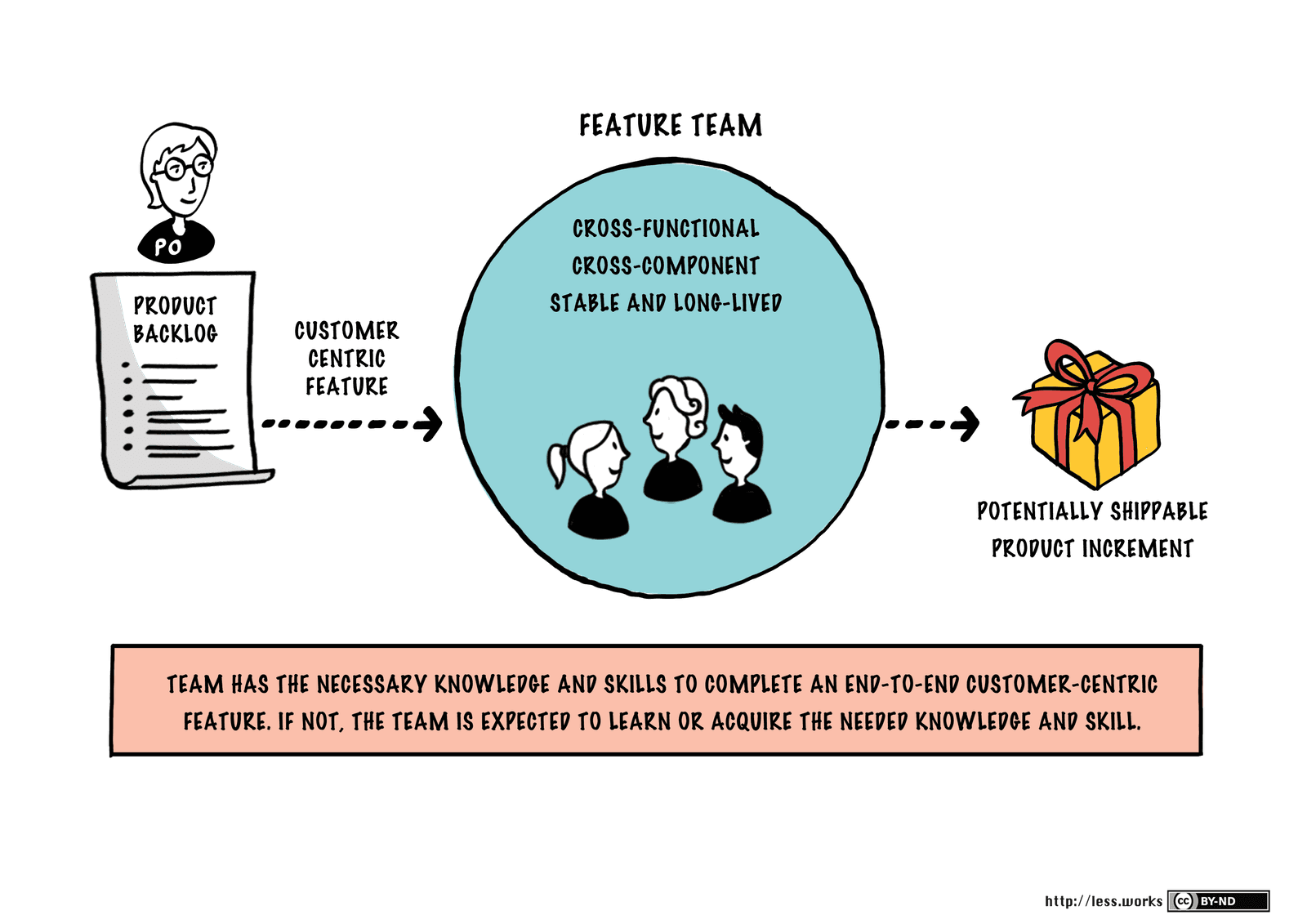
A feature team owns a customer-facing feature from start to finish, unlike component teams that own a single tech layer. This reduces handoffs and speeds up delivery.
The mental model
A feature team is organized around customer value, not technology layers. Think of it as a dedicated mission team that can build and ship an entire feature, from the UI button to the database entry, without waiting for another team. The opposite is a component team structure, where you have a 'UI team,' an 'API team,' and a 'database team.' In that model, shipping one feature requires a complex chain of handoffs and coordination, slowing everything down. Feature teams are designed to break these dependencies.
How it works
A feature team is long-lived, allowing members to 'jell' and improve their collective performance over time. It is cross-functional and cross-component, meaning it has all the expertise needed—analysis, design, coding across the stack, and testing. The team is composed of 'generalizing specialists,' who have deep expertise in one area but are willing to contribute to others. They work on one complete, customer-centric feature at a time. To make this work at scale, modern engineering practices are essential. Continuous integration, for example, is non-negotiable as it enables the shared code ownership required when multiple teams might touch the same components.
When to use it
Adopt feature teams when your primary goal is to optimize for fast delivery of customer value and reduce time-to-market. This structure is ideal for organizations looking to increase adaptability and responsiveness to customer needs. It works best when you can break down your product into vertical slices of functionality that can be delivered independently. It's a core concept in large-scale agile frameworks like LeSS (Large-Scale Scrum).
When not to use it
Component teams might be practical for a highly specialized, complex component that serves many products and requires deep, niche expertise, like a core transaction processing engine. In such cases, the overhead of distributing that rare knowledge across many feature teams could be too high. However, this should be treated as an exception, not the default organizational structure.
One canonical example
An e-commerce company wants to add a 'one-click buy' feature. In a component-team setup, the UI team builds the button, hands off to the API team for the endpoint, who hands off to the backend team for logic, who hands off to the database team. This takes weeks. In a feature-team setup, one team is tasked with 'one-click buy.' They design the UI, build the API, implement the logic, and update the database themselves, delivering the complete feature in a single sprint.
Interview question
What is the main mechanism by which feature teams accelerate the delivery of customer value?
- a.They ensure that specialized, complex components are managed by dedicated, expert-only teams.
- b.They reduce the need for diverse skill sets by focusing teams on specific technical components.
- c.They enable deep technical specialization within distinct layers of the software architecture.
- d.They empower a single, cross-functional team to deliver a complete customer-facing feature end-to-end.Correct
Why? this is the answer
Feature teams accelerate delivery by owning a customer-facing feature from start to finish, eliminating handoffs between different technical layers. Option C describes component teams, which often slow down delivery due to dependencies.
Just read this? Test yourself on what you have been reading.
Read the original → less.works
You just looked this up. Could you explain it out loud?
That is the part interviews actually test. Tezvyn takes questions like this one and gives you what the interviewer is really checking, the answer that lands, and the mistake that ends the conversation, in the four minutes before your next meeting.
The iPhone app is on the way
We are building it. Until it lands, nothing here is held back from you: every interview card, your saved cards, streaks and the job board all work in Safari, plus hundreds of free practice quizzes of thirty questions each. Sign in and it all carries over to the app the day it arrives.
Want it as an icon? Tap Share at the bottom of Safari, then Add to Home Screen. It opens full screen and the cards you have read stay available offline.
We are hiring for this. Open roles that interview on agile — each one lists the topics its interview covers.
See open roles