How does management evolve in scaled agile versus traditional program management?
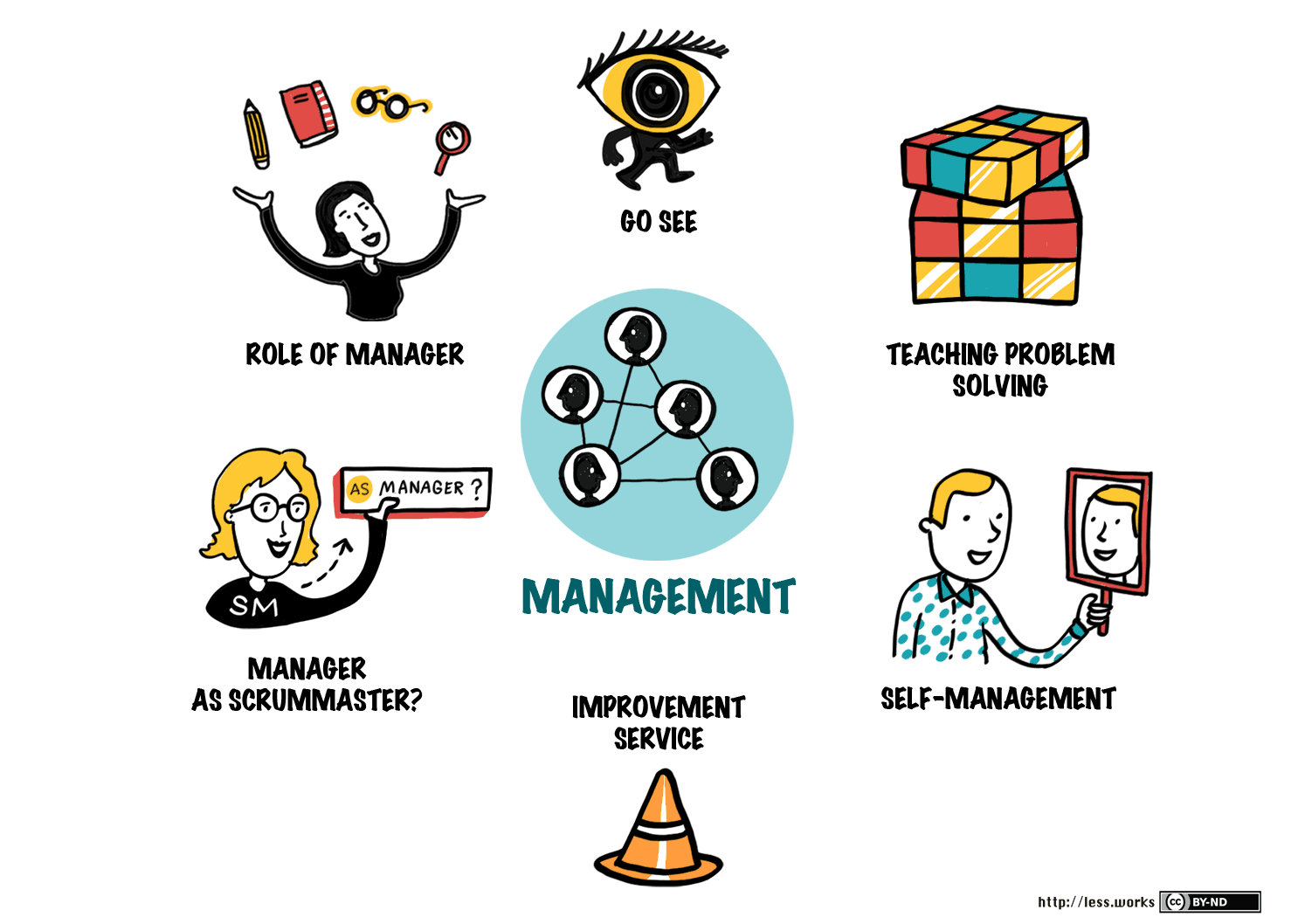
This tests whether you see scaled agile shifting management from command to enablement. A strong answer contrasts LeSS manager-as-teacher supporting self-managing teams against traditional program-management command structures.
What's really being asked
This question tests whether you understand that scaling agile is not merely a process expansion but a fundamental shift in management philosophy. The interviewer wants to see if you recognize that LeSS explicitly rejects traditional management by controlling subordinates in favor of a style aligned with Lean Thinking and the Managers as Teachers principle. You are expected to contrast this enabling posture with the command structures found in traditional program management.
The full answer
First, explain that LeSS dramatically changes the manager role because self-managing teams delegate responsibilities downward and Product Owners decide what the team works on, which removes the classic manager function of task assignment. Second, describe the LeSS management style as rooted in Lean Thinking where managers act as teachers who develop people and improve the system rather than directing daily work. Third, contrast this with traditional program management which typically relies on a Theory X assumption that people dislike work and must be coerced, controlled, directed, and threatened to extract effort, leading to top-down dependency resolution and alignment by command. Fourth, note that in LeSS cross-team dependencies are handled through team self-coordination, communities, and clear product ownership rather than by inserting a hierarchy of project managers.
The mistakes people make
A major red flag is proposing that scaled agile simply adds more project managers or program directors to coordinate dependencies. Another weak pattern is describing LeSS as just Scrum with extra meetings while ignoring the structural change in management accountability. Candidates who frame alignment as something leadership forces through detailed plans and Gantt charts rather than through product vision and clear priorities are missing the core distinction.
What usually comes next
An interviewer might ask how you would coach a former command-and-control manager to adopt a teaching role. They may also ask what specific systemic impediments you would expect a manager to remove in a LeSS adoption, or how you would handle a situation where a Product Owner and a former engineering manager disagree on priorities.
A concrete example
Imagine a company moving from a traditional program office that enforces quarterly milestones across five teams to LeSS. Under the old model, a program manager held weekly command meetings to resolve dependencies and reallocate resources when teams slipped. After adopting LeSS, the same leader stops assigning tasks and instead spends time removing organizational barriers like slow procurement, teaches teams to coordinate directly during multi-team Sprint Planning, and ensures the Product Owner has final say over the product backlog. Cross-team alignment shifts from status meetings to shared product ownership and transparent sprint reviews.
Interview question
How does LeSS fundamentally change a manager's approach to cross-team dependencies compared with traditional program management?
- a.LeSS replaces command meetings with team self-coordination and manager-as-teacher enablementCorrect
- b.LeSS introduces additional project managers to coordinate dependencies across teams
- c.LeSS scales Scrum by adding coordination meetings while keeping the same management hierarchy
- d.LeSS managers use detailed plans and Gantt charts to force alignment by command
Why? this is the answer
LeSS shifts from command to enablement, relying on team self-coordination and managers as teachers who remove systemic barriers. Option B is tempting because scaling often suggests adding coordinators, but LeSS explicitly rejects inserting more project managers to handle dependencies.
Just read this? Test yourself on what you have been reading.
Read the original → less.works
- #agile
- #less
- #scaling
- #leadership
- #program-management
You just looked this up. Could you explain it out loud?
That is the part interviews actually test. Tezvyn takes questions like this one and gives you what the interviewer is really checking, the answer that lands, and the mistake that ends the conversation, in the four minutes before your next meeting.
The iPhone app is on the way
We are building it. Until it lands, nothing here is held back from you: every interview card, your saved cards, streaks and the job board all work in Safari, plus hundreds of free practice quizzes of thirty questions each. Sign in and it all carries over to the app the day it arrives.
Want it as an icon? Tap Share at the bottom of Safari, then Add to Home Screen. It opens full screen and the cards you have read stay available offline.
We are hiring for this. Open roles that interview on agile — each one lists the topics its interview covers.
See open roles