How would you apply Conway's Law to design team structures?
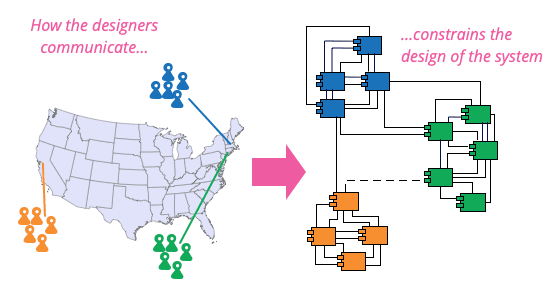
This tests applying organizational theory to technical strategy. A great answer defines the law, explains the 'Inverse Conway Maneuver' by structuring teams around business capabilities, and avoids imposing an architecture without changing team structure…
What's really being asked
This question tests your understanding of the socio-technical nature of software development. It's not about reciting the definition of Conway's Law, but about demonstrating how you would proactively use it as a strategic tool—the 'Inverse Conway Maneuver'—to shape your organization and achieve a desired architectural outcome like microservices. It separates candidates who see architecture as purely technical from those who understand it's deeply intertwined with people and communication.
The full answer
A good answer covers four key points. First, briefly define Conway's Law: organizations design systems that mirror their communication structures. Second, state the core principle of not fighting the law, but using it. Third, explain the 'Inverse Conway Maneuver' for microservices: structure teams around specific business capabilities or bounded contexts. Each team should have full ownership of their service(s), from development to deployment and operations. Fourth, describe the desired outcome: these small, autonomous teams with limited, well-defined communication channels will naturally produce small, autonomous services with limited, well-defined API boundaries.
The mistakes people make
A common wrong answer is to simply define the law and stop, or to describe fighting it. For example, suggesting you can mandate a microservices architecture while keeping teams structured by technical layers (e.g., a UI team, an API team, a database team). This structure will always pull the architecture back towards a layered monolith, as cross-team communication is required for every single feature, creating high coordination overhead and tight coupling. Another red flag is treating Conway's Law as an unbreakable, negative force rather than a neutral observation that can be leveraged for positive outcomes.
What usually comes next
Expect follow-ups about the practical challenges. For example: 'How would you handle cross-cutting concerns like authentication or logging in this team structure?' or 'What do you do when a feature requires changes across three different service teams? How do you manage that dependency?' or 'How do you decide on the team boundaries? What if you get them wrong?'
A concrete example
To achieve a microservices architecture for an e-commerce site, you wouldn't have a 'frontend' team and a 'backend' team. Instead, you would create a 'Payments' team, a 'Product Catalog' team, and a 'User Profile' team. The Payments team owns the entire vertical slice of their domain: the UI, API, and database for processing payments. Their communication with the Product Catalog team is limited to a formal API call to get product prices. This organizational boundary enforcement encourages the creation of a distinct, loosely coupled Payments microservice.
Interview question
To successfully transition to a microservices architecture, how should an organization best apply the 'Inverse Conway Maneuver'?
- a.Reorganize teams to have full ownership of vertical business capabilities, letting the architecture emerge from the new team structure.Correct
- b.Analyze existing communication patterns to map the current system, then design API boundaries based on that map.
- c.Establish a central architecture team to define and enforce strict API boundaries for all development teams to follow.
- d.Keep existing functional teams (e.g., UI, API, DB) but mandate that all new development occurs in separate microservices.
Why? this is the answer
The Inverse Conway Maneuver posits that to achieve a desired architecture, you must first structure the organization to mirror it. Organizing teams around business capabilities (A) creates the communication boundaries that naturally lead to loosely coupled microservices. Mandating a new architecture onto an old team structure (D) fights the law and is likely to fail.
Just read this? Test yourself on what you have been reading.
Read the original → martinfowler.com
- #agile
- #architecture
- #team-structure
- #conways-law
You just looked this up. Could you explain it out loud?
That is the part interviews actually test. Tezvyn takes questions like this one and gives you what the interviewer is really checking, the answer that lands, and the mistake that ends the conversation, in the four minutes before your next meeting.
The iPhone app is on the way
We are building it. Until it lands, nothing here is held back from you: every interview card, your saved cards, streaks and the job board all work in Safari, plus hundreds of free practice quizzes of thirty questions each. Sign in and it all carries over to the app the day it arrives.
Want it as an icon? Tap Share at the bottom of Safari, then Add to Home Screen. It opens full screen and the cards you have read stay available offline.
We are hiring for this. Open roles that interview on agile — each one lists the topics its interview covers.
See open roles