LeSS Huge: Scaling Scrum Beyond Eight Teams
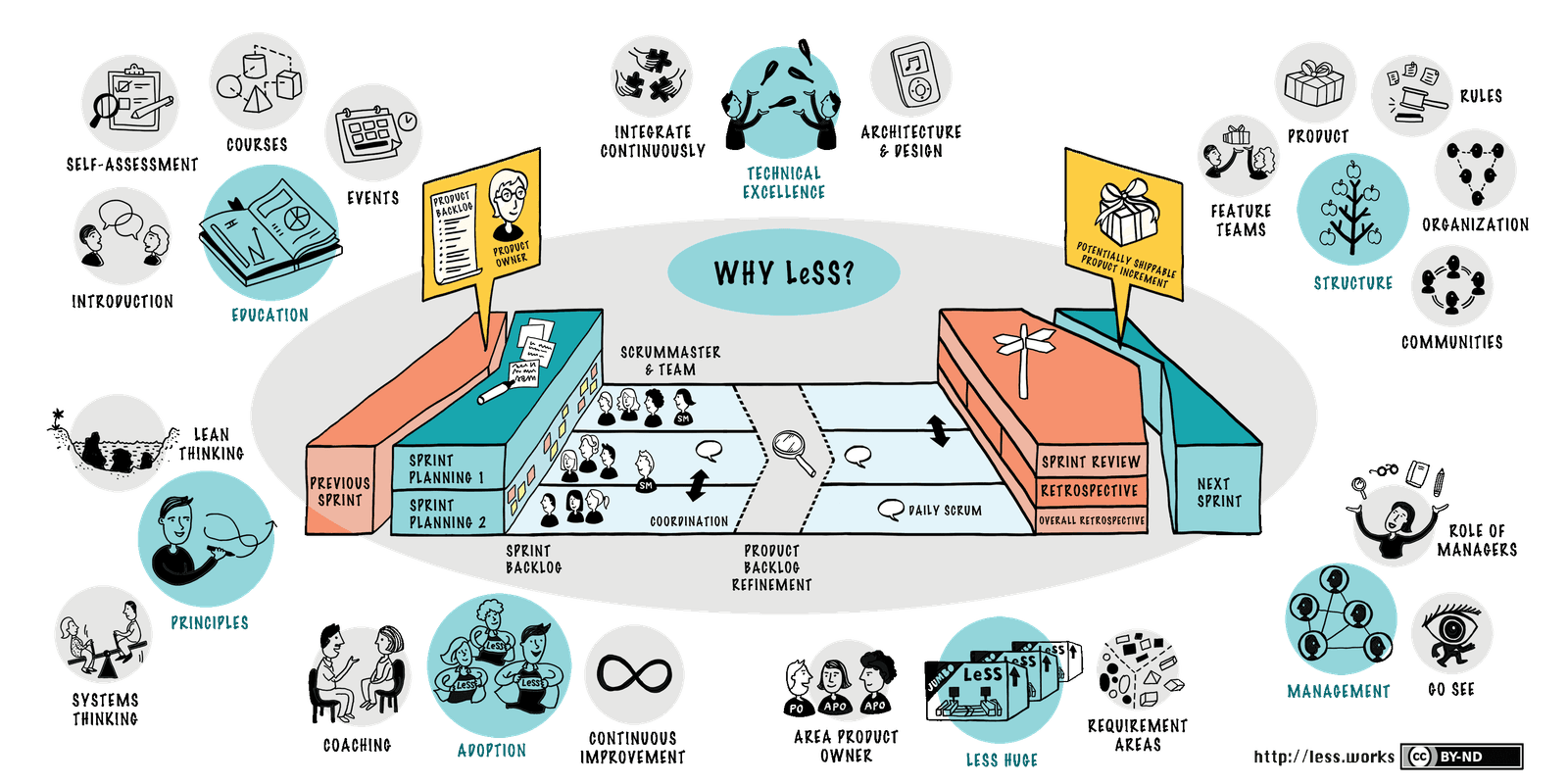
LeSS Huge is a framework for applying Scrum when over eight teams work on one product, organizing them into "Requirement Areas." It’s for massive projects, like autonomous driving systems, where dozens of teams must coordinate.
THE MENTAL MODEL: LeSS Huge is not just 'more Scrum.' It's a framework for descaling organizational complexity. When you have more than eight teams working on a single product, a single backlog and single Product Owner become a bottleneck. LeSS Huge addresses this by creating multiple smaller 'LeSS' implementations within a larger whole, each focused on a major area of customer requirements. The goal is to maintain the core LeSS principles—simplifying structure, amplifying learning, and technical excellence—at a massive scale.
HOW IT WORKS: LeSS Huge is designed for organizations with more than eight Scrum teams. The key structural addition is the 'Requirement Area.' The product is divided into major customer-centric areas, and teams are grouped into these areas. Each Requirement Area has an 'Area Product Owner' who manages a specific Area Product Backlog, which is a filtered view of the overall Product Backlog managed by the one, overall Product Owner. All teams still work in a synchronized cadence, participating in one overall Sprint Review and Retrospective, but much of the planning and refinement happens within their Requirement Area.
WHEN TO USE IT: Use LeSS Huge only when you have more than eight teams working on a single, end-to-end customer product. It is intended for massive development efforts where the scale of coordination makes the basic LeSS framework (for 2-8 teams) impractical. Examples from the field include developing autonomous driving platforms, modernizing core banking systems, or building complex logistics and port management software.
WHEN NOT TO USE IT: Do not use LeSS Huge if you have eight or fewer teams; the simpler LeSS framework is sufficient. Avoid it if your organization is not prepared for a radical redesign. It requires breaking down functional silos, empowering teams, and changing the role of management from director to coach. It will also fail without strong technical excellence; practices like continuous integration and test automation are non-negotiable for managing the dependencies between dozens of teams.
ONE CANONICAL EXAMPLE: A large automotive company is building a unified autonomous driving platform with 30 teams. A single backlog is chaos. They adopt LeSS Huge and create four Requirement Areas: 'Sensor Fusion,' 'Path Planning,' 'Driver Monitoring,' and 'In-Car Experience.' Each area has an Area Product Owner and 7-8 teams. This structure allows teams to focus on a cohesive part of the customer problem while still integrating their work into a single, shippable product increment every Sprint.
Read the original → less.works
Get five bites like this every day.
Tezvyn delivers a daily feed of 60-second tech bites with quizzes to lock in what you learn.