Star Schema: The Blueprint for Analytics Data
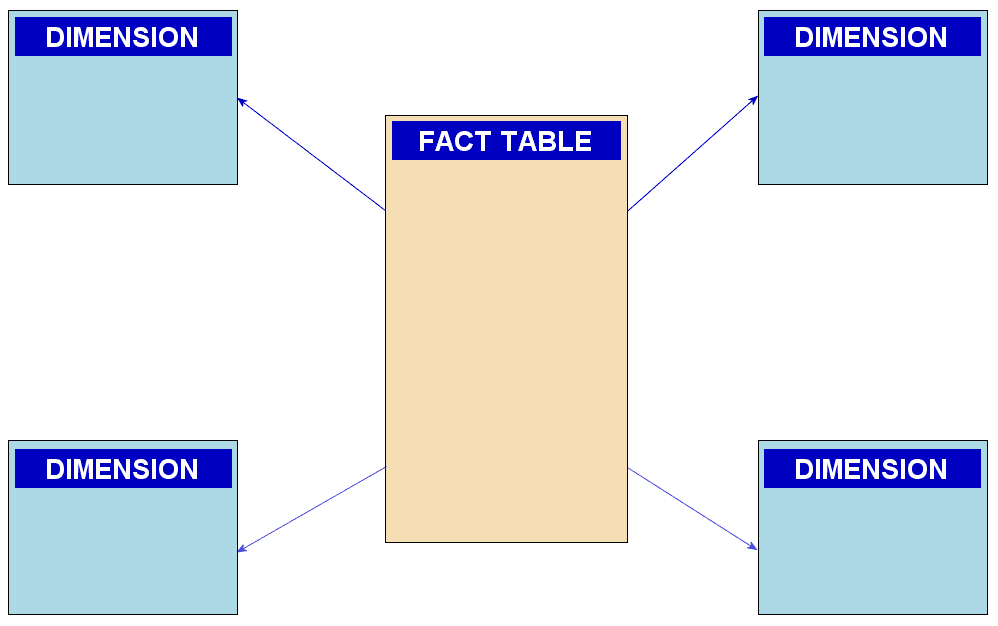
A star schema organizes analytics data with a central fact table (e.g., sales) surrounded by dimension tables (e.g., customers). It's built for fast queries in data warehouses. The footgun is normalizing dimensions, which negates its speed advantage.
The mental model
A star schema organizes data for business intelligence and analytics. Picture a central table of numbers (facts) connected to several descriptive tables (dimensions). The facts are the events you measure, like sales or clicks. The dimensions are the context for those events: who made the sale, what product was sold, and when it happened. This structure gets its name because a diagram of it looks like a star, with the fact table at the center and dimensions radiating outwards.
How it works
The schema has two table types. First, the fact table, which sits at the center. It contains foreign keys to the dimension tables and the quantitative measures (the facts) like quantity_sold or sale_price. It is typically long and has many rows. Second, the dimension tables. Each dimension table describes a business entity, like dim_customer, dim_product, or dim_date. They contain descriptive, textual attributes like customer_name or product_category. These tables are usually denormalized and wide to avoid extra joins. A query joins the central fact table with one or more dimension tables to slice and dice the data.
When to use it
The star schema is the standard for data warehouses and dimensional data marts. Use it when your primary goal is fast, simple querying and aggregation for reporting and analytics. Its structure requires fewer joins than more normalized models, which dramatically speeds up the read-heavy workloads typical of business intelligence tools. If you need to answer questions like "What were the total sales by store for each quarter?", a star schema is highly effective.
When not to use it
Avoid the star schema for transactional systems (OLTP), like an e-commerce checkout process. These systems require high normalization to ensure data integrity and avoid redundancy during frequent writes and updates. The star schema's denormalized nature makes writes inefficient. It is also less space-efficient than more normalized schemas due to data redundancy in the dimension tables. If storage is extremely constrained or queries are very complex, a snowflake schema might be a better fit.
One canonical example
An online retailer has a central fact_sales table with columns like date_key, customer_key, product_key, units_sold, and total_revenue. This fact table is connected to three dimension tables: dim_date (with month, year), dim_customer (with customer_name, city), and dim_product (with product_name, category). To find total sales for a specific category in January, you would join fact_sales with dim_product and dim_date on their respective keys.
Interview question
For a star schema to effectively support fast analytical queries, which characteristic is crucial?
- a.Dimension tables are denormalized and wide, containing comprehensive attributes.Correct
- b.Dimension tables are fully normalized to reduce data duplication.
- c.The fact table stores descriptive attributes instead of quantitative measures.
- d.It is optimized for high-volume, concurrent write operations.
Why? this is the answer
The card explicitly states that dimension tables in a star schema are "usually denormalized and wide to avoid extra joins," which is key for fast querying. Normalizing dimensions, as suggested in option B, is described as a "footgun" that negates the speed advantage.
Just read this? Test yourself on what you have been reading.
Read the original → en.wikipedia.org
You just looked this up. Could you explain it out loud?
That is the part interviews actually test. Tezvyn takes questions like this one and gives you what the interviewer is really checking, the answer that lands, and the mistake that ends the conversation, in the four minutes before your next meeting.
The iPhone app is on the way
We are building it. Until it lands, nothing here is held back from you: every interview card, your saved cards, streaks and the job board all work in Safari, plus hundreds of free practice quizzes of thirty questions each. Sign in and it all carries over to the app the day it arrives.
Want it as an icon? Tap Share at the bottom of Safari, then Add to Home Screen. It opens full screen and the cards you have read stay available offline.
We are hiring for this. Open roles that interview on data modeling — each one lists the topics its interview covers.
See open roles