The Technical Debt Quadrant
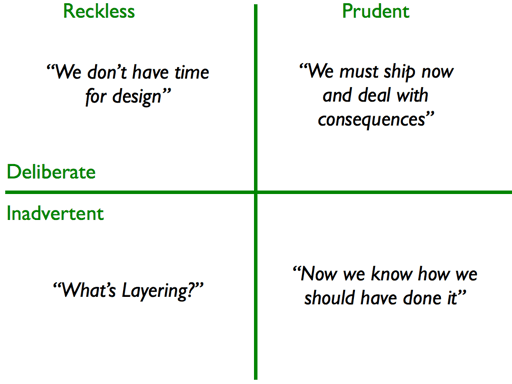
The Technical Debt Quadrant reframes debt not as one problem, but a 2x2 matrix: prudent vs. reckless and deliberate vs. inadvertent. This distinguishes a strategic choice to ship early from a simple mess. The footgun is treating all debt as equally bad.
The mental model
Technical debt is a useful metaphor, but not all debt is created equal. The Technical Debt Quadrant helps you classify design flaws to better communicate their origin and how to manage them. It uses two axes: prudent versus reckless, and deliberate versus inadvertent. The goal isn't to judge, but to understand the nature of the debt and make informed decisions.
How it works
The quadrant creates four distinct types of debt. First, Prudent and Deliberate debt is a conscious choice to trade quality for a short-term goal, like hitting a release date, with a plan to refactor later. Second, Reckless and Deliberate debt is a 'quick and dirty' approach where the team knows better but cuts corners anyway, underestimating the long-term cost. Third, Reckless and Inadvertent debt is a mess created by a team that doesn't know good design practices; they accrue high-interest debt without realizing it. Fourth, Prudent and Inadvertent debt is the kind even the best teams incur. As you work on a project, you learn more about the problem, and eventually realize what the design should have been. This new insight reveals a debt in the current, well-intentioned design.
When to use it
Use the quadrant to communicate with non-technical stakeholders about the cost and priority of refactoring. It helps justify paying down debt by explaining its type. For example, you can explain why a 'quick and dirty' fix (Reckless) is dangerous, while a planned refactor after a release (Prudent) is a strategic move. It also helps teams decide whether to pay down a debt or live with the interest payments, especially for prudent debt in rarely touched code.
When not to use it
Avoid using the quadrant as a tool for blame. The labels 'reckless' or 'inadvertent' should describe the situation and the code, not the character of the developers. The framework is a communication tool to facilitate strategic discussions, not a rigid accounting system for every minor flaw in the codebase.
One canonical example
The most insightful quadrant is Prudent and Inadvertent. Imagine a team delivers a valuable project with a clean codebase. A year later, after gaining deep domain knowledge, they realize a fundamentally better design is possible. The current design now represents a technical debt. It was created prudently, with the best knowledge at the time, but the debt itself was inadvertent—it only became visible with hindsight. This is an inevitable and healthy sign of a learning team.
Interview question
According to the Technical Debt Quadrant, what is the key advantage of categorizing debt by its origin and intent?
- a.It mandates immediate refactoring for all 'reckless' debt to prevent future issues.
- b.It helps identify which development teams are responsible for creating specific types of debt.
- c.It facilitates more effective communication and strategic decisions regarding refactoring priorities.Correct
- d.It allows for precise calculation of the financial cost of each debt item.
Why? this is the answer
The card emphasizes that the quadrant helps 'communicate with non-technical stakeholders' and 'make informed decisions' about managing debt. Option B is a tempting distractor, but the card explicitly states, 'Avoid using the quadrant as a tool for blame.'
Just read this? Test yourself on what you have been reading.
Read the original → martinfowler.com
- #technical debt
- #agile
- #software design
- #refactoring
You just looked this up. Could you explain it out loud?
That is the part interviews actually test. Tezvyn takes questions like this one and gives you what the interviewer is really checking, the answer that lands, and the mistake that ends the conversation, in the four minutes before your next meeting.
The iPhone app is on the way
We are building it. Until it lands, nothing here is held back from you: every interview card, your saved cards, streaks and the job board all work in Safari, plus hundreds of free practice quizzes of thirty questions each. Sign in and it all carries over to the app the day it arrives.
Want it as an icon? Tap Share at the bottom of Safari, then Add to Home Screen. It opens full screen and the cards you have read stay available offline.
We are hiring for this. Open roles that interview on technical debt — each one lists the topics its interview covers.
See open roles