Value vs. Effort Matrix: Prioritize What to Build Next
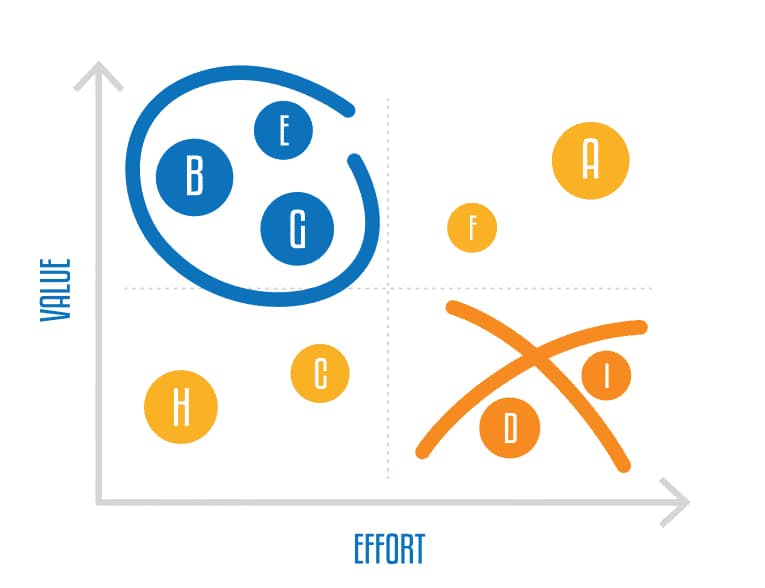
A Value vs. Effort matrix is a 2x2 grid for deciding what to build, plotting features by their potential value against implementation complexity. Product teams use it to prioritize roadmaps and justify resource allocation.
Why it exists
Teams always have more ideas than resources. They need a systematic, visual way to compare competing initiatives and decide where to invest their limited time and budget to maximize impact. The Value vs. Effort matrix provides a shared framework for making these tough prioritization calls.
The mental model
Think of it as a sorting tool for your team's to-do list, but with two dimensions. Instead of just asking "what's important?", you ask "what's important AND what's easy?". This forces a trade-off discussion, helping you find the quick wins and avoid the time sinks. It transforms a list of features into a visual map of strategic priorities.
How it works
You create a 2x2 grid with "Value" on the vertical axis and "Complexity" (or Effort) on the horizontal axis. For each proposed initiative, the team assigns a score for both value and complexity. Value is a mix of customer impact (solving pain points) and business impact (revenue, retention). Complexity is an estimate of the time, resources, and technical difficulty required. Plotting each item on the grid sorts them into four quadrants: High Value, Low Complexity: These are your quick wins. Do them now. High Value, High Complexity: These are major, strategic projects. Plan for them carefully. Low Value, Low Complexity: These are fill-in tasks. Do them if you have spare capacity. Low Value, High Complexity: These are time sinks. Avoid them.
When to use it
Use this framework during roadmap planning sessions to get alignment across product, engineering, and other stakeholders. It's excellent for quickly triaging a long backlog of features, enhancements, and fixes. It provides a clear, defensible rationale for why some things are being worked on and others are not.
When not to use it
Don't rely on it as the sole source of truth. The scores are subjective estimates. If your team can't agree on what "value" means or how to estimate "complexity," the model breaks down. It's also less useful for deeply interdependent features where the value of one depends entirely on another being built first. The matrix is a conversation starter, not a calculator.
One canonical example
A product team considers three features: adding social logins, refactoring the database, and building a new analytics dashboard. Social logins are high value (improves user onboarding) and low complexity. The analytics dashboard is high value but high complexity (a major project). The database refactor is low direct user value but high complexity. Using the matrix, the team decides to build social logins immediately, plan the dashboard for the next quarter, and avoid the refactor for now.
Interview question
A product team identifies a feature as 'High Value, Low Complexity' using a Value vs. Effort Matrix. What is the typical recommendation for such a feature?
- a.Assign it to junior developers as a training exercise due to its low complexity.
- b.Re-evaluate its value and complexity, as this quadrant is often misjudged.
- c.Defer its development until all 'High Value, High Complexity' projects are completed.
- d.Prioritize it as a "quick win" and aim for immediate implementation.Correct
Why? this is the answer
The card explicitly states that 'High Value, Low Complexity' items are 'quick wins' and should be done now to maximize impact efficiently. Deferring them or treating them as mere training tasks would contradict this core principle of the matrix.
Just read this? Test yourself on what you have been reading.
Read the original → productplan.com
- #product strategy
- #prioritization
- #product management
- #decision making
You just looked this up. Could you explain it out loud?
That is the part interviews actually test. Tezvyn takes questions like this one and gives you what the interviewer is really checking, the answer that lands, and the mistake that ends the conversation, in the four minutes before your next meeting.
The iPhone app is on the way
We are building it. Until it lands, nothing here is held back from you: every interview card, your saved cards, streaks and the job board all work in Safari, plus hundreds of free practice quizzes of thirty questions each. Sign in and it all carries over to the app the day it arrives.
Want it as an icon? Tap Share at the bottom of Safari, then Add to Home Screen. It opens full screen and the cards you have read stay available offline.
We are hiring for this. Open roles that interview on product strategy — each one lists the topics its interview covers.
See open roles