Vanity vs. Actionable Metrics: Measure What Matters
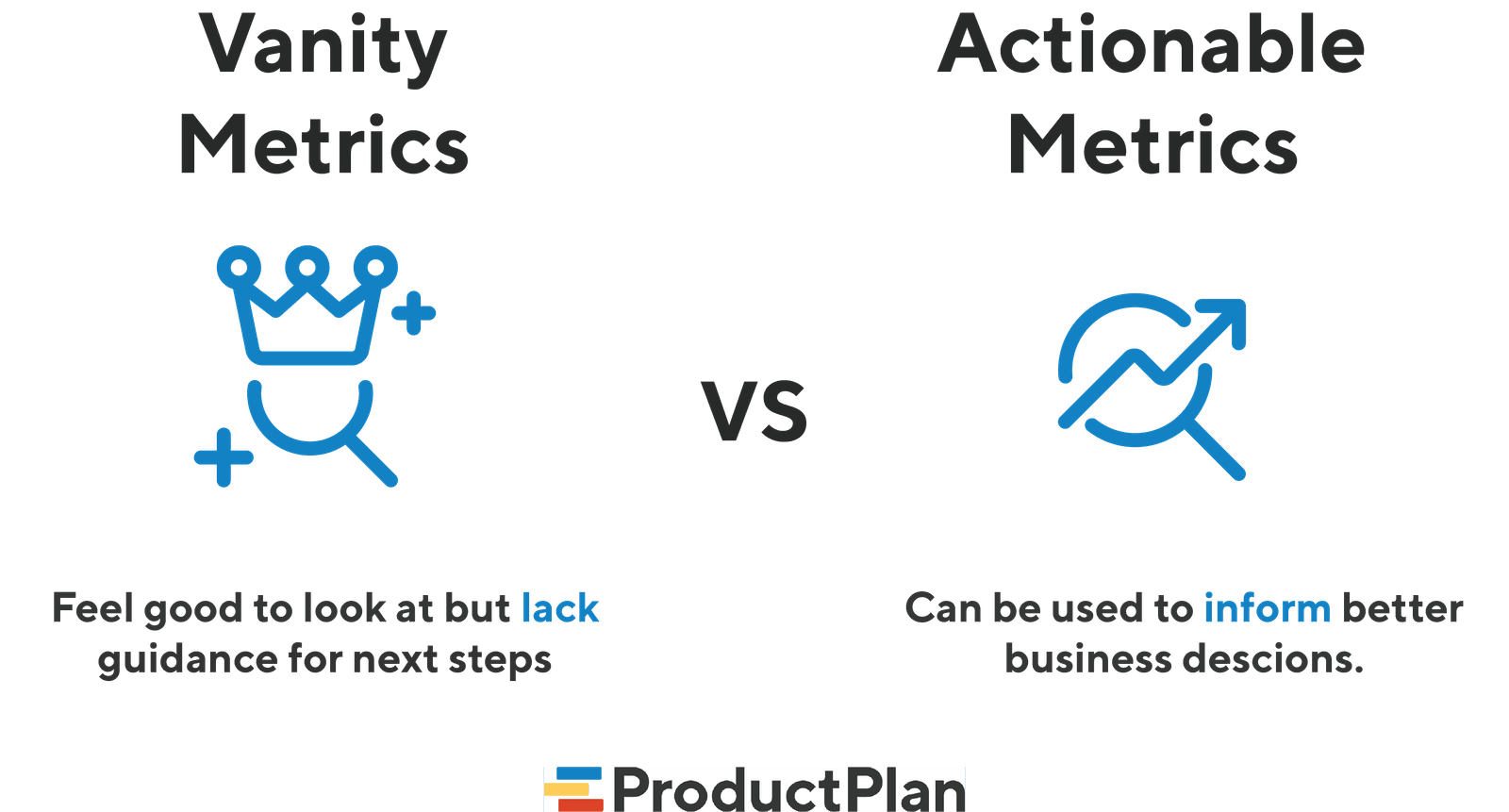
Vanity metrics look impressive but don't inform decisions (e.g., total downloads). Actionable metrics tie to business goals and guide your next move (e.g., conversion rate). This helps product teams focus on real growth, not just impressive-looking charts.
Why it exists
Businesses need to measure progress, but it's easy to track numbers that feel good while masking underlying problems. The distinction between vanity and actionable metrics was created to separate feel-good data from data that drives strategic decisions and genuine improvement.
The mental model
A vanity metric is like your car's odometer: a big, impressive number showing total miles driven that tells you nothing about your current trip. An actionable metric is your fuel gauge or MPG reading: data that helps you decide whether you need to refuel now or can keep driving. One is a historical artifact; the other informs your next action.
How it works
A metric becomes actionable when it helps you make a specific business decision. To tell the difference, ask three questions about any metric: First, what decision can I make with this data? Second, how can I reliably reproduce the result? Third, does this data reflect a real truth about user behavior? If you can't answer these, you're likely looking at a vanity metric. Common vanity metrics include raw pageviews, total downloads, or social media followers because they lack context. Actionable metrics are often rates or ratios, like conversion rate, weekly active users, or customer acquisition cost.
When to use it
Always prioritize actionable metrics when setting goals, reporting on progress, or deciding what to build next. Product teams should anchor their OKRs and KPIs to actionable metrics like user retention, lifetime value, or feature adoption rates. This ensures that effort is spent on work that demonstrably improves the business, not just on inflating a superficial number.
When not to use it
Avoid using vanity metrics to make strategic decisions or evaluate performance. While a spike in social media followers might be nice for a press release, it shouldn't be the primary justification for a marketing budget increase unless you can directly tie followers to sales. The danger is that they can mask underlying problems and lead teams to optimize for the wrong outcomes.
One canonical example
A mobile app team celebrates hitting 1 million total downloads. This is a classic vanity metric. It looks great, but it doesn't say if users are actually using the app or if it's making money. A more actionable metric would be the "Day 7 retention rate"—the percentage of users who return to the app seven days after downloading it. Improving this number from 15% to 20% is a clear, meaningful goal that directly reflects product value and predicts long-term success far better than the total download count.
Interview question
What is the primary reason product teams should prioritize actionable metrics over vanity metrics?
- a.They are simpler to track and require less complex data analysis tools.
- b.Actionable metrics consistently present larger, more impressive numbers for stakeholders.
- c.They provide clear insights that directly inform strategic business decisions and next steps.Correct
- d.Their main purpose is to generate positive public perception and press coverage.
Why? this is the answer
The card emphasizes that actionable metrics "tie to business goals and guide your next move" and "help you make a specific business decision." Option C accurately reflects this, while vanity metrics, though sometimes impressive, do not inform decisions.
Just read this? Test yourself on what you have been reading.
Read the original → productplan.com
You just looked this up. Could you explain it out loud?
That is the part interviews actually test. Tezvyn takes questions like this one and gives you what the interviewer is really checking, the answer that lands, and the mistake that ends the conversation, in the four minutes before your next meeting.
The iPhone app is on the way
We are building it. Until it lands, nothing here is held back from you: every interview card, your saved cards, streaks and the job board all work in Safari, plus hundreds of free practice quizzes of thirty questions each. Sign in and it all carries over to the app the day it arrives.
Want it as an icon? Tap Share at the bottom of Safari, then Add to Home Screen. It opens full screen and the cards you have read stay available offline.
We are hiring for this. Open roles that interview on product strategy — each one lists the topics its interview covers.
See open roles