Continuous Discovery: Talk to Users Weekly, Not Yearly
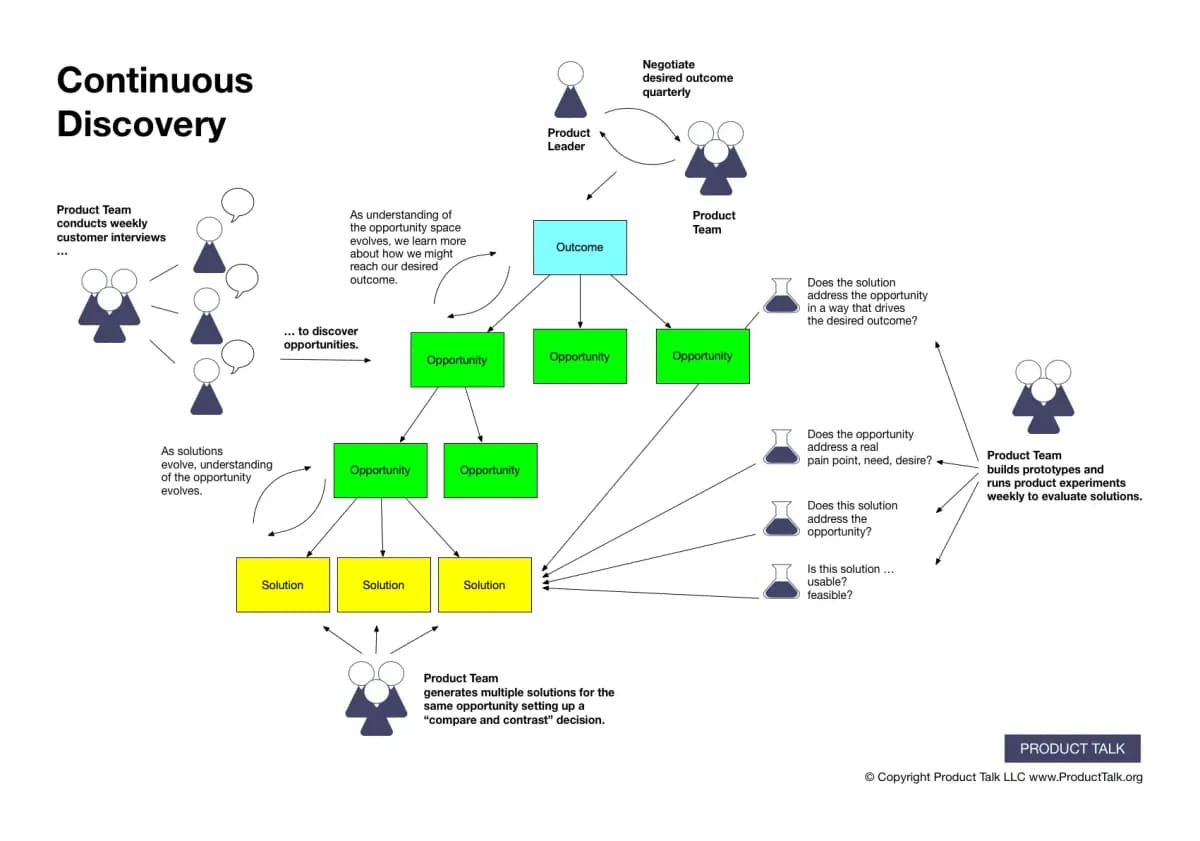
Continuous discovery means small, weekly chats with customers, not a big upfront research phase. It's for teams building products that are never 'done,' like Netflix or your SaaS app. The footgun is treating discovery as a project, leading to stale insights.
Why it exists
The traditional model of building software is project-based: a feature is planned, built, and shipped, and then the project is 'done.' But digital products are never truly finished. To compete, products like Netflix or Facebook must constantly evolve, meaning product decisions are made continuously, not just once a year during budgeting.
The mental model
Continuous discovery is the shift from a 'research phase' to an 'ongoing conversation.' If your team makes decisions about what to build every week, you need fresh customer input every week. It's a habit of including the customer throughout the decision-making process, not just at the start of a project.
How it works
Instead of conducting a dozen interviews at the beginning of a six-month project, a team practicing continuous discovery might talk to one or two customers every week. These frequent, small-batch activities (like interviews, usability tests, or assumption tests) create a constant stream of insights. This ensures that the daily and weekly decisions about what to build are grounded in current customer needs, not in research that is months old.
When to use it
Use this approach when you have a 'product mindset' rather than a 'project mindset.' It is essential for teams building digital products in a competitive landscape, where the product is never considered complete and can always be improved. If you are continuously shipping, you must be continuously learning.
When not to use it
This model is a difficult fit in organizations that are strictly project-based, with rigid annual budgeting cycles and success defined simply as 'shipping the feature.' In such an environment, discovery is often seen as a one-time, upfront activity. Adopting continuous discovery here often requires a broader cultural shift away from a project-centric view of work.
One canonical example
Netflix is a prime example. It didn't become a streaming giant and original content creator through a single project. It evolved from a DVD-by-mail service through countless iterations, new features, and UI enhancements. This constant evolution is fueled by continuously discovering customer needs and making decisions to create more value.
Interview question
What is the defining characteristic of continuous discovery that sets it apart from traditional product research?
- a.It integrates frequent, small-batch customer interactions directly into the ongoing product development cycle.Correct
- b.It focuses on gathering all customer insights upfront to define a product's entire roadmap.
- c.It involves conducting large-scale surveys and A/B tests to validate product hypotheses.
- d.It is primarily used to assess customer satisfaction for a product that has already been shipped.
Why? this is the answer
Continuous discovery is characterized by ongoing, small-batch customer interactions integrated into the development process, ensuring decisions are based on fresh insights. Option B describes traditional, project-based research, which continuous discovery aims to replace with its continuous, iterative approach.
Just read this? Test yourself on what you have been reading.
Read the original → producttalk.org
- #product management
- #product discovery
- #user research
- #product strategy
You just looked this up. Could you explain it out loud?
That is the part interviews actually test. Tezvyn takes questions like this one and gives you what the interviewer is really checking, the answer that lands, and the mistake that ends the conversation, in the four minutes before your next meeting.
The iPhone app is on the way
We are building it. Until it lands, nothing here is held back from you: every interview card, your saved cards, streaks and the job board all work in Safari, plus hundreds of free practice quizzes of thirty questions each. Sign in and it all carries over to the app the day it arrives.
Want it as an icon? Tap Share at the bottom of Safari, then Add to Home Screen. It opens full screen and the cards you have read stay available offline.
We are hiring for this. Open roles that interview on product management — each one lists the topics its interview covers.
See open roles