Intermediate concepts in AI & ML, page 8

LLM Guardrails: Keeping Model Outputs on Track
LLM guardrails are safety policies that steer model outputs, acting like bumpers in a bowling alley to prevent responses from going off-topic, leaking data, or generating harmful content. They are crucial for topic control and preventing prompt injections.

Adversarial Attacks: Tricking LLMs into Misbehaving
Adversarial attacks are inputs designed to trick an LLM, bypassing its safety alignment. This is how "jailbreaks" coax models into generating harmful content. The footgun is assuming safety training makes a model foolproof; it just makes attacks more subtle.
ML Interpretability: Cracking Open the Black Box
ML interpretability cracks open the 'black box' to explain *why* a model made a specific decision. It's essential in high-stakes fields like finance or medicine to ensure automated decisions are fair. The footgun is trusting accuracy alone.
Recurrent Neural Networks: Networks with Memory
An RNN is a neural network with a memory loop, processing sequential data by feeding its own output back in as input. It's used for text generation or time-series analysis where context is key.
Generative Adversarial Network (GAN)
A GAN trains two networks in competition: a generator that fabricates fake samples and a discriminator that judges real versus fake. Their adversarial game pushes the generator toward realistic outputs, enabling image synthesis and data generation without…
Value Learning
Value learning is the AI-safety approach of having a system infer what humans actually value, rather than optimizing a hand-coded proxy, so that capable agents pursue goals aligned with human intent even in novel situations.
TensorFlow Extended (TFX): Production ML Pipelines
TFX is an end-to-end platform for building production ML pipelines, like an assembly line for your models. It automates data validation, training, analysis, and serving. The footgun: TFX is not one tool, but a suite of libraries you must learn and connect.
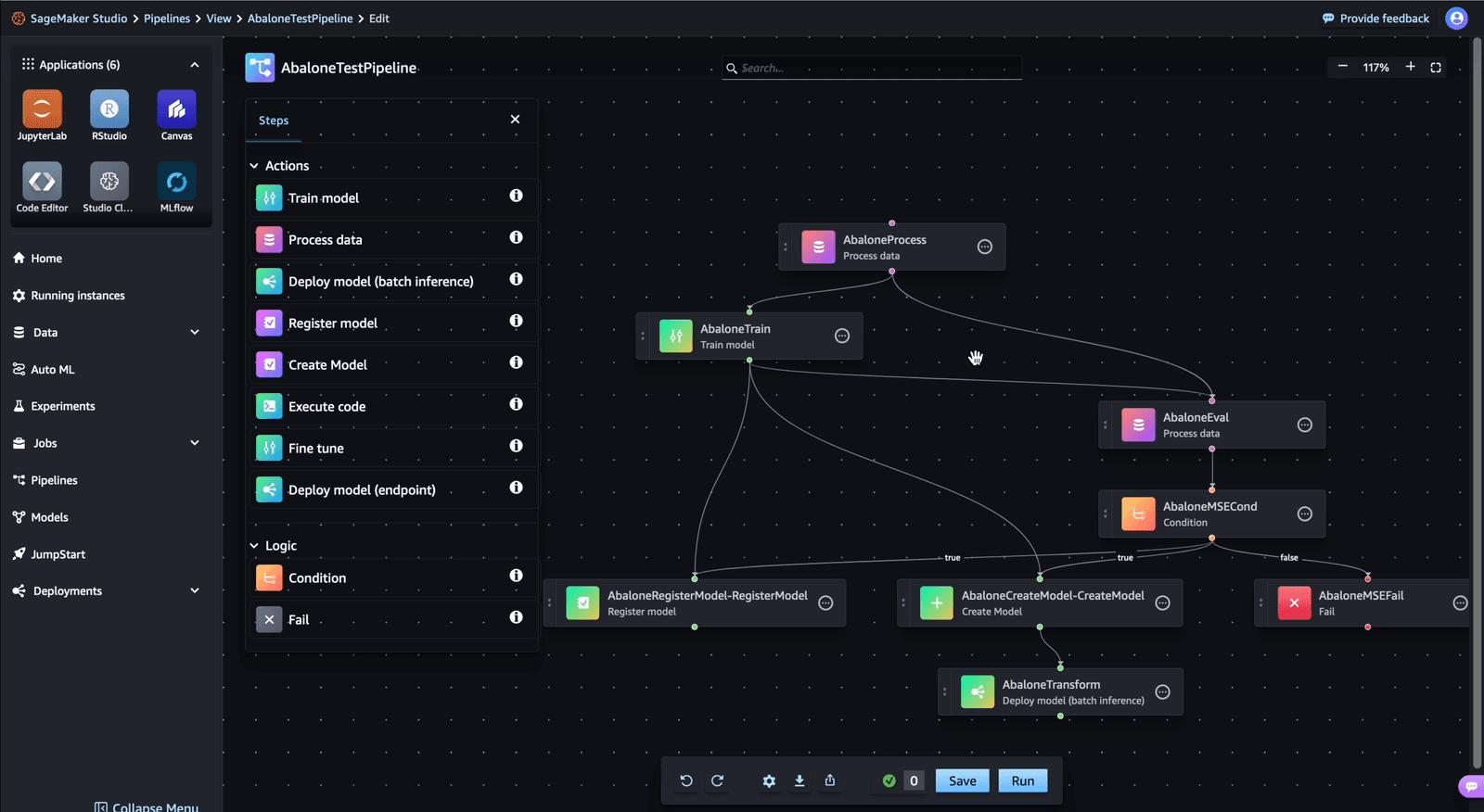
Amazon SageMaker Pipelines: Repeatable ML Workflows
Think of SageMaker Pipelines as a CI/CD pipeline for ML models, automating workflows from data prep to deployment. Use it for reproducible training and automated retraining.
Topic Modeling: Finding Themes in Unstructured Text
Topic modeling automatically finds themes in text by grouping words that often appear together. It's used to analyze customer feedback or organize large document sets.
Vertex AI Pipelines: Orchestrating ML Workflows
Think of it as an assembly line for your machine learning models, automating everything from data prep to deployment. Use it to build reproducible, production-grade ML systems on Google Cloud.
Named Entity Recognition: Finding the 'Who, What, Where' in Text
Named Entity Recognition (NER) is a smart highlighter for text, automatically finding and tagging nouns like people, places, and organizations. It powers search and extracts structured data from news or support tickets.
Argo Workflows: Run Complex Jobs on Kubernetes
Think of Argo Workflows as a script runner for Kubernetes, where each command is a container. It runs multi-step jobs like CI/CD or ML pipelines. The footgun is treating it like a full CI server; it's just an engine and lacks features like Git polling.
Q-Learning: Teaching an Agent by Trial and Error
Q-Learning teaches an agent the 'quality' of an action in a given state through trial and error, like training a pet with treats. It's used in robotics for navigation or in games where an AI learns optimal moves.

Pipeline Step Caching: Don't Recompute What You Don't Have To
Pipeline step caching is memoization for your ML infrastructure, saving time and money by reusing previous results. It's used in MLOps pipelines when inputs and code haven't changed. The footgun: the cache is scoped to one pipeline and a timeout, not globally.
Markov Decision Process: A Map for Sequential Decisions
A Markov Decision Process models sequential choices with uncertain outcomes. Think of it as a game with states, actions, and rewards, but where your next move is probabilistic.

Multi-Head Attention: Seeing Data From Multiple Angles
Multi-head attention lets a model analyze a sequence from multiple perspectives at once. It runs several "attention heads" in parallel, each focusing on different relationships, like syntax vs. semantics.
DETR: Object Detection as Direct Set Prediction
DETR reframes object detection from a filtering task to direct set prediction. It uses a Transformer to output a fixed set of object predictions in one pass, eliminating complex post-processing.
Post-Training Quantization: Shrink Models Without Retraining
Post-Training Quantization (PTQ) shrinks a pre-trained model by converting its weights to lower precision, like turning a WAV file into an MP3. Use it to run large models on consumer GPUs without costly retraining.

ONNX Runtime: Run Any AI Model, Anywhere
ONNX Runtime is a universal engine for AI models, letting you run them efficiently on any hardware, from cloud GPUs to a user's browser. It's used to deploy models for fast inference on servers or mobile devices.
FlashAttention: Faster, Memory-Efficient Exact Attention
FlashAttention is an IO-aware algorithm that computes exact attention faster and with less memory. It avoids slow GPU memory transfers, making it a key optimization for training and serving large models on modern GPUs.
We are hiring for this. Every open role lists the topics its interview covers, so you can prepare for the real thing rather than guessing.
See open roles